Vision Restored to Blind Patients in Gene Therapy Breakthrough

Share
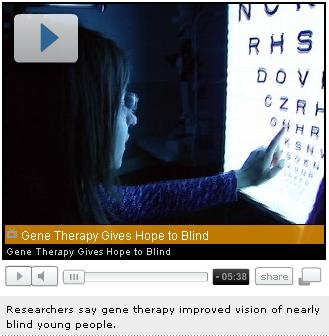
The emerging field of gene therapy took a huge leap forward in 2008 when vision was substantially restored to several blind patients.
The patients in the study suffer from Leber’s congenital amaurosis (LCA), a rare inherited eye disease caused by a defective gene called RPE65. The condition appears at birth or in the first few months of life and causes progressive deterioration in vision. Until now there have been no effective treatments available.
Below is an excellent "must watch" video from CBS documenting this amazing breakthrough, followed by further details and comments:
Normally, cells in the eye activate the RPE65 gene to produce an enzyme necessary for the function and health of a protective layer of cells underlying light- and color-detecting photoreceptor cells in the eye. Patients with a defective RPE65 gene are unable to produce this enzyme, leading to photoreceptor cells that are otherwise healthy but unable to do their job. Over many years the photoreceptor cells themselves steadily become damaged beyond repair.
Researchers theorized that if they could "upgrade" these photoreceptor cells with the non-defective gene then damage to the photoreceptor cells would cease and any remaining healthy cells would regain their ability to function. A virus was used to inject the functioning gene into the target cells and within a week vision improved and remained so after 90 days -- the study's endpoint.
In theory, the younger the patient, the better this therapy will work because the degenerative nature of the disease will have had less time to cause permanent destruction to photoreceptor cells. Trials are now underway with younger patients and the researchers are hopeful that these younger patients will see substantial, perhaps even full recovery of vision.
Be Part of the Future
Sign up to receive top stories about groundbreaking technologies and visionary thinkers from SingularityHub.

Wired has an excellent review of this story. A few excerpts:
Though the trial was designed to test the therapy's safety rather than its efficacy, its benefits were so impressive that the researchers decided to publicize their results.
Much more detail can be gathered at the following links:
http://www.ucl.ac.uk/ioo/research/patients/clinical_trials.html
http://www.ucl.ac.uk/ioo/research/patients/clinical_trials_furtherinfo.html

Related Articles
After Decades of Failure, ‘Undruggable’ Cancers Begin to Give Way

Orbital Airbag Could Shield Earth From Devastating Solar Storms

This Week’s Awesome Tech Stories From Around the Web (Through June 7)
After Decades of Failure, ‘Undruggable’ Cancers Begin to Give Way
Orbital Airbag Could Shield Earth From Devastating Solar Storms
This Week’s Awesome Tech Stories From Around the Web (Through June 7)
What we’re reading