


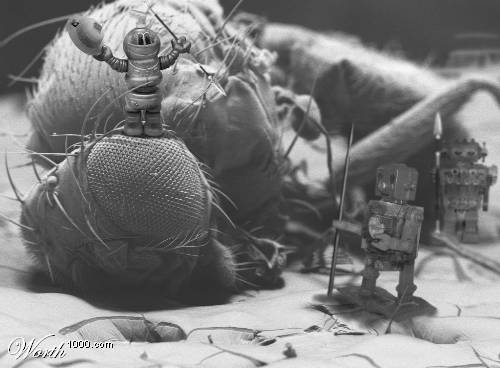
The media is abuzz with the announcement of a 250 micrometer motor that could someday be used to power tiny robots that swim through human blood vessels. Will tiny nanobots or man-made molecular structures travel the human body performing marvelous medical miracles in the coming decades? Absolutely! In fact they already are doing this in the laboratory, but not in the way most people think. The first generation of nanobots use the same mechanism already used by the human body for transport – floating – and are unlikely to resemble Fantastic Voyage inspired dreams of tiny vehicles “driving” around in our blood vessels any time soon.
The tiny motor published today by researchers from the Micro/Nanophysics Research Laboratory at Australia’s Monash University is neat, and the accompanying video is a fun journey for our imaginations, but this motor is very far from fulfilling our nanobot ambitions.
Enjoy the video below, then see our followup afterward as to why this motor is not all it is hyped up to be.
The 250 micrometer motor is a Piezoelectric ultrasonic resonant motor with the potential to directly drive a flagellum for swimming within the viscosity of human blood. The motor works, and it could potentially serve many uses for small scale needs in machines outside of the human body. But what use is it as a nanobot component? Not much if you ask us! The motor was driven by an external power source. For the motor to be useful as a nanobot we would first need to design a nano-sized battery to power it, an innovation that still seems a ways off. Even ignoring the battery problem, there are several other challenges associated with steering the nanobot, getting it unstuck or untangled from vascular debris, and keeping the nanobot from degrading within the biologically active “wet” environment of human blood.
To truly shuttle tiny man-made objects through the blood stream, we will likely emulate the techniques that the human body already uses. Instead of robots with motors and flagella, the first generation of successful nanobots aren’t doing anything like “swimming”. Instead they float through the blood stream, carried along by the pressurized flow maintained by our hearts, attaching and detaching themselves to target molecules and cells as they go about achieving their objective.
This first generation of nanobots may not fulfill our Fantastic Voyage inspired dreams of vehicles driving around inside the human body, yet they are every bit as effective in providing the medical breakthroughs that we are all hoping for. These nanobots don’t have microprocessors in them that think and act according to a program. They don’t swim intelligently to a desired target in a straight line path. Instead they float around, exhibiting simple behaviors such as releasing a chemical agent, attaching to something, or destroying something based on their geometries and chemical constituents. When used in proper quantity and with well defined objectives, these “boring”, “dumb” nanobots have the potential to attack cancer in new ways, target malfunctioning proteins, repair damaged tissues, and much more.
image source