Brain-Doping at the Lab Bench
Share
One year ago on April 1st, the World Anti-Brain Doping Authority (WABDA) released a statement that scientists would soon be the target of a crackdown on performance-enhancing drugs. WABDA, backed by the Federal National Institute of Health (NIH), spoke of impending drug tests for researchers' use of brain boosters like Provigil and Ritalin. The news spread like wildfire in academic circles, and many scientists - some of whom I know - traded nervous glances over the press release. Was this for real?
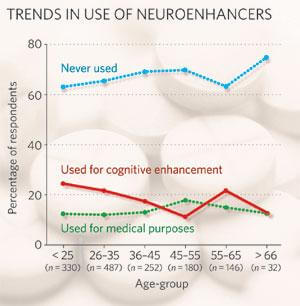
They should have checked their calenders. WABDA (a pun on the real-life WADA) was an April Fools brainchild of UC Davis biologist Jonathan Eisen, who coordinated the prank with a number of friends and even set up a website for the organization. While the news was fake, it struck a very real nerve. The viral spread of the prank revealed an actual anxiety should the NIH start collecting urine samples. Ten days later, an informal survey in Nature showed why.
Of 1,427 people working at scientific institutions in over 60 countries, about 20% of the respondents admitted to using brain-enhancing drugs for non-medical purposes. The most popular drug was Ritalin, a drug that treats ADHD, with 62% of users. The second most popular was Provigil, a drug to improve awakeness in narcoleptics; 44% of users take it. 15% of users admitted to using beta-blockers, drugs designed for cardiac arrhythmias which have an anti-anxiety effect. Most respondants reported that they used the drugs to improve their concentration, memory and focus. Others pointed to treating jet-lag, partying, housecleaning, and a wide variety of other purposes.
Surprise, surprise. Drugs and science have a long history together. Kary Mullis won the Nobel Prize for his invention of Polymerase Chain Reaction (PCR), the laboratory foundation of modern genetics. He later divulged to Albert Hofmann, the late Swiss chemist who first synthesized LSD, that the drug helped him to develop the technique. Similar rumors surround Francis Crick's realization about the double-helix structure of DNA (another "eureka" of Nobel Prize fame).
Should we be outraged? After all, Barry Bonds made headlines worldwide when it was revealed that he took performance-enhancing drugs. The Tour de France is plagued by accusations of drug use, and fans are justifiably angry when tests return positive. How is mental exercise any different? Why should some scientists have a chemical edge over others?
Be Part of the Future
Sign up to receive top stories about groundbreaking technologies and visionary thinkers from SingularityHub.

For one thing, as much as it might resemble one, science is not a competition sport. The logic behind anti-doping regulations in sports makes perfect sense; one athlete with a chemical advantage ruins the idea of fair competition, which is the foundation of sports in general. Watching Michael Jordan dunk is less impressive if we know he was just injected with testosterone. Science, on the other hand, is fundamentally a quest for knowledge of the world we live in. If a scientist can unveil new revelations about our world, is that knowledge less true because chemicals influenced the discovery?
Even in competive testing - the SAT or GRE, for example - the lines get blurry. I can personally attest to gulping a big, fat cup of coffee before every major examination of my life; is this so different from pharmaceutical enhancements? Where can we draw the line? The essential difficulty here is that any "baseline level of performance" - from which drug use is a supposed departure - is an imaginary concept. Our bodies are built differently, and have different baseline performances (mental and otherwise). Drugs like Adderall help those with ADHD to function at a higher level than their personal baseline (diagnosed as a subnormal capacity for attention). Does Adderall bring them back up to average? Slightly above or below average? What is an average attention span, anyway?
This is not to suggest that these drugs don't help millions to function in the world - they do. But the field of psychology is notoriously plagued by the difficulties of diagnosis, simply because pathologies aren't as clear as black and white. They occur in many shades of grey, and defining "normal" (and basing diagnoses on it) is both a difficult and a political act.
The first step to a responsible consideration of brain boosters is to consider the vague definition of drugs themselves. Caffeine, the most widely used drug on the planet, is socially accepted as a "fair" mental performance enhancer. Prescription drugs, to many, still fall within the paradigm of medical science as cures to pathologies. But - as the numbers show - a growing number of scientists feel differently, and use the drugs to boost their healthy brains. They're not the only ones.
If trends today are any indication, our species' course is one that increasingly blends our biological bodies with our technologies. Prosthetics are happily invited to restore functionality to lost limbs. Vaccines and antibiotics allow us to hack our immune system to keep us healthier. Hell, we wear clothes! Today, brain boosters are eyed suspiciously outside of their medical context. Maybe (just maybe) our grandkids will think differently. Not to mention faster, more clearly, and with a great attention span.

Related Articles

An ‘AI Legal Team’ Has Won Its First Case. It’s a Rare Victory for Access to Justice.

Long Foreseen, the Problem of AI Alignment Is Finally Reality. Solving It Won’t Be Easy.

DeepMind’s Weather AI Predicts Hurricanes a Day Earlier Than Traditional Forecasting
An ‘AI Legal Team’ Has Won Its First Case. It’s a Rare Victory for Access to Justice.
Long Foreseen, the Problem of AI Alignment Is Finally Reality. Solving It Won’t Be Easy.
DeepMind’s Weather AI Predicts Hurricanes a Day Earlier Than Traditional Forecasting
What we’re reading