Commanding Military Drones – Now iPhone Has an App for That
Share
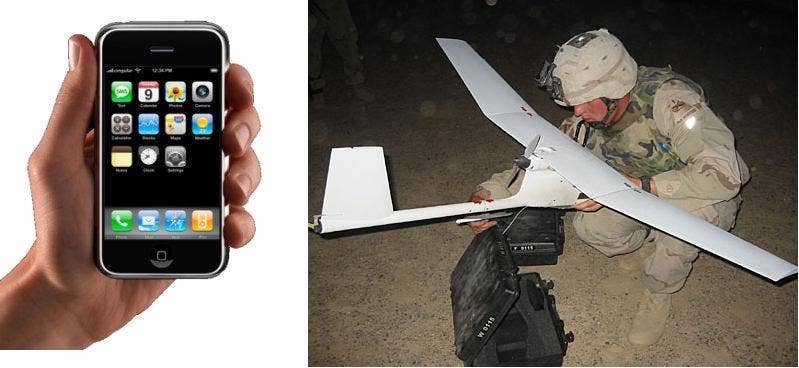
If you've got drones in different area codes, iPhone has an app for that. MIT's Human and Automation Lab (HAL) has been able to control an unmanned aerial vehicle (UAV) using everyone's favorite smart phone. By utilizing the iPhone's touch screen, tilting sensors, and high speed data transfer HAL is able to manually fly the drone or guide it to follow a prescribed path. In turn, the drone sends back video and snap shots as requested. MIT's success shows how the controls for UAVs can get smaller, simpler, and easier to use. Watch the three demonstration videos after the break.
UAVs and other military drones are an important part of the modernization of the US Army. The Raven drone is a light-weight surveillance platform that can be launched by hand. Unfortunately, it's operating controls are a heavy briefcase like enclosure that has to be lugged around. That sort of discontinuity irks HAL team leader Prof. Missy Cummings. Cummings was once a F/A-18 Hornet fighter pilot for the Navy and saw the UAVs as a great way to prove that drone control could be light-weight, simple, and elegant. Her students were the ones that pointed out they could use iPhones. (They would all have to receive iPhones as part of their research, of course).
The proof of concept tests were done with a commercially available four-rotor spy drone called a micro aerial vehicel (MAV). The drone only cost about $5000 and flew well inside the MIT robotics range. Watching the ease at which the operator controls the MAV it is hard to believe that HAL got the project from conception to demonstration in just six weeks!
It's kind of crazy what a simple iPhone app can do. Besides manual control, the iPhone operator can cue in locations that he or she wants the drone to travel to called waypoints. There are single touch keys for launch and landing, and streaming video appears right inside the app. All this and the phone can still receive calls, texts, etc.
Be Part of the Future
Sign up to receive top stories about groundbreaking technologies and visionary thinkers from SingularityHub.

If the military decides to pick up HAL's work, it will drastically lighten the load of soldiers in the field and allow them an easier way to manage their drones. Certainly the application could be modified so that a single iPhone could serve as a control for several different drones on collaborative missions.
Outside of the military, commercial drones could find more popularity with the ease of use promised by an iPhone application. In the final video, we see how the MAV can explore a new region with a high level of autonomy using a webcam and laser range finder. That's good news for everyone from cave explorers, to security guards, to rescue workers. We're bound to see more people using light weight and simple drones in important roles in the years to come. After all, iPhone now has an App for that.
Related Articles
Anthropic’s Claude Can Now Autonomously Run Science Experiments With Lab Equipment
Unitree Claims New Humanoid Robot Outruns Usain Bolt
In a First, a Humanoid Robot Performed Live Surgery Under a Surgeon’s Control
Anthropic’s Claude Can Now Autonomously Run Science Experiments With Lab Equipment
Unitree Claims New Humanoid Robot Outruns Usain Bolt
In a First, a Humanoid Robot Performed Live Surgery Under a Surgeon’s Control
What we’re reading