Swarm Bots Evolve Communications Skills and Deceit (Video)
Share
Oh what a tangled web a robot weaves when it first practices to deceive. S-bots, the swarm bots developed in Lausanne, Switzerland at EPFL were shown to evolve communication skills over time. The S-bots rose to infamy earlier when a video was made of them pulling a child across a room (see below). In the pursuit of virtual food, and the avoidance of virtual poison, S-bots developed different means to signal their colonies...and learned to hide those signals from others. Helped along by selection criteria from researchers, the evolving S-bots helped demonstrate that evolution could be a helpful tool in robotics just as it is in biology. Check out the videos of S-bots finding food, and working together after the break.
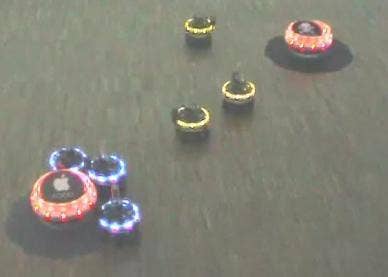
In order to simulate evolution, the S-bots were given innate preferences for food, and avoidance of poison. They were also programmed with random movements, their genome if you will. Successful robots (who ate food not poison) were recombined in a mimicking of sexual reproduction. Over 500 such generations of bots were first simulated in computer then demonstrated with machines. At first, each robot produced lights randomly, this created an increase in light around food (where robots tended to congregate). S-bots learned to look for light to find food, and then to signal others when they found food, and also to avoid signaling when competing for food. That control of communication is not only a great tool for the bots, it demonstrates how a natural selection process can lead to cunning, even in machines.
As you can see in the video, the S-bots begin to congregate around the apple station, and mostly avoid the skull and cross bones station. As more robots find the apple, changing colors signal to other bots that there is food nearby. Similar signaling can help S-bots move a load as a group that no one bot could pull on its own:
Be Part of the Future
Sign up to receive top stories about groundbreaking technologies and visionary thinkers from SingularityHub.

Unfortunately, these swarm robots haven't received much press recently, with no papers published since 2007 (though we did mention them in an earlier post). Still, what EPFL accomplished with the S-bots is certainly impressive. The creation of cooperating robots that can use guile...that's got to look good on any engineer's resume. And it's not like anything can go wrong with that. Right?...
[photo and video credits: New Scientist, EPFL]

Related Articles
Companies Could Soon Staff ‘Stubbornly Local’ Jobs With Workers 4,000 Miles Away
Japan Thinks Swarms of Transformer Robots Could Explore the Moon
AI Can Now Design and Run Thousands of Experiments Without Human Hands. We Aren’t Ready for the Risk to Biosecurity.
Companies Could Soon Staff ‘Stubbornly Local’ Jobs With Workers 4,000 Miles Away
Japan Thinks Swarms of Transformer Robots Could Explore the Moon
AI Can Now Design and Run Thousands of Experiments Without Human Hands. We Aren’t Ready for the Risk to Biosecurity.
What we’re reading