

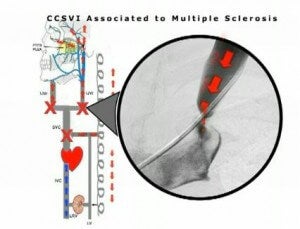
Could MS be caused by restricted blood flow? One Italian scientist has gotten amazing results by treating blocked veins in MS patients.
Holy Crap! There could be a cure for Multiple Sclerosis (MS)! Even more remarkable, this cure could be coming from outside of the established MS research community. There isn’t agreement on the exact nature and cause of MS, but an Italian doctor, Paolo Zamboni from the University of Ferrara, has developed a theory and provided a possible treatment. Zamboni believes that most cases are caused by the build up of iron due to restricted blood flow in veins. This proposed condition, Chronic Cerebrospinal Venous Insufficiency (CCSVI), turns accepted MS theory on its head. Yet of the 65 patients Zamboni treated 73% have lived for more than two years without symptoms. Check out Zamboni’s explanation video, and a Canadian news segment on his work, after the break.
MS is a debilitating condition where the myelin sheath on nerves is slowly destroyed. Lesions (aka scleroses) form in the brain and spinal cord. During regular relapses, and over time, patients lose muscle control and neurological function. In short, MS is awful. MS is commonly regarded as an autoimmune disease with a strong genetic bias. Zamboni essentially proposes that it is a vascular disease that can be corrected fairly easily. As with angioplasty, CCSVI is treated by inserting a balloon or metal stent into a blocked vein (typically the jugular or azygos). This corrects blood flow and MS symptoms just seem to melt away. While this appears to be miraculous news for the 2.5 million sufferers world wide, the MS Society of Canada is calling for more tests and research before supporting the CCSVI theory. The National MS Society in the US acknowledges that more research is needed but encourages its members not to get tested for CCSVI or seek vascular surgery. Still, online forum discussions on the CCSVI-MS connection are rampant, and many are clamoring for surgical trials in North America.
My own skepticism about CCSVI is partially augmented by a remarkable coincidence around Zamboni’s discoveries. First, his wife Elena Ravalli began to suffer from MS in 1995. This inspired Zamboni to research the disease. Zamboni is a vascular surgeon and he just so happens to discover that MS is a vascular condition with a surgical cure. I ask myself, if an orthopedic surgeon had a spouse who developed MS, would the cure for MS magically be a bone graft?
Still, it’s hard to argue with Zamboni’s results. Using Doppler ultrasound techniques and MRI scans, he found that 90% of MS patients had deformations or damage (called strictures) to the veins draining blood from the brain. Doctors have long noted that MS patients have higher levels of iron deposits in the brain. Zamboni proposes that these deposits are not a by-product, but a key cause of MS. By opening venous strictures, he believes that iron is able to be removed from the brain and spine. 65 patients were treated by Zamboni’s team and showed remarkable improvements. Active scleroses for the group dropped from 50% to 12%, and 73% of patients had no MS symptoms after two years. Mrs. Ravalli has gone more than three years without a MS relapse.
As wonderful as these cures may appear, there is much more research to be done. 65 patients is a very small sample set. To that end, Dr. Bianca Weinstock-Guttman at SUNY Buffalo, and Dr. Mark Haacke at McMaster University in Hamilton are each pursuing separate verification of Zamboni’s work. SUNY is actively seeking 1700 adults and children (with and without MS) for studies in blood flow and iron levels using MRI and ultrasound. Haacke, a renowned expert in imaging, is requesting patients to send him MRI scans.
It’s still much too early to know if Zamboni’s CCSVI theory will be proven correct, or if there will ever be a proven surgical cure for MS. Yet the Italian doctor’s work gives hope to all of us who want to live longer and healthier. Diseases with unknown causes are the unpredictable roadblocks on the path of life. The sooner that each can be understood and cured the better all of our chances will be to live forever. Even if you’re not into the whole immortality game, work like Zamboni’s shows that given the right conditions, researchers may find completely new solutions to the problems that plague our friends and families. That’s good news for everyone.
[screen capture credit: Paolo Zamboni]
[video credit: Paolo Zamboni, CTV M5]
Tags: CCSVI, chronic cerebrospinal venous insufficiency, MS, Multiple Scelorsis, Paolo Zamboni, University Ferrara Italy
Share


And it is exactly this kind of headline that has confused people with MS so much that they are going off their treatments. Not once has Dr. Zamboni called it a cure. This term has come from the media.
Please remove the word “cure”…Dr. Zamboni never said this. At best, CCSVI is the causation of MS, but this process of reflux, hypoxic injury and iron deposition damages brain tissue, perhaps permanently. That is why we are urgently asking MS societies and universities to further fund and study CCSVI today.
I wonder, relating to MS societies’ support for various research, what happens to MS societies once a hypothetical cure is found that works? Do they dissolve into dust or is there a purpose for them afterwards? How much vested interest is there for society administrators and staff to maintain their societies’ existences after their main purpose (which I assume is eliminating MS) is gone?
At coyotl… they’ll just move on to other causes that require their dedication, blood, sweat and tears. There’s more than one disease out there. I don’t believe in the conspiracy theory.
wow! Took the words right out of my mouth
@sage I didn’t offer a theory, you make an assumption. I asked a question. I think it’s an important question. People can get settled into an institution with institutional thought without having bad intentions. My wife’s mother died of MS and as contributors to that society, I want them to aggressively support all valid lines of research and I believe this is one of them, at least enough to pay for larger trials. I’ll judge them by their actions.
at coyotl – and I don’t believe I accused you of posing a theory or assuming. Read my comment carefully. No need to get defensive. I only stated my own belief (or lack thereof) regarding conspiracy theories.
coyotl. In case you’re not aware, many people do believe in the theory that the MS Society, current MS drug manufacturers and even MS neurologists don’t want MS to be cured because it would put them out of business. I don’t believe in those theories, but I think someone reading your post could very reasonably come to the conclusion that you do. Are you clearly stating now that you don’t buy into those conspiracy theories?
As far as this CCSVI, I’d say it sounds interesting based on these very preliminary reports. I’d like to see data published in a jounal so others can review the data and see if they make the same conclusions. I’ve had MS long enough that I no longer get excited when something sounds promising early on. It almost always leads to disappointment. I hope this treatment is an exception to that rule.
Fred, I do not know what the truth is. I don’t believe that any of the MS societies, nevermind all of them, have dishonorable intent. But that doesn’t mean I’m going to blissfully ignore the possibility that their are possible conflicts of interest that could influence what treatments or trials get attention. Like I told sage, I will judge by actions, not declarations of intent. Is that fair enough? All I care about is keeping my wife and my son safe from this disease that took her mother.
My wife had surgery at Stanford and has made a remarkable recovery.
Her life has turned around 100% but no one is claiming a cure.
Love the blog by the way I read every day and was excited to see this hit this blog it really is paradigm changing.
Of course more research needs to be done hopefully media attention can accelerate that and let it stand and fall on its scientific merits.
Delighted to hear your wife is a lot better – I wonder what tests did your wife have before the surgery?
regards
`gerard
In regards to the comment “Zamboni is a vascular surgeon and he just so happens to discover that MS is a vascular condition with a surgical cure.”: Another way to look at it is that MS *was* a vascular condition, but since no one was looking at it that way, it took a vascular surgeon to come along and look at it in a new way, the only way he knew how, from his perspective. Not saying this is necessarily the case, just thought I’d provide the ‘half full’ view.
I wish you could edit your posts… that sounded moronic.
if it makes you feel any better, I understand the point you’re making .. ie, there’s no evidence that non-vascular types have not looked for non-vascular cures and not found those .. so I’d say the article’s author’s reason for skepticism is not necessarily a good one (not that there aren’t reasons to be skeptical). +, this post probably sounds moronic, too .. and that’s what anonymity is for
Coyoti,
The MS Society is an ad hoc arm of Big Pharma (their job is to collect advertising dollars and keep patients away from all competing alternative ideas and therapies) so your skepticism is warranted.
(Sage, optimism is good, but pushed too far away from caution runs it right into naive.)
I am curious whether iron levels in the brain are reduced after such a treatment. There is no mention of it in the article. Only the cessation of symptoms is mentioned. If iron levels did in fact go down it would go a long way towards proving Zambonies theory.
I’ve had MS for 35 years. I went to Sanford for CCSVI. After testing, it was found I do not have blocked veins and I was sent home untreated. The proedure may helpp many…but not me.
Oh muffin!
My sister has had MS for 20 years. She has been an absolute piller of strength and inspiration………..Just
recently her 19 year old son has been
diagnosed. This new discovery is joyfully welcomed and looking forward to treatment.
That MS is a symptom rather than a disease, is not only an intrguing prospect, but a VERY logical one as well. In keeping with the essence of research, further study is definitely warranted.
Are there any cases where this procedure didn’t work? And is there a way to find the patients to and ask them how they reacted to it? Also, did anyone die from it?
My fiance was diagnosed with MS in 2008 and he’s very interested in this procedure. I just need to know (as a very concerned caregiver and soon-to-be wife) if this could kill him and if it’ll work. I don’t want him to get killed or have his MS exacerbated even more. Anyone have any info?
Ami
Yes Ami you can come visit us at the link and ask any questions you like.
As far as this being a cure for MS I think that does need to be further researched. As far as it allowing improved blood circulation to my brain I am ready for it right now. That would seem to be common sense. If I have restricted flow to my brain I would like that fixed immediately. What would be the harm in that. I will stay on my MS meds until it is further determined that this procedure has cured my MS or not. Keep it simple folks!
Question: Why veins in the brain
are with strictures?