World’s Largest Digital Photo is 26 Gigapixels of Dresden Skyline
Share
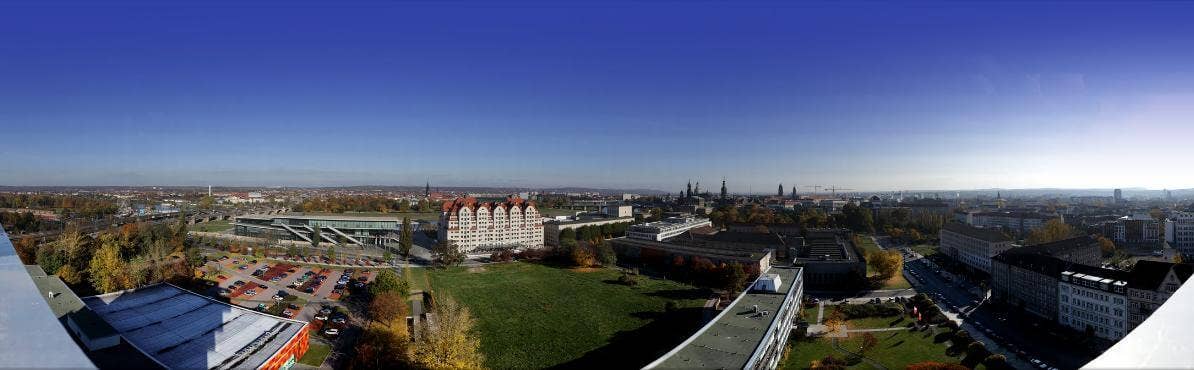
If you printed it out you would have an image 105 meters long and 35 meters high, almost the size of a football field. It's the world's largest photo ever taken and it displays the beautiful skyline of Dresden, Germany. Taken by Holger Schulze with a 400 mm lens camera by AFB Media GMBH, the image is a composite of 1,665 photos each about 21 megapixels (Mpx) in size. A robotic stand was used to capture the city during a slow rotation that took 172 minutes to complete. A specially made computer (with a whopping 4 terrabytes of hard disk space and 48 GB of memory) was needed to stitch the photos together into the final image. The process took 94 hours over 11 days. Still, talking about the photo doesn't really do it justice. You can view the interactive version on the official website and watch a video about its creation after the break.
Schulze worked in association with SZ-Online to produce the photo as a means of securing the world record. It beats out an earlier skyline photo of Paris that measures around 20 Gpx. As impressive as the Dresden creation is, I think we all know that its only a matter of time before such a record is shattered. Digital cameras are roughly following Moore's Law and current models are available near 160 Mpx. So it should take less than 5 years before Gpx photos are available in retail outlets everywhere. That is, of course, assuming we need bigger photos. Most people probably cannot tell the difference between a photo taken with 3 Mpx and 6 Mpx. Anything beyond that is likely to be used exclusively for high detail and zoomable online work. Still, the advent of Gpx photos may change the way we think of photography. Already we've seen how mobile phone cameras can be adapted to microscopy. Maybe we'll find a new use for high resolution images beyond simply looking cool. In the meantime, congrats to Herr Schulze and his record, however long it may stand. I wonder what kind of enormous projector he uses to show the photo to his friends when they come to visit.
Be Part of the Future
Sign up to receive top stories about groundbreaking technologies and visionary thinkers from SingularityHub.

[photo and video credit: Holger Schulze]

Related Articles

AI Is Advancing Faster Than Our Ability to Understand It, Researchers Warn

After Decades of Failure, ‘Undruggable’ Cancers Begin to Give Way
Orbital Airbag Could Shield Earth From Devastating Solar Storms
AI Is Advancing Faster Than Our Ability to Understand It, Researchers Warn
After Decades of Failure, ‘Undruggable’ Cancers Begin to Give Way
Orbital Airbag Could Shield Earth From Devastating Solar Storms
What we’re reading