



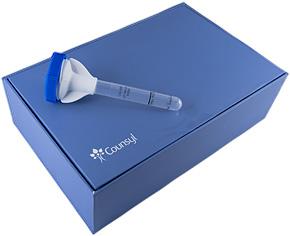
If you know that you’re a carrier for a genetic disease, you can choose not to risk passing that disease on to your offspring. Yet so many of us don’t know which maladies we have lurking in our DNA. Silicon Valley based Counsyl is a genetics testing company looking to make pre-pregnancy screening a social standard. Their $350 Universal Genetic Test uses saliva samples to look for rare genetic diseases which you could carry without knowing. The UGT works for all ethnicities, in both men and women. After testing, individuals or couples are informed of the associated risk of producing children who would have any of the 100+ illnesses that the UGT screens. Counsyl is leveraging insurance company support and community advocacy to launch their product into public consciousness. They hope that their product will help eliminate genetic diseases from our society in a similar way to how Tay-Sachs was purged. Such testing could help prevent thousands of infant deaths but it could also pave the way for designer babies.
What happens if you know you have a high risk for a genetic disease? If you use in Vitro fertilization, you can opt for Preimplantation Genetic Diagnosis (PGD). That is, you can selectively screen fertilized embryos for those without a genetic disease. PGD has been around since the late 80s, is occasionally very controversial (it’s illegal in Germany), and is the first step towards designer babies. Let’s not pull punches here: all pre-pregnancy genetic screening is about designer babies. In the best possible way perhaps; such tests are used to prevent children from living short lives full of horrific and painful diseases. Still, when you test for genes, you tend to select for genes, and that leads to genetic tailoring at the most basic level.
So let’s go there. How much design can you put in your baby before its wrong? Perhaps more relavent: how much genetic design will we tolerate as a society? GINA and similar genetic non-discrimination legislature helps protect those born with genetic diseases. What about sperm and eggs carrying those traits – is it genetic discrimination to selectively screen your own bodily fluids? What about your partner’s bodily fluids? If I could make a prediction: genetic screening is going to lead to at least one divorce. Who knows, it probably already has.
There’s no clear indication at the moment about how popular pre-pregnancy genetic screening will become. However, in the US people are pretty drawn towards learning about their children as early as possible. Americans are divided over what to do once you learn about a genetic illness, but they certainly want to know as much about their hypothetical babies as possible.
Counsyl is doing its best to avoid all the selective breeding and designer babies controversy. Their website is positively obsessed with providing equal space for all the possible choices you have once you find out you’re carrying a genetic time bomb. Have babies naturally and accept what happens. Have babies using PGD. Have babies using egg/sperm donors. Counsyl will support you in whichever decision you make. They just want you to make an informed choice.
I’m always a little worried when a company has fear helping them sell their product, but I think that Counsyl is honestly trying to do the right thing here. (Though alternative spelling for words is a classic evil organization trope). They’ve made a product that could conceivably lead to a drastic reduction in over a hundred terrible genetic diseases. Counsyl has also done its best to make that test affordable. $350 a person is considerably less than you would spend on taking care of an ill infant. That angle plays well with insurance companies. They’ve gotten industry giants Blue Shield and Aetna (in some locations) to cover the test. Counsyl is even actively pursuing support for communities at high risk for certain genetic diseases. They offer financial aid for the Universal Genetic Test and preference is given to those in underserved groups or with a family history of genetic illness.
According to the New York Times, Counsyl is already profitable, and they’ve been selling the UGT for less than a year. Much of their success comes from in Vitro clinics and other fertility specialists who strongly advocate for genetic screening. The cynic in me would like to point out that in Vitro clinics make more money when patients elect for PGD…but this is arguably for the patient’s benefit, so the conflict of interest is somewhat muted.
Leaving all the financial interests aside for a moment, I should note that the UGT isn’t the most advanced genetic screen available. Not by a long shot. There are 1000s of diseases with genetic causes. The UGT only focuses on about 100, and each of those is linked to a single gene variant. In other words, these are the simplest genetic diseases to screen for. The big selling point for Counsyl then is that they are able to offer the UGT so cheaply. It won’t catch everything, but it will catch the (relatively) common stuff.
Unfortunately, it’s hard to verify how successful the UGT is with the 100 or so genes it is designed to evaluate. The company claims to have 99.9% sensitivity/specificity and they have an impressive set of world class advisors. However, Counsyl has yet to produce a peer reviewed paper, or provide third party verification, describing the methodologies and accuracy of their work. According to their site, “Full technical details about the Universal Genetic Test will be published soon.”
*UPDATE: Counsyl has recently updated their site to include more details about the test’s accuracy, including a soon to be published paper for Nature. This paper provides peer reviewed evidence in support of the UGT. See comments for more information.
So let’s recap: Counsyl provides a basic level screening at a noteworthy price and is aggressively marketing that test as a new standard. This could lead to a drastic reduction in genetic based diseases if parents chose to use some controversial methods. The UGT, however, has not been thoroughly tested. Even if it works as planned, it will not eliminate all genetic diseases and its “success” is predicated on techniques that could lead us towards designer babies.
All in all, I’m not surprised. If Counsyl wasn’t attempting this, some other company would be. Genetic screening has been around for decades, and as DNA sequencing technology improves it’s only going to become more ubiquitous. Using PGD to eliminate genetic disease may be a step towards designer babies, but it’s an early step. There is still plenty of room on that road if society decides it doesn’t want to customize its offspring. Yet, if I were to guess, I would say that we’ll probably end up all the way down that path. Full fledged genetic design (or even unbridled use of PGD) is too powerful of a tool for someone not to use it. Once some begin to design their kids, there will be a ‘genetic gap’ and other parents will be pressured to do the same. The only question in my mind is when this will happen. Outlaw PGD (as in Germany), discourage Counsyl, and you’ll put this off for decades or more. Advocate for these techniques and your grandchildren may end up being designer babies. It sounds scary…but hey, aren’t kids supposed to scare their parents a little?
[image credits: Counsyl]