MIT’s Flyfire – Miniature Helicopters Turn Sky into Digital Screen (video)

Share
Robots may be taking your place on the factory floor, but they're also aiming for higher goals: replacing fireworks and conquering the sky. MIT's Flyfire project uses a swarm of miniature helicopters with embedded LED lights to act as 'smart pixels' as they fly through the air. Acting in concert they will be able to form complex three dimensional shapes - digital displays that will awe you more than exploding chemicals ever could. Not only will the pixels change color, the 3D dynamic movement will create an immersive experience that you can view from any angle. According to a recent press release, MIT only has a few of these micro-copters up and flying at the moment, but they want to scale up the project to large numbers quickly. They've produced an awesome demonstration video with a few shots of the copters and a lot of simulated footage. Check it out below:
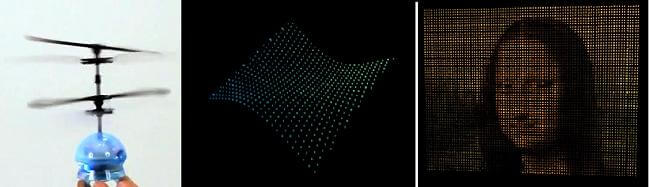
Swarm robots are really coming into their own. They're set to explore the ocean, play football, even cooperate or trick each other to get resources. The MIT Flyfire project is the most visually grabbing of the group. A collaboration between the Senseable City Lab, and the ARES Lab, Flyfire could reshape the way we think of public displays. Yet, relatively speaking, the Flyfire copters are fairly large for swarm robots. I wonder what will happen as miniaturization and improved energy efficiency provide for smaller and brighter smart pixels. Could we have true 3D displays that move around and interact with us? If you can project a moving face onto Flyfire, could you use it for telepresence? I would love to interact with friends as a giant swarm of glowing helicopters. Wouldn't you? It may be too early to know how successful the Flyfire project will be (a handful of bots is far from a swarm). I hope it will be one of the endeavors which take the physical world and allow it to "wake up" by filling it with digital information and displays. The future is going to look amazing.
Be Part of the Future
Sign up to receive top stories about groundbreaking technologies and visionary thinkers from SingularityHub.

[image and video credits: MIT's Senseable City Lab]

Related Articles
Anthropic’s Claude Can Now Autonomously Run Science Experiments With Lab Equipment
Unitree Claims New Humanoid Robot Outruns Usain Bolt

Heat Is an Orbital Data Center’s Greatest Foe. These Tiles Dump It at the Source.
Anthropic’s Claude Can Now Autonomously Run Science Experiments With Lab Equipment
Unitree Claims New Humanoid Robot Outruns Usain Bolt
Heat Is an Orbital Data Center’s Greatest Foe. These Tiles Dump It at the Source.
What we’re reading