BeBionic Artificial Hand and Wrist – Now With Kung-Fu Grip! (video)
Share
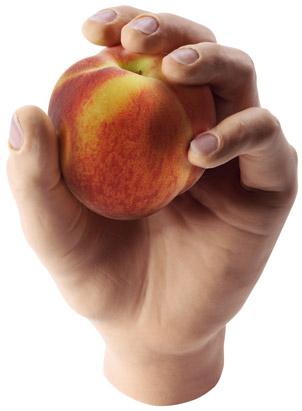
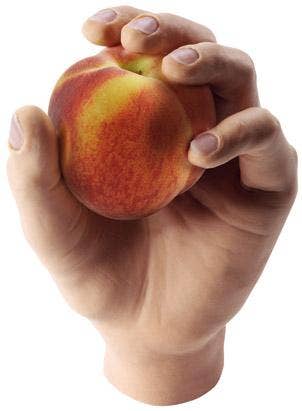
The BeBionic hand comes close to the real thing. It has four different kinds of grips and a silicone skin.
Judging by the latest promo videos, the BeBionic hand is out to kick more butt than...well, an artificial foot. Full of heavy rock licks, the BeBionic demo shows off the four grips (key, pinch, finger, and power) of its newest prosthetic hand and wrist. The system senses muscle signals on the skin of your residual limb to control its movements, a technique known in the field as myo-electric sensing. To match that life-like motion with a life-like appearance BeBionic also comes with a silicone covering in one of 19 possible shades of human skin and with customized finger nails. Produced by RSL Steeper, the BeBionic hand and wrist are set to debut (with pricing and availability details) in May at the Orthopadie Technik in Leipzig, Germany. You can check them out now in the videos below. Where's the "rock-on" gesture grip when you need it?
In the following video highlighting BeBioinic's four grips, notice how the silicone skin looks more life-like at 0:45 than at 1:06. Not sure if this is an artifact of lighting and camera angle.
Be Part of the Future
Sign up to receive top stories about groundbreaking technologies and visionary thinkers from SingularityHub.

Prosthetics are a very exciting field for Singularity Hub because they highlight how man and machine can work together in a very physical and personal way. Unfortunately, the BeBionic hand isn't showing us a lot that is new. Yes, this is the first powered wrist that we've seen, and it has an impressive range of motion (135 ° rotation, 35° flexion/extension). The hand itself, however, seems very similar to the i-Limb hand and digits we've reviewed before. Myo-electric sensors are certainly cool, but, again, we've seen those with Deka and other prosthesis projects. RSL Steeper is including some in-house designed software to let each individual custom their controls via wireless connection to a computer. That's a nice innovation, but combined with the four grip types I don't think that will provide a range of control that greatly exceeds the other prostheses on the market.
And I can't help looking at these hands and wondering if they aren't all following a dead end. Myo-electrics probably allow for a more intuitive method for control than foot pedals or shoulder flexing. Yet, we've already seen projects that hope to directly integrate nerves into the artificial limb. Direct nerve integration also provides the possibility for haptics - having the user feel what the limb feels. Those projects are likely many years from completion, but I think they're where prostheses will ultimately end up.
Considering costs, availability, and setup requirements (connecting directly to nerves requires surgery), it's likely that all of these prostheses types will exist on the market simultaneously. Users will have to choose between traditional "hook" hands, pedal/pressure controls, myo-electrics, and nerve integrated limbs depending on their budget, etc. It's hard to know which will provide the greatest amount of utility per dollar. However, I would think that, all things being equal, those looking to replicate a missing limb would naturally gravitate towards the hands that could actually provide feedback.
Still, it's much too early to decide which prosthetic hand will win the hearts of its users. Again, a lot probably rests on which insurance providers will cover which prosthetics. What we really need is a side by side comparison of all the different upper body limb replacement systems so that potential customers can see the relative speed, power, and precision of each choice. The good news is that as more companies compete to provide these technologies the costs of these devices may drop down to where they are more affordable to amputees. After all, you can build the coolest prosthetic in the world, but it won't matter unless people get to use it.
[image and video credit RSL Steeper and BeBionic]

Related Articles

Why Scientists Redesigned the Botox Enzyme With AI
Scientists Are Designing CRISPR Gene Editors With AI

Scientists Inch Closer to Creating Human Sperm in the Lab
Why Scientists Redesigned the Botox Enzyme With AI
Scientists Are Designing CRISPR Gene Editors With AI
Scientists Inch Closer to Creating Human Sperm in the Lab
What we’re reading