Let The RoboGames Begin!
Share
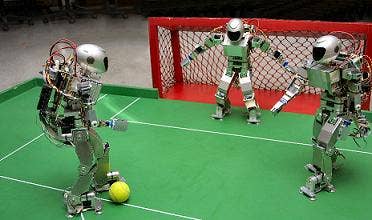
RoboGames, now in its 7th year, is the world’s largest robotics competition. For this year’s contest they secured the 5,000 person San Mateo Expo Center, just outside of San Francisco. From April 23-25 this will be the hallowed grounds where thousands of contestants, controlling more than 500 robots, compete in 70+ events. Many of these events will be robot-on-robot battles such as biped kung-fu and robot sumo wrestling. There will also be an exciting new event this year called “mechwars.” Contestants will battle using walking robots, but their view will be restricted to a bot-mounted pov camera. They will then compete in a scale-model city with flamethrowers and CO2 powered rifles to take out their opponent. How hardcore is that! I was able to talk with founder David Calkins and get the scoop on how that competition and others makes the RoboGames better every year.
Most events will take place in the shadow of the biggest draw at RoboGames- robotic combat. In these games, robots go after each other in a lexan-enclosed arena with everything from buzz saws to pneumatic hammers.
But RoboGames is about more than just honing the combat capabilities of our future overlords, the competition includes robot marathon and sprinting competitions, hockey, soccer, basketball, and junior events. In talking with RoboGames founder David Calkins, he said that events will continue to be added going forward based on what the robot designers are interested in. In the past, this meant adding the many artistic categories that are now part of the games, “we found we had a lot of requests from robot artists to compete.”
On a side note, I’ve always wondered why robot sprinting isn’t a bigger deal. The 100m dash is probably the marquee event at the human Olympics, but sprinting is just another event at the RoboGames (actually, it’s three events, for different sized robot sprinters). But I’m not blaming the organizers, it just seems like nobody takes the “world’s fastest robot” title seriously (of course at SingularityHub, we do). If you Google “world’s fastest robot” you get videos of quick working sorting bots, not Usian Bolt wannabees. Organizers of the yearly RoboCup, where humanoid robots play soccer, have stated their goal to field a robot team that can beat the human winners of the World Cup by 2050. That’s a pretty distant goal (mind the pun), but it’s distant for a good reason- playing a good match of soccer would required just about every aspect of a humanoid to be perfected, and then some. Beating the world’s faster runner to 100 meters seems more like it’s within the realm of possibility, at least something that a researcher could both start and finish. Plus, it just looks cool.
Toyota's humanoid running robot, the world's fastest:
Be Part of the Future
Sign up to receive top stories about groundbreaking technologies and visionary thinkers from SingularityHub.

Last year, teams from all over the world came to RoboGames and this year will be no different. Newcomers from Pakistan and Egypt will join traditional powerhouses like Japan and Taiwan, as they go for the gold. The games are a huge deal for many of the foreign teams, some of whom publish research papers based on their experiences at the games, and a few, like winners from Mexico and Indonesia last year, get an invite to meet their country’s president.
This international flavor goes a long way towards accomplishing one of the main goals of RoboGames- strengthening the bonds between different groups of robot engineers. Many of the events at RoboGames involve only a small subset of robotics. For instance, combat bots are very mechanical engineering heavy, whereas the automated events are often very computer engineering heavy. Other events have strong electrical engineering, or artistic components. David thinks the games help cross-pollinate the various fields with information from other researchers.
But cultural exchanges, spirited competition, and gold medals aren’t the only thing that the RoboGames share with the Olympics. When I asked David how the competition changes from year to year, he told me “the games are pretty much the same, but the contestants just keep getting better.”
The 7th annual RoboGames will be held from April 23rd through the 25th. For more information, head to http://robogames.net/
The San Mateo Expo Center is also the location for the Maker Faire, coming May 22nd. More on that, later.
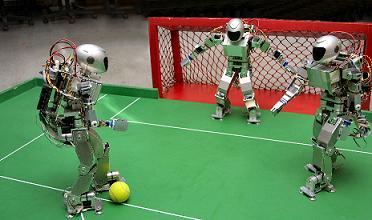
[photo credit: Kaist]
[video credit: Blogphilo New Media, Toyota via Smart Machines]

Related Articles
In a First, a Humanoid Robot Performed Live Surgery Under a Surgeon’s Control
Companies Could Soon Staff ‘Stubbornly Local’ Jobs With Workers 4,000 Miles Away
Japan Thinks Swarms of Transformer Robots Could Explore the Moon
In a First, a Humanoid Robot Performed Live Surgery Under a Surgeon’s Control
Companies Could Soon Staff ‘Stubbornly Local’ Jobs With Workers 4,000 Miles Away
Japan Thinks Swarms of Transformer Robots Could Explore the Moon
What we’re reading