Phenomenal Touchscreen Wall Demos Gigapixel Photos, Video Games
Share
Students at the University of Tromso in Norway have built an amazing multitouch wall with a mind-blowing 7168x3072 resolution - 22 megapixels! The WallScope has 28 projectors whose graphics are fueled by 31 nodes in a cluster. A series of 16 cameras on the floor create a 2D 'multitouch plane' so you can control the WallScope without making contact with the wall. Recently, the students used the WallScope to explore a huge 13.3 gigapixel photo of Tromso, zooming in with resolution you can't appreciate on any other system. Tor-Magne Stein Hagen and Daniel Stodle created the setup under the guidance of their professor Otto Anshus. While the gigapixel photo is breaking news, the multitouch wall technology behind the WallScope has been around for a few years, long enough for the Tromso team to play some pretty awesome games of Quake. We got video of the gigapixel photo on the Wallscope, as well as an older demo of the system's capabilities. Don't miss the sweet Quake action at 1:46 in the second video - they even wrote a paper about it!
We've seen some impressive multitouch walls, but the power of the WallScope is pretty sweet. It may not have the audio of the Las Vegas Hard Rock Cafe touch wall, but the graphics are definitely superior. Remember that 45 meter long multitouch wall in Germany? That was 34 megapixels. Wallscope is only about a tenth as long but has more than half the pixels. That's crazy resolution. Of course, some of that graphic beauty is marred by the irregularities in projectors. The WallScope website explains that many of those projectors are old and failing, leading to large variations in brightness. That's unfortunate, but I still think the Wallscope's resolution on that scale looks incredible.
Be Part of the Future
Sign up to receive top stories about groundbreaking technologies and visionary thinkers from SingularityHub.

Now, when you have that much density of image, there's only so many practical applications. I love playing video games, but the real news here is the gigapixel (Gpx) photo. As we've seen before, Gpx photos are time consuming, difficult creations, but they give an amazing sense of cityscapes. I could see systems like WallScopes built to allow people an in-house (in-museum?) look at distant locations. Sight-seeing without the travel. Systems like this may also find applications in education as we've seen with touchscreen autopsies. No matter where we end up seeing these high resolution touch surfaces, however, I'm sure people will be clamoring to use them. I certainly am. ...How much is a plane ticket to Norway this time of year?
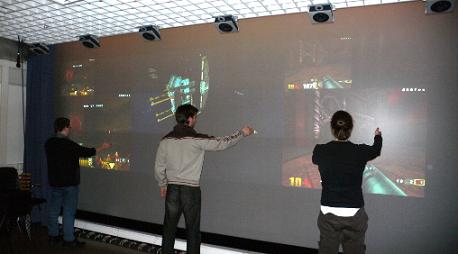
[image and video credit: Tor-Magne Stien Hagen, Daniel Stødle and Otto J. Anshus, University of Tromsø, Norway, In collaboration with Eirik Helland Urke, gigapix.no]
[sources: University of Tromso, Gigapix.no]

Related Articles
US Launches $215 Million Race to Build an Error-Corrected Quantum Computer by 2028
Heat Is an Orbital Data Center’s Greatest Foe. These Tiles Dump It at the Source.
Europe Approves Bionic Eye to Restore Vision Lost to Blindness
US Launches $215 Million Race to Build an Error-Corrected Quantum Computer by 2028
Heat Is an Orbital Data Center’s Greatest Foe. These Tiles Dump It at the Source.
Europe Approves Bionic Eye to Restore Vision Lost to Blindness
What we’re reading