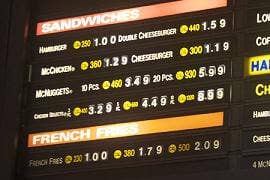
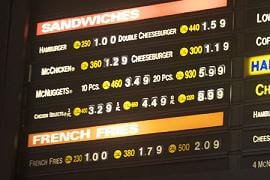
Calories on menus - Coming soon to a restaurant near you. Not a bad idea, but I don't think it will solve our obesity problems.
The recent US healthcare reform bill has a lot on its plate. Then, again, so do Americans. One of the provisions of the bill will give the FDA one year to develop standards by which all chain restaurants with 20 or more locations will be required to post calorie counts on their menus. More than 200,000 establishments will be effected, with the hope that this will help reduce rates of obesity in the US. Similar programs already exist in locations across the nation including New York City, California, and Seattle. It’s debatable about whether any of those programs have been successful in changing how people eat. While Singularity Hub fully supports giving consumers more information so that they can make informed decisions, I have my doubts as to whether this new provision will change the health of Americans.
There is evidence that the calorie counts already provided by chain restaurants are, in fact, faulty. According to a January 2010 article in the Journal of the American Dietetic Association, researchers at Tufts University found that the real caloric value for foods at chain restaurants was an average 18% higher than listed. In some cases the actual value was 200%, with free side dishes often pushing that up to 245%. Frozen meals in supermarkets scored better at 8% over listings. The study laments that there was such a wide range of discrepancy between actual and listed values that the average in both cases has little practical meaning. While the healthcare bill provision gives the FDA power to fine and pursue criminal penalties against those who fail to list their calories on menus, it doesn’t establish (or fund?) the creation of a task force to verify those calorie counts. What’s the point of listing these numbers if they’re aren’t valid?
But what if they were? Let’s imagine that these calorie counts were double checked, and enforced perfectly. Will this help Americans lose weight? Posting calorie counts on menus is the crudest form of dieting technology. I like data, data is good, but just listing numbers next to food items is really the simplest way to pair science and eating. There are websites dedicated to providing up to date nutritional information on foods, and even iPhone Apps that will scan bar codes to help you monitor your food intake. You can get a bathroom scale that tracks your weight and broadcasts your stats to friends and dieting buddies. Give it time and I’m sure there will be a fitness robot that will urge and guide you in how to exercise (maybe Wii Fit counts?). Bottom line, if you wanted to get “smart” about your diet, there are better ways out there than a simple calorie count.
I’m not sure all data is equal, either. Getting the calorie information out there seems like a good idea, but I think it focuses consumers in the wrong direction. For example, the provision requires better calorie labeling for vending machines. Sounds good, but calorie count alone doesn’t really help you make a better decision. Doesn’t it matter if you get 100 calories from potato chips versus 100 calories from raisins? Maybe instead of getting smarter vending machines we should just get vending machines that dispense better food.
Changing our weight and health as a nation will take considerably more than data. We need to rethink things at a basic level. First, why are we eating at chain restaurants? We are we eating things with barcodes? Why are we eating things that have been processed and manufactured so that someone in New York and someone in Seattle can have the same meal?
We’ve seen places around the world, the Blue Zones, where people regularly live long and healthy lives largely free of the chronic heart disease and diabetes that plague the US. In these places, people generally eat local foods made at home. There’s not a calorie count on the spinach you grow in a garden, there’s not a barcode on the beans from the neighborhood farmer’s market. When you eat real food, mostly plants, you tend to do okay.
Of course, one of the reasons that people eat at chain restaurants is because it’s cheap and easy. To that retort I have little to suggest beyond more government reform. We could, with changes in farm subsidies, economic incentive packages, and tax breaks, promote the growth and sale of local (non processed) foods. We could make good foods cheaper. As for easier…maybe learn to eat more things raw? I don’t know, I’m sure we can come up with other ideas.
It will take widespread individual effort, not just government regulation to help change the way Americans eat. I’m glad something is being done, but I would favor education over stand alone information. We should teach children and adults to avoid their high fructose corn syrup snacks and chose wholesome foods instead. We probably also need to teach ourselves how to stay active, to build strong community bonds, and to avoid stress (the other key ingredients that keep people healthy in Blue Zones). In the end, being obese isn’t wrong. There’s nothing morally superior about being fit. But not providing ourselves with the understanding about how to control our weight is wrong. Not helping each individual make their own choice about their size is immoral. The provision in the healthcare bill is a nice idea, but calorie counts are just a fraction of the information we’ll need in order to change.
[image credit: Fathead-Movie.com]
[sources: Associated Press, NY Times, JADA]


Comments
There are two words that everybody has skirted around: Activists, and Lobbyists. Personally, I don’t think the Feds give a rat’s butt if we clog our arteries or not. But with activists and lobbyists giving EVERYBODY grief, our world has indeed become a place where I’d rather just crawl into a hermetically sealed bubble with feeding and waste tubes, to be protected from the self inflicted apocalypse due to happen any minute now.
I’ve an idea: food cards. You put in, say, $400 for a month’s food. You can only buy food with these cards. You cannot exceed x amount of calories per month. Home-made food is outlawed as there are so many irregularities.
Great idea! Know what else? We should have the federal government dictate what you wear, what you read, where you live, and what you do for fun! All these things affect your health, so they’re clearly within the range of the feds’ authority if they’ve got the power to dictate things like calorie counts and insurance coverage.
to add to that, the government should tell us who to love, when to get married, what car to buy ( you know, for global warming ) What cities we can and can’t live in. When and where we travel, how we travel, how much money we can make, when we can work out, have sex, use the crapper, take breaks, and how many children we can have, and while they are at it they might as well genetically modify all children ( you know for health care ) and systematically weed out all “lesser” genes so there is no longer a need for doctors. Then we can all be happy.
I’ve an idea: food cards. You put in, say, $400 for a month’s food. You can only buy food with these cards. You cannot exceed x amount of calories per month. Home-made food is outlawed as there are so many irregularities.
Great idea! Know what else? We should have the federal government dictate what you wear, what you read, where you live, and what you do for fun! All these things affect your health, so they’re clearly within the range of the feds’ authority if they’ve got the power to dictate things like calorie counts and insurance coverage.
to add to that, the government should tell us who to love, when to get married, what car to buy ( you know, for global warming ) What cities we can and can’t live in. When and where we travel, how we travel, how much money we can make, when we can work out, have sex, use the crapper, take breaks, and how many children we can have, and while they are at it they might as well genetically modify all children ( you know for health care ) and systematically weed out all “lesser” genes so there is no longer a need for doctors. Then we can all be happy.
“This is not rocket science. The key to a fit and healthy life is fruit, vegetables, low fat meat and exercise. It’s that simple and people know it.”
While I know a few guys that might disagree with you about the low-fat (look for “Primal Diet”), this is really all there is to it.
People already know this food isn’t great; if they are unwilling to take responsibility for themselves, government regulations isn’t going to help them unless the government goes as far as banning fast-food altogether.
Although some might think that wouldn’t be a bad idea… you do have to question a society that reduces its people essentially to spoon-fed cattle that need a higher body to make all their decisions for them. That, and, even if it’s not great for you to eat it all the time, there’s still nothing wrong with having a taco or burger every once in a while!
“This is not rocket science. The key to a fit and healthy life is fruit, vegetables, low fat meat and exercise. It’s that simple and people know it.”
While I know a few guys that might disagree with you about the low-fat (look for “Primal Diet”), this is really all there is to it.
People already know this food isn’t great; if they are unwilling to take responsibility for themselves, government regulations isn’t going to help them unless the government goes as far as banning fast-food altogether.
Although some might think that wouldn’t be a bad idea… you do have to question a society that reduces its people essentially to spoon-fed cattle that need a higher body to make all their decisions for them. That, and, even if it’s not great for you to eat it all the time, there’s still nothing wrong with having a taco or burger every once in a while!
You missed something, and it’s clear you don’t live in one of the cities where this is already being done.
The scenario goes like this: You’re a grown-up. Of course you know you’re not supposed to be eating high-fructose corn syrup or whatever. But, you’re in line at Taco Bell anyway. Because you’ve got $7 in your pocket and going next door to the deli to get a salad would cost $8.75, that’s why. Now, your favorite, go-to, stuff-your-face food since forever is the Grilled Stufft Burrito meal. You don’t even have to think about it; it’s all impulse. But, you look up at the menu and see that the 7-layer burrito has 400 fewer calories. Eh, why not, you think.
Look, the point is that fast food is all about exactly two things: loose change and impulse. You’re buying fast food cause it’s cheap. You’re selecting from the menu completely on impulse. Very few brain cells are in play. The calorie count in NYC does exactly what it was intended to do– give you a moment’s pause and a way to compare across the menu to see whether there’s a slightly lower-calorie option. It already presupposes you’re in the fast food joint, so the calorie count isn’t going to impel you to run out and eat a locavore, organic meal. You’re already on the junk food bus. What it does do is inject about 2 seconds worth of critical thinking into the food selection process.
The calorie count isn’t really intended to change lives or diets on a grand scale– it was intended to help you figure out whether you could get a #4 with fewer calories for the same price as that #7.
You missed something, and it’s clear you don’t live in one of the cities where this is already being done.
The scenario goes like this: You’re a grown-up. Of course you know you’re not supposed to be eating high-fructose corn syrup or whatever. But, you’re in line at Taco Bell anyway. Because you’ve got $7 in your pocket and going next door to the deli to get a salad would cost $8.75, that’s why. Now, your favorite, go-to, stuff-your-face food since forever is the Grilled Stufft Burrito meal. You don’t even have to think about it; it’s all impulse. But, you look up at the menu and see that the 7-layer burrito has 400 fewer calories. Eh, why not, you think.
Look, the point is that fast food is all about exactly two things: loose change and impulse. You’re buying fast food cause it’s cheap. You’re selecting from the menu completely on impulse. Very few brain cells are in play. The calorie count in NYC does exactly what it was intended to do– give you a moment’s pause and a way to compare across the menu to see whether there’s a slightly lower-calorie option. It already presupposes you’re in the fast food joint, so the calorie count isn’t going to impel you to run out and eat a locavore, organic meal. You’re already on the junk food bus. What it does do is inject about 2 seconds worth of critical thinking into the food selection process.
The calorie count isn’t really intended to change lives or diets on a grand scale– it was intended to help you figure out whether you could get a #4 with fewer calories for the same price as that #7.
I think there will be no effect with these numbers in the menus. The people that care and know what the numbers mean, are the people who are more healthy than average.
If you think about it, counting calories is a bad idea. To do it properly, you must include everything you eat, which is impractical.
This is not rocket science. The key to a fit and healthy life is fruit, vegetables, low fat meat and exercise. It’s that simple and people know it. The problem is to do it. Here the long list of excuses turn up:
1. I’m too stressed.
2. Don’t have time to exercise.
3.
4….
A mental change is needed.
I think there will be no effect with these numbers in the menus. The people that care and know what the numbers mean, are the people who are more healthy than average.
If you think about it, counting calories is a bad idea. To do it properly, you must include everything you eat, which is impractical.
This is not rocket science. The key to a fit and healthy life is fruit, vegetables, low fat meat and exercise. It’s that simple and people know it. The problem is to do it. Here the long list of excuses turn up:
1. I’m too stressed.
2. Don’t have time to exercise.
3.
4….
A mental change is needed.