

Quantcast

Boolean Logic Unlocks The Key To Finding New Genes in Milliseconds

by Aaron Saenz April 10th, 2010 | Comments (16)

Share
Share by email
Import Addresses
Send To A Friend Close


Save time! Click Here to select directly from your AOL, Gmail, Hotmail, or Yahoo! Address Book
Ad
 
boolean logic finds genes

New computer analysis out of Stanford is poised to help researchers find important genes in a fraction of a second.

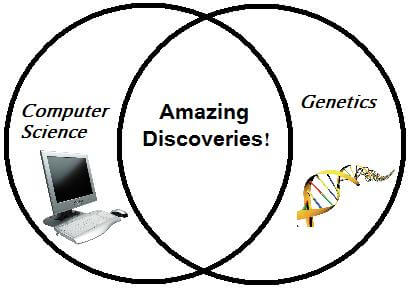
A little bit of computer science has made it possible to reduce the time it takes to find new genes from years to milliseconds. Researchers at Stanford University have developed a simple processing method for searching through large public databases of genes and their associated proteins. Using Boolean logic (if A then B, if not C then D, etc), they have found a way to suggest which genes are responsible for different stages of complex chemical processes in our cells. Biologists generally take months or even years to find these genes experimentally, but the Boolean search method takes just a fraction of a second. When widely applied, the new method may accelerate genetic research enormously. Great things happen when sciences come together.

There are tens of thousands of human genes, and we are still uncertain about the exact function of most of them. Still, scientists have mapped the proteins associated with many genes. Large databases of these gene and protein relations have been compiled, and many are open for researchers to access. There’s huge amounts of data here, but turning it into meaningful scientific insight isn’t easy. Luckily, Debashis Sahoo of Stanford had an insight: the expression of genes is often asymmetric. Some gene X will be expressed only when gene A is not expressed. This lets you use Boolean logic to sort genes.

From that simple beginning Sahoo was able to perform a sort of Boolean analysis to determine a gene’s importance in a given protein pathway. Say you know that a protein pathway starts with gene A and ends with gene B, but you don’t know much about what happens in between. You can look through all the other genes and their associated proteins and find some that are not expressed at the same time as A, but are expressed with B. These genes may code for proteins that occur inside the pathway.

That’s an overly simplified explanation of the Boolean net Sahoo assembled, but you get the idea. With the right “if then” filters Sahoo was able to sort through thousands of genes in a fraction of a second, finding just those which are likely to be important in a given protein pathway. Instantly he had a short list of genes that geneticists could examine.

Does all this computer science sorting actually yield results? You bet. As discussed in PNAS, Sahoo and other Stanford researchers used their Boolean method to comb through a database looking for genes related to B-cells (an immune system cell). They found 62 genes that could be involved in B-cell pathways. They then looked at the DNA from 41 strains of mice that had been modified to have disruptions (so called ‘knockouts’) in those genes. In 26 of those 41 strains, they found mice that had disrupted B-cells. In other words, the Boolean method looks to have been better than 50% accurate in suggesting genes that might be related to B-cell development. That may not sound like much, but think of all the thousands of genes that they looked through – it’s like finding needles in a haystack!

And this is just the beginning. Those databases of genes and proteins can now be sorted using Sahoo’s method to suggest new genes to explore. Think of an important gene out there, say the FOXO3A gene that may code for longevity. Wouldn’t you like to know which genes are related to it? Oh yes. Scientists are starting to suspect that most of the characteristics we want to investigate (longevity, intelligence, resistance to a certain disease) may rely on a very complex interaction of different genes. Sahoo’s Boolean method will help researchers hunt down related genes quickly and effectively and get a better understanding of those complex interactions. We already have large stores of genetic information, biobanks, ready to be sequenced and examined. As that information becomes available, analytical methods will allow us to turn raw data into meaningful insights into how we should perform genetic research. In the end, genetics is an information science and with the right application of computer skills we’ll be able to accelerate its progress. That’s going to mean quicker and better results. So give some praise to computer logic. If Boolean Then awesome.

[image credit: Singularity Hub]
[source: Stanford News, PNAS]


Related Stories


Connect With Us

.

Post a Comment

Sort By:

Comments

  • User Picture

    Some have used glp (glapak) based linear programming to solve this.

  • User Picture

    Some have used glp (glapak) based linear programming to solve this.

  • User Picture

    not enough life-sciences dudes have enough quant background currently – ’twill be fixed in a decade though, LOL, but then that means less females in that specialty :-(

  • User Picture

    not enough life-sciences dudes have enough quant background currently – ’twill be fixed in a decade though, LOL, but then that means less females in that specialty :-(

  • User Picture

    I agree with Afterthought and Keith that Endre and Arvind both seem to miss the point being made here. The technological breakthrough being highlighted, however, reminds me of Ray Kurzweil’s “The Singularity is Near”. Kurzweil outlines the premise that nanotechnology will allow us to merge human technology and human intelligence into one indivisible unit. The 4th and 5th lines of the 1st paragraph on page 21, however, echoes my concern for the Science of Harmony® to be implemented throughout this planet’s education system. The words of those lines state: “But the Singularity will also amplify the ability to act on our destructive inclinations, so its full story has not yet been written.” Those words confirm the fact that before we pursue singularity between our technology and our intelligence, that we need singularity between our power source, its transmission and our human form. The ability to establish harmony between those three expressions of our existence will eliminate concerns about our destructive inclinations, because every educated person will know that he/she is the formless “being” who conceived his/her “human” form to demonstrate the positive attributes of his/her creative genius. In the absence of this scientific fact being widely disseminated throughout the human species, gene therapy and nanotechnology will be the new frankenstein.

  • User Picture

    I agree with Afterthought and Keith that Endre and Arvind both seem to miss the point being made here. The technological breakthrough being highlighted, however, reminds me of Ray Kurzweil’s “The Singularity is Near”. Kurzweil outlines the premise that nanotechnology will allow us to merge human technology and human intelligence into one indivisible unit. The 4th and 5th lines of the 1st paragraph on page 21, however, echoes my concern for the Science of Harmony® to be implemented throughout this planet’s education system. The words of those lines state: “But the Singularity will also amplify the ability to act on our destructive inclinations, so its full story has not yet been written.” Those words confirm the fact that before we pursue singularity between our technology and our intelligence, that we need singularity between our power source, its transmission and our human form. The ability to establish harmony between those three expressions of our existence will eliminate concerns about our destructive inclinations, because every educated person will know that he/she is the formless “being” who conceived his/her “human” form to demonstrate the positive attributes of his/her creative genius. In the absence of this scientific fact being widely disseminated throughout the human species, gene therapy and nanotechnology will be the new frankenstein.

  • User Picture

    Finally, some recognition for the bioinformatics field. Being a bioinformatics student, I find it very often that I have to explain to people what I do. “Computer scientists work with computers, biologists work in the lab, but what is an bioinformatician?”
    To all those annoyed repliers here, bioinformatics is not a very old field (about 15 years old or so). However, I have to admit that as an initial sorting of genes into groups (this reacts with this, this reacts with that), Boolean networks are relatively easy to use and quite fast. But when it comes to actual analysis of gene expressions in network, nothing beats a good old Dynamic Bayesian network (more extensive, measures probability rather then simple yes/no connections).

  • User Picture

    Finally, some recognition for the bioinformatics field. Being a bioinformatics student, I find it very often that I have to explain to people what I do. “Computer scientists work with computers, biologists work in the lab, but what is an bioinformatician?”
    To all those annoyed repliers here, bioinformatics is not a very old field (about 15 years old or so). However, I have to admit that as an initial sorting of genes into groups (this reacts with this, this reacts with that), Boolean networks are relatively easy to use and quite fast. But when it comes to actual analysis of gene expressions in network, nothing beats a good old Dynamic Bayesian network (more extensive, measures probability rather then simple yes/no connections).

  • User Picture

    The point is instead of using BLAST, hidden markov models and other computationally intensive homology protocols, this dude found them using much simpler logic which takes far less computational power.

    If the above is incomprehensible to you, then don’t diss it.

  • User Picture

    The point is instead of using BLAST, hidden markov models and other computationally intensive homology protocols, this dude found them using much simpler logic which takes far less computational power.

    If the above is incomprehensible to you, then don’t diss it.

  • User Picture

    I’m not a bioinformatics expert but I’ve heard from researchers in the field that this paper is massively overhyped. This article is certainly needlessly breathless. The pairing of computer science and genetics is revolutionary? Let me give you an analogy. It’s like you read an epidemiology paper, realized for the first time that diseases are caused by germs, and proclaimed it a breakthrough discovery that was going to change the world.

    I like most of your articles. But before you make grand claims about a paper on a subject you don’t know very much about, perhaps you should ask some actual scientists for opinions :-)

  • User Picture

    I’m not a bioinformatics expert but I’ve heard from researchers in the field that this paper is massively overhyped. This article is certainly needlessly breathless. The pairing of computer science and genetics is revolutionary? Let me give you an analogy. It’s like you read an epidemiology paper, realized for the first time that diseases are caused by germs, and proclaimed it a breakthrough discovery that was going to change the world.

    I like most of your articles. But before you make grand claims about a paper on a subject you don’t know very much about, perhaps you should ask some actual scientists for opinions :-)


  • Well…I am glad you like some of our stories – I guess we can’t expect you or anyone to like all of them :)

    I think you are missing the point of the story in your comments, however. The “boolean logic” and the computer science is not what is revolutionary here. What is interesting is that it is being paired with genetics.

    Sadly it is all too common for separate disciplines, such as mathematics, computer science, and genetics to ignore each other. The exciting thing being highlighted in this story is that when these separate fields are combined, great progress can be made. Another interesting thing here is that none of this would be possible without the growing availability of genetic biobanks. This story is hopefully highlighting just the beginning of an exciting trend in which we will be able to mine and extract useful information out of the growing genetics data that is being generated each year.

  • User Picture

    Well…I am glad you like some of our stories – I guess we can’t expect you or anyone to like all of them :)

    I think you are missing the point of the story in your comments, however. The “boolean logic” and the computer science is not what is revolutionary here. What is interesting is that it is being paired with genetics.

    Sadly it is all too common for separate disciplines, such as mathematics, computer science, and genetics to ignore each other. The exciting thing being highlighted in this story is that when these separate fields are combined, great progress can be made. Another interesting thing here is that none of this would be possible without the growing availability of genetic biobanks. This story is hopefully highlighting just the beginning of an exciting trend in which we will be able to mine and extract useful information out of the growing genetics data that is being generated each year.

  • User Picture

    I’ve been reading most of these posts with joy, where I feel that they’re pulling some insight out of the subject. However, this piece is utter crap.

    “Boolean logic”, like that in any way whatsoever is revolutionary?? That is the bleeding /premise/ for a computer!! Does the author have ANY idea about computers at all? This is about just as interesting as stating “Using a keyboard, the scientists didn’t have to write with a pen!!!1!one”.

    This was reading like som April 1st joke, but that’s 10 days late.

  • User Picture

    I’ve been reading most of these posts with joy, where I feel that they’re pulling some insight out of the subject. However, this piece is utter crap.

    “Boolean logic”, like that in any way whatsoever is revolutionary?? That is the bleeding /premise/ for a computer!! Does the author have ANY idea about computers at all? This is about just as interesting as stating “Using a keyboard, the scientists didn’t have to write with a pen!!!1!one”.

    This was reading like som April 1st joke, but that’s 10 days late.

Get Our Newsletter

Popular On The Hub

Singularity

Martin Ford Asks: Will Automation Lead to Economic Collapse?

Written by: Aaron Saenz 716 days ago

lights-in-the-tunnel

Will the future be filled with cool technologies and endless opportunities or will our own creations lead to eventual doom? [...]

Robots

5 Axis Robot Carves Metal Like Butter (Video)

Written by: Aaron Saenz 605 days ago

metal-helmet-machine

Industrial robots are getting precise enough that they’re less like dumb machines and more like automated sculptors producing artwork. Case [...]

Genetics

Designer Babies – Like It Or Not, Here They Come

Written by: Keith Kleiner 1009 days ago

designer-babies

Long before Watson and Crick famously uncovered the structure of DNA in 1953, people envisioned with both horror and hope [...]

Stem Cells, Gadgets, Robots, Longevity, Health, Artificial Intelligence, Genetics, Body Implants, Cyborgs, Science, Technology, Singularity, The Future!