

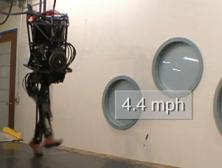
Look out Usain Bolt, walking robots are starting to pick up speed. Boston Dynamics recently released video of their Petman protoype running at 4.4 mph, a little better than the 7 km/h managed by the Toyota robot. This makes Petman one of the fastest walking bots we’ve seen, and it may, in fact, be the fastest bipedal robot in the world for the moment. I knew there was a reason we chose it as one of our favorite bots of 2009. As quick as Petman is, it wants to get even quicker. The robot is being built to mimic human movements so it can test chemically protective suits for the US Army, and it is slated to be ready for work in 2011. Watch Petman walk and run like a human in the following video, and make sure to catch its ground-breaking speed at 0:58.
Boston Dynamics is responsible for some great walking robots, including Big Dog and Little Dog. All of the BD bots, Petman included, have the impressive ability to recover from adverse lateral motions (aka being kicked). Petman also walks heel to toe, wears shoes and has the traditional gait of a human being. Human-like walking is one of the many hurdles in the quest to create humanoid robots, and if Petman can perfect it, it will go down in history as a very influential robot. For now, we’re just excited to see Boston Dynamics break the 7 km/h barrier. They still have a long way to go until they can outpace Bolt (22+ mph), but just give them time. After all, robots never tire.
[screen capture and video credit: Boston Dynamics]
[source: Boston Dynamics]




Comments
It’s cool, but of course it’s not running, and wouldn’t be running if it was going 20 miles per hour. It’s called “speed walking”if you’re just walking very fast. You’re running when one leg launches the body into the air and, for a moment of time, there are no feet on the ground, until the other foot comes down and launches the body into the air again. So as long as something is touching the ground (or floor, or treadmill) when switching feet, it’s called walking, not running.
In all likelihood there is a kernel of truth to the story about testing biohazard suits but it is being used as a cover because of a funding issues. For example, nuclear powered-planes were a cover to investigate funding for liquid-fluoride reactor (thorium). I find it harder to believe that they couldn’t get funding for a bi-pedal robot as advanced as this, though. So…I dunno.
too bad it is not anthropomorphic. Humans were not meant to land on our heels. Try walking barefoot on concrete and you’ll find that landing on your forefoot is the correct way to walk.
only for running. We didn’t evolve on concrete, we evolved on the savanna, try tiptoeing on grass for an entire day, see how you legs feel.
too bad it is not anthropomorphic. Humans were not meant to land on our heels. Try walking barefoot on concrete and you’ll find that landing on your forefoot is the correct way to walk.
only for running. We didn’t evolve on concrete, we evolved on the savanna, try tiptoeing on grass for an entire day, see how you legs feel.
test chemical suits? maybe your grandmother will believe this
Human features for robots are a quaint irrelevance. What matters is their utility and their appeal to the consumer tech market. What we need is the iPhone of robotic butlers. I don’t want my robot butler to be as smart as me, or necessarily walk on two legs or have a human face: I want it to get a drink for me when I am thirsty, do my laundry, go get a hammer for me from the garage; stuff like that. I long for the day when we can say “There’s an app for that” about the home robot.