Factory, Schmactory, My Life Sciences Lab Has Been Automated for Years (video)
Share
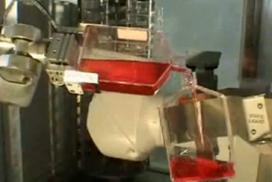
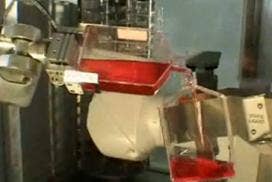
Sure, you've seen factory floors filled with endless rows of robots but the automation revolution reaches far beyond manufacturing. All over the world, researchers are solving the mysteries of biochemistry and genetics, and who is playing Watson to their Holmes? Robots. Many life sciences labs require a nearly infinite repetition of basic procedures and tests. Separate that DNA, grow this yeast culture, heat that sample...and do each step 1000 times each week. While these tasks used to be the sole province of graduate students (and to some degree still are), automated systems have started to take over these tedious chores at a touch of button. An increasing amount of complex lab work is being handed over to robots, and allowing more time for human scientists to make valuable discoveries. That, and the bots are cool to watch too. Check out the videos below to see how automation has taken a firm grasp on the life sciences lab.
Any time you have repetition you have the possibility of robotic invasion. Time and time again we've seen how automation and artificial intelligence are putting machines in charge of tasks ranging from the mundane to the Machiavellian. The same holds true in the science lab. We've already seen Adam, the robot that can actually make scientific discoveries, and Eureqa, a computer program that can find new theories. As software and hardware improves these artificial agents are going to take on more complex and human-like responsibilities. Even now, you can see how seemingly difficult scientific procedures have been broken down and transformed into routines that robots can easily digest.
To start off our parade of life science lab robots, let's take a look at Staubli. A fairly mainstream robot producer, this Swiss company adapted many manufacturing style automation ideas for the lab. If you can twist a hub cap or sort nuts and bolts, you have the robotic tools necessary to do a lot of work in biochemistry and genetics. This video's pretty long, so feel free to skip around:
The first level of lab automation is using robots to just organize your work. Thousands of biological samples have to be processed, labeled, stored, and retrieved. Why not give the grunt work to a machine? RTS Life Sciences has a cool system that automates the time-consuming process of finding the test tubes you need to work on.
But let's make this a little more interesting. As a scientist, there are many tasks that you do by hand that take precision and control. An experienced researcher can make these steps look easy, but even the steadiest of hands will find it harder to work a pipette at 3am. Robots can perform these tasks without rest and make every drop as accurate as the first. The Kerscher Lab at William and Mary uses a Norgren CP 7200 to transfer yeast colonies to help them with their research into how cell's prevent DNA damage and loss. Each tungsten needle picks up yeast, drops it off, and is sterilized before it does it again. They say the machine can move 4000 colonies in a single afternoon. Pretty impressive. I bet the grad students love it.
Be Part of the Future
Sign up to receive top stories about groundbreaking technologies and visionary thinkers from SingularityHub.

Along the same lines, ArrayIt has their Spot Bot Personal Microarrayer. Imagine doing this work by hand!
At some point, lab robots are actually able to replace technicians, or maybe even grad students. A system from Tecan can handle almost every stage of a polymerase chain reaction from start to finish. This thing takes the sample, sets it up, seals it, performs the PCR, then preps it for study. That's incredible.
Adam the robot scientist is pretty much a one of a kind system. Eureqa is equally unique, though it can be copied across many different computers. The robots I just showed you...there are thousands already in the field. Life science labs are full of these things. Sure, a large part of research is still done by hand, but automation is present and getting more prevalent. We've had debates here at the Hub about whether full scale automation will be a positive or negative. I hope we can all agree, however, that machines are going to take over a huge amount of human work, and in arenas people don't normally consider. Blue collar workers in Detroit -sure, they've lost jobs to robots, but lab technicians and scientists will, too. My hope is that for every 'lost job', humans will have more time to take over the work that truly fascinates us and challenges our intellects, be that art, philosophy, theory, leisure, or whatever. As for the robots themselves, I'm genuinely impressed with their lab skills...though I can think of better ways to put them to use.
[video credits: Staubli, Kerscher Lab, Arrayit (via Ex.V.P. Todd Martinsky), Uri Shabi (Shapiro Lab), RTS Life Sciences]
[source: Norgren Systems, RTS Life Sciences, Arrayit, Tecan]

Related Articles
This Robot Dog Crushed a Marathon Without Stopping to Recharge
Anthropic’s Claude Can Now Autonomously Run Science Experiments With Lab Equipment
Unitree Claims New Humanoid Robot Outruns Usain Bolt
This Robot Dog Crushed a Marathon Without Stopping to Recharge
Anthropic’s Claude Can Now Autonomously Run Science Experiments With Lab Equipment
Unitree Claims New Humanoid Robot Outruns Usain Bolt
What we’re reading