Quantcast

Harvard Starts Heart Outside Body, Preserves Organs for 10 Days
by Aaron Saenz May 5th, 2010 | Comments (32)

Share
Share by email
Import Addresses
Send To A Friend Close


Save time! Click Here to select directly from your AOL, Gmail, Hotmail, or Yahoo! Address Book
 
chemical-heart-preservation

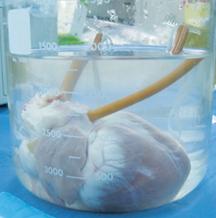
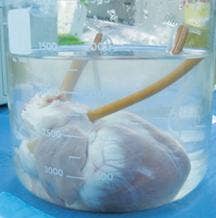
IT'S ALIVE! ...seriously though, this pig heart is still alive. Cell decay has been slowed using Somah, Harvard's new wonder preservative.

Science fiction is fraught with mad scientists who discover strange chemicals that can empower the human body or even reanimate the dead. Well, Harvard has come about as close to that scenario as anyone would want them to. Prof. Hemant Thatte has developed a cocktail of 21 chemical compounds that he calls Somah, derived from the sanskrit for “ambrosia of rejuvenation”. Using Somah, Thattle and his team have accomplished some amazing feats with pig hearts. They can keep the organ viable for transplant up to 10 days after harvest – that’s incredibly longer than the 4 hour limit seen in hospitals today. Not only that, but using low temperatures and Somah, they were able to take a pig heart that was removed post mortem and get it to beat 24 hours later in the lab. Watch that amazing video after the break.

We’ve seen amazing chemical treatments that have the potential to transform the medical industry. Mark Roth is working with hydrogen sulfide to put soldiers and other trauma victims into suspended animation on the way to hospitals. The University of Bristol uses xenon gas and low temperatures to prevent brain damage caused by oxygen deprivation. Now Somah could help preserve organs for more than a week outside the body. As researchers continue to unlock the mysteries of your body’s chemistry, they may find more ways of preserving and protecting it indefinitely. This will make it much easier to repair or replace parts of your body as they fail, letting you live longer, and healthier. Maybe indefinitely.

Thousands of patients waiting for an organ transplant die each year in the US alone. Donated organs are limited in availability by distance and time. After harvesting, a heart has just about 4 hours to reach its recipient, anything more than that and decomposition will render the heart nonviable. If we could extend that window to 10 days, almost any organ could be made available to almost anyone, anywhere. That will lead to many saved lives. It will also lower costs as there would be no need for chartered jets and other speedy transports.

Somah may also save lives by extending the number of viable heart donors. Now, most of these organs are harvested from patients who are brain dead, but with a beating heart (effectively still alive as far as the body is concerned). After death, cells begin to degrade quickly. If a donor arrives to a hospital DOA, their organs may not be available to transplant to needy recipients. Somah, however, has been shown to reverse some of this cell decay. The chemical cocktail helps transform metabolic agents into preservative agents. Thatte’s team took a pig heart harvested post mortem and let it sit in Somah for 24 hours at lower temperatures. The cell degradation was very low. They then warmed the heart up, hooked it into an artificial circulatory system and got it to beat. This clip is brief, but it shows the incredible achievement:

To better understand if and how Somah preserved a heart, Thatte and his group harvested two female pig hearts and placed them in two different containers. One was filled with Somah, the other with Celsior from Genzyme – the standard chemical bath which preserves organs in hospitals today. As described in the journal Circulation, the team took tissue samples every four hours from each heart. They found that the Somah heart had a much lower rate of cell decay, including important cardiomyocyte and endothelial cells which are necessary for the heart to work in a new host. Based on this research they concluded that hearts preserved in Somah should be viable for up to 10 days. Celsior can store the organ for 4 hours. That’s an epic difference.

And one that investors are hoping to bank on. A new startup, Hibergenica, is looking to commercialize Somah for use in humans. The company is still in its very early stages. Likewise, Somah still has a ways to go. Transplants from pigs to other pigs (using Somah) will have to be performed before human clinical trials can begin. We’re talking years of research before the FDA would possibly approve Somah for use in the US.

Other companies are relatively closer to augmenting the time hearts stay fresh outside the body. We’ve already seen how TransMedics can keep a heart beating for 12 hours inside a machine, and they are moving forward with tens of millions in funding. Somah, however, could potentially keep hearts viable for 20 times longer, and probably with fewer electrical and mechanical requirements. It will be interesting to see how these technologies ramp up in comparison to stem cell projects aimed at creating entirely new organs from a patient’s own cells. Simpler forms of that concept (for windpipes) have had a series of successes recently with human patients. No matter which of these technologies is the first to achieve widespread use, the future seems ready to provide us with the means to get a new heart when we need it.

[image credit: Harvard]
[video credit: Thatte, Harvard]
[source: Technology Review, Tech Transfer (Harvard), Circulation]



Related Stories


Connect With Us

.

Post a Comment

Sort By:

Comments

  • User Picture

    And one that investors are hoping to bank on. A new startup, Hibergenica, is looking to commercialize Somah for use in humans. The company is still in its very early stages. Likewise, Somah still has a ways to go. Transplants from pigs to other pigs (using Somah) will have to be performed before human clinical trials can begin. We’re talking years of research before the FDA would possibly approve Somah for use in the US.

  • User Picture

    wow that was amazing ,this is such a innovation in science
    video is very cool (how hear beet :)

  • User Picture

    # Medics: Transplanting a Beating Heart
    # TransMedics: Transplanting a Real Beating Heart
    # Harvard Grows Heart Tissue, Watches it Beat
    # Stem Cells Used to Gr

  • User Picture

    Great article. Just one gripe: why add the “Maybe indefinitely” sentence (discussing human longevity)? I doubt very much Thatte has suggested Somah may assist in preventing death forever, or indeed if anyone with any expertise has.

  • User Picture

    Fascinating indeed, but the world needs fewer people.

  • User Picture

    wow…this is such a innovation in science, very interesting…

  • User Picture

    oh my god thats amazing i never thought science had come so far to be able to do that

  • User Picture

    i still confuse how it work, but nice share…thanks
    http://free-mobilethemes.com/

  • User Picture

    Wow! I never knew this thing can be done.

  • User Picture

    Way to go harvard.
    This is definitely a big medical gain for us.

  • User Picture

    now thats disgusting

  • User Picture

    visit me
    http://cupre.info

  • User Picture

    Great scientific strides are being made everyday, and I love it. We live in a great time period. This research will give people a fighting chance, being someone who has a bad heart, this article is of particular interest to me. Keep up the good work.

    Thank you and God bless

  • User Picture

    Great scientific strides are being made everyday, and I love it. We live in a great time period. This research will give people a fighting chance, being someone who has a bad heart, this article is of particular interest to me. Keep up the good work.

    Thank you and God bless

  • User Picture

    One step closer to a functional Cryonics protocol.

    http://www.cryonics.org

  • User Picture

    One step closer to a functional Cryonics protocol.

    http://www.cryonics.org

  • User Picture

    We’re too afraid of dying — at least when it’s finally time to call it. Of course, everyone would want a child or younger person to have every chance to live, but for us older folks death is part of life, isn’t it? Are we so much in need of more population on this planet? Do we need to invent more ways to jack up our health care expenses to save the very few or would the money be spent more wisely in improving the health care of hundreds?

    Sounds ugly, but we have to acknowledge the need for rationing our limited health care dollars.

  • User Picture

    We’re too afraid of dying — at least when it’s finally time to call it. Of course, everyone would want a child or younger person to have every chance to live, but for us older folks death is part of life, isn’t it? Are we so much in need of more population on this planet? Do we need to invent more ways to jack up our health care expenses to save the very few or would the money be spent more wisely in improving the health care of hundreds?

    Sounds ugly, but we have to acknowledge the need for rationing our limited health care dollars.

  • User Picture

    Hi,

    Great article. Just one gripe: why add the “Maybe indefinitely” sentence (discussing human longevity)? I doubt very much Thatte has suggested Somah may assist in preventing death forever, or indeed if anyone with any expertise has.

    Implying Somah is some kind of miracle in that “may” allow us to live “indefinitely” seriously detracts from the credibility of your article. It’s tiresome when the press drags out the usual, tedious over-extrapolations and sensational claims in a vain attempt to make interesting reading. Especially unfortunate here, as the story is genuinely fascinating.

  • User Picture

    Hi,

    Great article. Just one gripe: why add the “Maybe indefinitely” sentence (discussing human longevity)? I doubt very much Thatte has suggested Somah may assist in preventing death forever, or indeed if anyone with any expertise has.

    Implying Somah is some kind of miracle in that “may” allow us to live “indefinitely” seriously detracts from the credibility of your article. It’s tiresome when the press drags out the usual, tedious over-extrapolations and sensational claims in a vain attempt to make interesting reading. Especially unfortunate here, as the story is genuinely fascinating.

  • User Picture

    T-Virus I hear you say…

  • User Picture

    T-Virus I hear you say…

  • User Picture

    THAT MUCH CLOSER TO ZOMBIES!!!

  • User Picture

    THAT MUCH CLOSER TO ZOMBIES!!!

  • User Picture

    absolutely fascinating. But now there’s the fear of what to do when is the planet is over populated

  • User Picture

    absolutely fascinating. But now there’s the fear of what to do when is the planet is over populated

  • User Picture

    iiuuhh .. what is that ?

  • User Picture

    iiuuhh .. what is that ?

  • User Picture

    This is very promising and inspiring work. Great article, though the scientist’s name is actually spelled “Thatte.”

    Soma was also the name of the dream-inducing drug in Brave New World. Evidently Aldous Huxley was inspired by ancient Indian culture too.

  • User Picture

    This is very promising and inspiring work. Great article, though the scientist’s name is actually spelled “Thatte.”

    Soma was also the name of the dream-inducing drug in Brave New World. Evidently Aldous Huxley was inspired by ancient Indian culture too.

    • User Picture

      Totally agree with you there Daryl.

Get Our Newsletter

Popular On The Hub

Singularity

Martin Ford Asks: Will Automation Lead to Economic Collapse?

Written by: Aaron Saenz 716 days ago

lights-in-the-tunnel

Will the future be filled with cool technologies and endless opportunities or will our own creations lead to eventual doom? [...]

Robots

5 Axis Robot Carves Metal Like Butter (Video)

Written by: Aaron Saenz 605 days ago

metal-helmet-machine

Industrial robots are getting precise enough that they’re less like dumb machines and more like automated sculptors producing artwork. Case [...]

Genetics

Designer Babies – Like It Or Not, Here They Come

Written by: Keith Kleiner 1009 days ago

designer-babies

Long before Watson and Crick famously uncovered the structure of DNA in 1953, people envisioned with both horror and hope [...]

Stem Cells, Gadgets, Robots, Longevity, Health, Artificial Intelligence, Genetics, Body Implants, Cyborgs, Science, Technology, Singularity, The Future!