*Update: We’ve included the Science interview with Venter after the break.
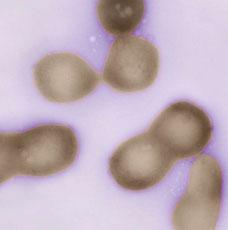
Craig Venter wants to program life the way we program computers, and today he announced a momentous win: the first synthetic self-replicating bacterium. The J. Craig Venter Institute (JCVI) used the four types of chemicals that make up DNA, and complex assembly methods utilizing yeast cells, to ’program’ the 1.08 million base pairs that make up the genome for the bacteria cell. As described in the journal Science, the result was a synthetic copy of the Mycoplasma mycoides, dubbed M. mycoides JCVI-syn1.0, that can grow and divide like normal. The little “1.0″ highlights the vast potential of Venter’s project, as JCVI will be able to update and improve their synthetic organism base pair by base pair, gene by gene. Computers can now program sustainable synthetic life – welcome to the future.
JCVI, funded through Synthetic Genomic Inc, has been working on the concept of programming life for more than a decade. In 2003 they had programmed the first synthetic virus. In 2008 they created a synthetic bacteria genome but were unable to get it to thrive inside a cell. In Venter’s most recent presentation at TED, he described these efforts and said it was possible that 2010 would see the arrival of the first fully synthesized organism. Clearly he has delivered on that prediction with flying colors. The M. mycoides JCVI-syn1.0 represents a whole new level of synthetic biology. Science interviewed Venter about the endeavor via Skype:
The main methodology for synthetic biologists up to this point has been ‘cut and paste’. The DNA of one organism has been carefully selected and transplanted into another. In this way, scientists have been able to give the properties of one organism to another. This ‘gene-splicing’ or ‘bio-hacking’ is far from crude, and represents a growing and important field of study. MIT has an expanding databank of DNA, its Registy of Standard Biological Parts, that can be used to transform organisms (almost always bacteria) for synthetic biology projects. This methodology is at the heart of iGEM, OpenWetWare, and virtually every single other synthetic bio endeavor we’ve discussed at Singularity Hub.
Venter just made that entire field of study look like finger painting next to a Picasso. JCVI’s approach to synthetic biology isn’t hacking, it’s programming from the ground up. Yes, this first bacterium was just a copy of a natural organism. But that copy was assembled base pair by base pair. In the future, instead of pain-stakingly slicing in genes from other bacteria, Venter can just change a few parameters in his computer software. When fully developed this technology will let you ‘code’ a new organism. Can you imagine the power of that kind of control? Forget finger painting and Picasso, this is the difference between playing Frankenstein and playing God.
For those who missed Venter’s TED talk on the subject, let me describe briefly what this amazing process entails. The underlying concept is that the software of life (DNA) will build its own hardware (the cell). Using the four basic chemicals of DNA (the G,A,C,T) small snippets of genetic code are implanted into yeast cells. The yeast cells act as little factories, assembling these snippets into overlapping segments of DNA. When the newly programmed bacteria genome is assembled, it can be transplanted into a host bacterium where it takes over, rewriting the cell to create the new synthetic organism. Thus, while this is called a synthetic form of life, many natural forms of life are necessary to assemble it and provide its cytoplasm body. Keep in mind though that when the M. mycoides JCVI syn1.0 forms a colony, not a single bacterium will contain the proteins of the assembling yeast or host bacterium. The programmed DNA is king.
Despite JCVI’s amazing innovations with their new approach to synthetic biology, it’s likely that ‘bio-hacking’ will remain dominant in the near term. There are many more teams working with that technique, and years of experience with getting it to work. Even after the JCVI approach picks up speed, it is likely to copy many of its ideas from the greatest DNA programmer humans have ever seen: nature. In other words, most of the first changes to the 1.0 will probably be adoptions of known DNA segments from other natural organisms, so this will not seem so different from the bio-hacking approach. Eventually however, programming DNA is going to lead to an explosion of new organisms. Rather than slicing in a few genes at a time, JCVI and others will be able to ‘write’ genetic code. With enough computing power they would also be able to simulate these changes before ‘booting’ them up into real cells, but I’m not sure which approach (simulate or guess and check) will end up being more cost effective. Either way, we’ll be building new life from the ground up, custom building organisms for our needs.
Biofuels, vaccines, antibiotics, synthetic insulin, advanced solar cells…there’s an almost limitless amount of possible ‘first applications’ for this new technology. JCVI is already working with Exxon to create algae fuels though maybe they’lll take a stab at all of these ideas. It could take some time. As always with biotechnology, and with synthetic biology in particular, there are many safety and administrative hurdles to clear before lab work can be converted into marketable products. Will these synthetic species cause ecological damage if released out of the lab? Can we build fail-safe DNA (a genetic kill-switch) into these organisms to prevent their accidental or intentional misuse? Will customers trust a non-natural organism for biofuels/vaccines/whatever? Each of these questions will need to be addressed before we can reap the benefits of Venter’s work. One day soon, though, humanity will take its first cautious steps through the door of fully synthetic biology. When that happens we will see amazing and powerful changes. This could be the defining technology of the 21st century. May 20th, 2010. Remember the date.
[image credits: J. Craig Venter Institute]
[video credit: Science]
[source: JCVI, JCVI press release, Science]
Tags: Craig Venter, J. Craig Venter Institute, JCVI, M. mycoides, M. mycoides JCVI syn1.0, programming DNA, programming life, synthetic biology, Synthetic Genomics
Share


A-MAZ-ING … Welcome to the biotech revolution!
I think we are nearing a steep slope of advances. This will be an amazing ride over the next ten years.
Is he working with Exxon or BP?
In the article “Artificial Life on the Horizon”, the article indicates Venter is working with BP (see above Related Posts section) and here it states he is working with Exxon.
So, may 20th wasnt only draw muhhamed day, but also a day the gene programming was born. Nice
I know how to get a great PR for that controversial technology, how about crude oil eating bacteria ehh? Is there a better way of promotion than saving the day?
That’s actually a great breakthrough in the field of biology. Of course there are people who have doubts and concerns, but every revolutionary development comes packaged with these factors.
[...] רוצים לדעת יותר? הנה מספר מקורות: הכתבה בנושא ב- YNET. המאמר בנושא מהאתר סינגולרטי-אהב (ותודה לסרג'יו על הלינק) אופן-ווט-וור – תכנות ביולוגי [...]
Durka Durka?
Very funny
It’s Hebrew, and it just refers to an article which mentions this unbelievable feat of biotechnology
This is for the history books, one of the greatest moments in biology, biotechnology and biological philosophy
It would be nice if someone occasionally recognized the people who did the actual hard work. How about “Venter’s team Creates First Synthetic Self-Replicating Bacteria from Scratch”?
How long before the Pentagon wants to weaponize this? Will it become a terrorist tool? One errant bacteria seems like it could do a lot of harm.
Uh…from scratch? The DNA was made synthetically but, as far as I gathered, to be a 100% copy of the genome of the bacterium that they inserted that DNA to. The cell itself was not sythesized, it was a “naturally” made, neutered (of it’s DNA) organism that got it’s genome replaced by an exact copy of the original. A big step, by all means, but hardly an organism “from scratch”.
From what I understand, they took the all the “junk” DNA out and removed as much as possible until they had the bare minimum of what could survive and self-replicate. They then took the code for each individual piece, and assembled them into a very DNA-Efficient organism. They now have a basic “lego set” with which to make marvelous structures from, brick by brick. They could build an organism snippet by snippet, but it would be a waste of time not to use the chunks we already understand and to recreate them arbitrarily just to show they could. I think this is a more time efficient method to get us into the era of designer organisms without worrying about a strange side effect that could have been hidden in the inactive DNA of a more complicated organism that we have been using (like ebola) to insert instructions into an organism.
[...] http://singularityhub.com/2010/05/20/venter-creates-first-synthetic-self-replicating-bacteria-from-s... [...]
“Venter just made that entire field of study look like finger painting next to a Picasso.”
Not the best comparison, because Picasso basically is a well-marketed finger painting.
This is great news. Gratz to Craig Venter. It did annoy me though that the media (was it CNN?) immediately tried to get a comment on this from the vatican…as if the vatican has any relevance to anything. “Might as well ask the cat” as John Cleese once said.
Researchers have only a crude understanding of the human genetic blueprint. Scientist’s thought the number of genes a human should have to be around 100,000. That was revised to 23,000 in 2004. They were 300% wrong in their original thinking. The revelation is that human genes perform more than one function. According to University of Toronto professor Brendan Frey,”they actually generate hundreds of thousands of genetic messages.” Scientists are humbled. Imagine hearing what you think is a full orchestra playing behind a vaulted door, and when the door is blasted open, only four musicians are generating the music.. What happens when the blast scrambles the musicians? What happens when the violin is knocked into the hands of the piano player, and the harp is suddenly missing strings?Add in a foreign conductor and I wonder if anyone will recognize the music anymore.
97% of human DNA is currently called ‘junk’ DNA because scientists do not know its function. What if it isn’t junk? And what if really they only understand 3% of the information?
This technology is in its infancy, with an endless amount of variables to go wrong. The illusion the biotech industry would have you believe is that removing a single gene out of a spider and putting the spider gene into a goat is as easy as ‘cut’ and ‘paste’ on your computer. It is more like doing heart surgery with a shovel, at least for the ‘pasting’ end of the process. ‘Bio-hacking’ technology is where computers were in the 1970’s. So I have even less faith in the synthesis of life when so little is truly understood about the holistic nature of the lifecode.
This technology is not a shiny new toy, and we are playing for keeps.
O ‘lord’. Here we go again.
[...] entailed……oh, maybe you haven’t heard yet; but don’t worry, you will. Craig Venter may think he’s going to make a small fortune with his artificial bacterium, but trust me, [...]
[...] Researchers at the J Craig Venter Institute recently unveiled their first self-replicating synthetic… (M. mycoides JCVI-syn1.0) whose DNA was ‘programmed’ base pair by base pair. To verify that they had synthesized a new organism and not assembled the DNA from another natural bacteria, scientists encoded a series of ‘watermarks’ into the genes of M. mycoides JCVI-syn1.0. There are four of these hidden messages: an explanation of the coding system used, a URL address for those who crack the code to go visit, a list of 46 authors and contributors, and a series of famous quotes. The presence of these watermarks verifies that M. mycoides JCVI-syn1.0 truly is synthetic and demonstrates the precision and power of JCVI’s new techniques in synthetic biology. [...]
[...] I/O news very promising, and fricken mosquito-killing lasers! … we are living in the future. World's First Synthetic Self-Replicating Bacteria Created From Scratch SingularityHub Explains The DNA Watermarking Behind Venter's Creation Craig Venter Press [...]
[...] Researchers at the J Craig Venter Institute recently unveiled their first self-replicating syn… (M. mycoides JCVI-syn1.0) whose DNA was ‘programmed’ base pair by base pair. To verify that they had synthesized a new organism and not assembled the DNA from another natural bacteria, scientists encoded a series of ‘watermarks’ into the genes of M. mycoides JCVI-syn1.0. There are four of these hidden messages: an explanation of the coding system used, a URL address for those who crack the code to go visit, a list of 46 authors and contributors, and a series of famous quotes. The presence of these watermarks verifies that M. mycoides JCVI-syn1.0 truly is synthetic and demonstrates the precision and power of JCVI’s new techniques in synthetic biology. [...]
[...] about new frontiers in the genetics revolution – the amazing success of prenatal screening, the dawn of synthetic genomics, chasing the causes of autism and developing new cancer treatments. The acceleration of [...]
[...] Venter Creates First Synthetic Self-Replicating Bacteria from Scratch [...]

Oh my listen to the interview between Steve Quayle and Tom Horn….this is just plain creepy crap!
Please i need the list of ten microorganism used for bio disintegration
[...] gave Der Spiegel in an amazing interview. Venter, decoder of the human genome and creator of the world’s first fully synthetic bacteria, doesn’t pull any punches when describing the medical benefits we’ve derived from [...]
It is clear that the author of this piece has no idea what he/she is talking about. Venter et al. have not by any means created a synthetic organism, and there was no “programming” of any sort. The “synthetic organism” produced is in fact nothing more than an ordinary E. coli bacterium. All they have done is take an existing organism, create a faithful artificial replica of one of its parts (the DNA), and show that this replica can replace the original. It is like taking an existing car, reverse engineering the engine to produce a replica, and replacing the engine with the new replica. But to do this, you don’t have to understand how the engine works, and you don’t have to innovate, since you are only copying what is already there. Thus, what Venter et al. have done comes down to a challenge of engineering – reports that they altered or “reprogrammed” the bacterial chromosome are false. It is an identical copy of the natural one. It is an impressive technical feat, no doubt, to assemble such a large construct, but they are very far from being able to “reprogram” bacteria to perform arbitrary tasks, let alone create an organism “from scratch” (i.e. from component chemicals.
After rereading, I see that it is not E. coli, but M. mycoides. In any case, it is still overblown PR crap. This is not in any sense “programming from the ground up.” Venter et al. have simply copied what is already there and inserted it into natural macinery. They have not shown the ability to generate functional genomes de novo, which would be required to “reprogram” or produce arbitrary synthetic organism. Indeed, we may be decades away from being able to perform such a feet.