Monkey Controls Robot Arm With Brain Implant (Video)
Share
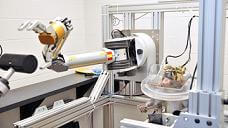
If you want the epitome of cool cybernetics, it doesn't get much better than a monkey waving around a robot arm. Researchers from the University of Pittsburgh have placed two neural implants in the brain of a macaque, allowing it to control a seven degree of freedom robot arm using only its thoughts. The experiment was designed to push the limits of brain-computer interfaces and increase the complexity of devices controlled by direct neural connections. Check out the amazing video of the monkey using his robot arm in the brief video from IEEE Spectrum below.
While this is the most complex monkey-controlled robot we've seen to date, it's not the only one. The University of Pittsburgh's earlier version of this experiment used a four degree of freedom robot arm. We've also seen similar work in humans: Kevin Warwick of Reading University used a neural implant in his arm to control a robot hand, and the Smart Hand is a complete hand prosthetic controlled by nerve signals in the arm. The macaque projects, however, stand out because of the complexity of the robotic device and the placement of the neural interface directly into the brain. The robot arm nearly has the same degrees of freedom of a human arm (minus the fingers), and the implants in the monkey's brain measure signals associated with both the arm and the hand.
In the University of Pittsburgh experiment, the macaque needs the complexity of the arm to accomplish its task. The monkey moves a control stick with its natural arm, which places a black knob in an arbitrary position and orientation. Using the robotic arm, the macaque lightly grasps the black knob and receives a liquid treat via a tube. Using this reward system, the monkey was able to learn how to manipulate its robot arm into many different configurations made possible by its high degrees of freedom. Erico Guizzo of IEEE Spectrum was able to talk to Andrew Schwartz of the University of Pittsburgh team. He mentioned that the monkey was not only able to use the robotic arm to touch the black knob, but rotate it in place as well.
Be Part of the Future
Sign up to receive top stories about groundbreaking technologies and visionary thinkers from SingularityHub.

Watching the monkey deftly manipulate the robot arm is really amazing, but this experiment is just one avenue of approach towards the ultimate goal: humans controlling artificial limbs and bodies using nothing but their brains. We've already seen human motor neurons wired to control computer cursors and motorized wheelchairs using the Braingate device. Taken together with the cyborg hand projects we mentioned above, the monkey and human neural interfaces demonstrate that we are nearing that goal. Perhaps much quicker than any would have imagined. It's no surprise that we could see an XPrize for BCI in the near future. With the right financial incentives, advances to tap directly into the brain could be greatly accelerated. Once the more complex problems of understanding sensory input are overcome, we'll have humans controlling computers with their thoughts and exploring virtual environments with their minds. That sounds just awesome enough to beat out monkey-cyborgs on my list of cool technologies.
[image credit: Motor Lab, University of Pittsburgh via IEEE]
[video credit: IEEE Spectrum]
[sources: Motor Lab Univ. Pittsburgh, IEEE Spectrum]

Related Articles

The ‘WarGames’ Problem: Computer Science Has Long Understood What It Takes to Keep AI Under Control
This Robot Dog Crushed a Marathon Without Stopping to Recharge
US Launches $215 Million Race to Build an Error-Corrected Quantum Computer by 2028
The ‘WarGames’ Problem: Computer Science Has Long Understood What It Takes to Keep AI Under Control
This Robot Dog Crushed a Marathon Without Stopping to Recharge
US Launches $215 Million Race to Build an Error-Corrected Quantum Computer by 2028
What we’re reading