

Quantcast

Myon – The Child-Like Learning Robot with a Modular Body

by Aaron Saenz June 25th, 2010 | Comments (8)

Share
Share by email
Import Addresses
Send To A Friend Close


Save time! Click Here to select directly from your AOL, Gmail, Hotmail, or Yahoo! Address Book
Ad
 
muon-robot-shell

Hello, Myon!

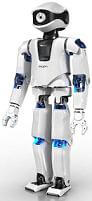
With it’s cyclops eye and shiny plastic shell the Myon robot may not exactly look like your typical eight year old, but its designers hope that you’ll think there’s a vague resemblance. The Myon project is aimed at understanding how robots could gain and develop language skills. For that, it needs to interact easily with human partners and so it’s been given the rough size and shape of a young child. Unlike any human kid, however, each of Myon’s limbs are completely modular, with their own power supply and controls. Hack off an arm and the robot can continue working with no problems.  Myon recently made its debut at the recent DMY International Design Festival in Berlin. Check out a simplified version of the bot taking a walk in the video below.
muon-robot-partial-shell

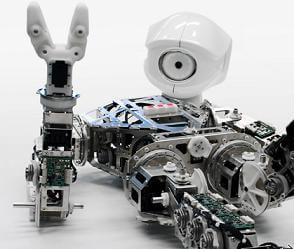
Myon...kind of like an eight year old child that can cut off its own limbs and survive.

Robots designed to look and learn like children isn’t a new concept. We’ve seen the iCub work it’s way towards understanding visual cues and eye contact, and the Diego-san robot from UCSD and Kokoro was made for cognitive experiments (as well as terrifying everyone who sees it). Without seeing Myon tackle actual language tasks, it’s hard to know how it stacks up to these other projects. However, Myon is part of the ambitious and rather successful Artificial Language Evolution on Autonomous Robots (ALEAR) project, which is a point in its favor.

Where Myon seems to stand out is its hardware. It has 192 sensors, 48 joints, and a touchscreen on its chest. Most impressively it has a modular design structure so that it can function even after losing a major portion of its body. Myon was developed by the Lab of Neuro Robotics at Humboldt University in Germany, in collaboration with design firm Frackenpohl Poulheim. They hope that the modular design may help answer questions such as what happens when a learning robot swaps out a limb with an untrained sibling. It’s shiny shell is made of makrolon, a polycarbonate product by Bayer Material Sciences. The external covering has structural importance – it provides support for torsion forces used in movement. Still, I’m not too impressed with the walking skills shown in the video below. It’s not a bad bit of locomotion, but I’ve seen better from Lego bots.

I think it’s kind of interesting that the pursuit of understanding artificial cognition almost always pushes researchers into acts of mimicry. Myon and similar projects use robots in the rough shape of children. The Blue Brain Project is trying to simulate a human neocortex. We’ve also seen robots helping shed light on evolutionary forces in animals. All of this copy-catting is cool to watch, but I always wonder, when will we just let robots be robots? The most impressive part of Myon is that it might be able to be trained and then share that education by trading the relevantly experienced limb. That’s a style of learning unique to robots (and bacteria, I guess). In the future it should be interesting to see if projects like Myon can find original ways to study cognition with or without following the human intelligence paradigm.

A warning to the machines: stop trying to train your kids to learn like human children, or I’ll starting training my (hypothetical) human children to learn like robots.
muon-robot

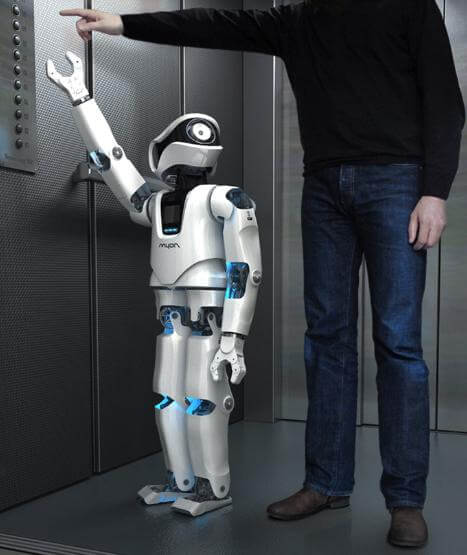
Well, they got one thing right: I've never met an eight year old that didn't want to press the buttons on the elevator.

[image credits: Frackenpohl Poulheim]
[video credit: DesignBoom]
[source: Frackenpohl Poulheim, Neuro Robotics at Humboldt University, ALEAR]


Related Stories


Connect With Us

.

Post a Comment

Sort By:

Comments

  • User Picture

    Why do people “act like” the culture they come from? Answer: Mimicry.
    Humans are adaptive.

  • User Picture

    Why do people “act like” the culture they come from? Answer: Mimicry.
    Humans are adaptive.

  • User Picture

    In my opinion, robots will always remain robots.

  • User Picture

    In my opinion, robots will always remain robots.

  • User Picture

    Mimicry has worked for humans for thousands of years, it is a lot faster than trying to program the robot directly and is an essential ability if robots are to be of any use or gain any form of autonomy. Eventually they will not only mimic humans, but each other, that is when things get really interesting.

  • User Picture

    Mimicry has worked for humans for thousands of years, it is a lot faster than trying to program the robot directly and is an essential ability if robots are to be of any use or gain any form of autonomy. Eventually they will not only mimic humans, but each other, that is when things get really interesting.

  • User Picture

    This is definitely a very cool direction in AI and robotics. I agree that while mimicry may have merit along the lines of helping to study what it is one is trying to have a robot mimic, in terms of merely getting more intelligent agents, it is not necessarily the way to go. Take, for example, Adaptive AI. This is a company that is going after general AI and throwing requirements for human like intelligence completely out the window. It is a refreshing, and so far quite impressive direction.

  • User Picture

    This is definitely a very cool direction in AI and robotics. I agree that while mimicry may have merit along the lines of helping to study what it is one is trying to have a robot mimic, in terms of merely getting more intelligent agents, it is not necessarily the way to go. Take, for example, Adaptive AI. This is a company that is going after general AI and throwing requirements for human like intelligence completely out the window. It is a refreshing, and so far quite impressive direction.

Get Our Newsletter

Popular On The Hub

Singularity

Martin Ford Asks: Will Automation Lead to Economic Collapse?

Written by: Aaron Saenz 716 days ago

lights-in-the-tunnel

Will the future be filled with cool technologies and endless opportunities or will our own creations lead to eventual doom? [...]

Robots

5 Axis Robot Carves Metal Like Butter (Video)

Written by: Aaron Saenz 605 days ago

metal-helmet-machine

Industrial robots are getting precise enough that they’re less like dumb machines and more like automated sculptors producing artwork. Case [...]

Genetics

Designer Babies – Like It Or Not, Here They Come

Written by: Keith Kleiner 1009 days ago

designer-babies

Long before Watson and Crick famously uncovered the structure of DNA in 1953, people envisioned with both horror and hope [...]

Stem Cells, Gadgets, Robots, Longevity, Health, Artificial Intelligence, Genetics, Body Implants, Cyborgs, Science, Technology, Singularity, The Future!