Quantcast

New Zealand’s Robot Legs Let Paraplegics Walk….for $150,000! (video)

by Aaron Saenz July 23rd, 2010 | Comments (9)

Share
Share by email
Import Addresses
Send To A Friend Close


Save time! Click Here to select directly from your AOL, Gmail, Hotmail, or Yahoo! Address Book
 
rex-bionic-legs

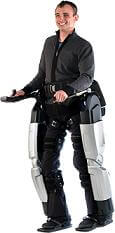
Paraplegics walk again with the Rex.

The Kiwis may have won the race for robotic legs. July 14th saw New Zealand’s Rex Bionics launch the Rex system, a set of powered limbs that allow a paraplegic to walk again. Designed to be used in place of wheelchairs, the legs aren’t prosthetics but rather an exoskeleton that lifts and moves a patient. Users control it via two joysticks, and the machine walks under its own power. With it, paraplegics will be able to stand up straight, walk, and even climb stairs. According to Rex Bionics, the machine is currently available in New Zealand and will be coming to other countries in 2011. This likely makes it the first system of its kind to be commercially available. Unfortunately, while many of the wheelchair bound may be interested in the walking platform, the hefty price tag of around $150,000 (USD) will make it inaccessible to most. Singularity Hub applauds Rex Bionics for helping paraplegics walk again, but honestly we expect better. This system needs to be much cheaper and faster. It seems like they intentionally avoid showing how slow Rex moves in their two demo videos (check them out below).

Earlier in the year we saw renewed interest in another walking platform for paraplegics, the ReWalk from Argo Medical Technologies. The ReWalk is supposed to launch sometime this year, but it looks like Rex Bionics got out of the gate first. Without seeing the final version of the ReWalk it’s hard to fairly compare the two systems, but my intuition is that while the Rex is available first it’s not the better option. Watch these videos and you’ll see why: Rex looks big and slow.

Actually, this second video is remarkably similar to the first, except that Hayden Allen, the user, has shaved. If you’re a beard lover, feel free to skip.

Rex weighs about 38 kg (~84 lbs) and seems rather bulky. Not only that, but it looks slow. Really slow. Here’s a video of the ReWalk for comparison:

Neither system lets you sprint, but it does seem like the ReWalk is faster. It also requires arm supports, however, so maybe there’s a trade-off here such that some will prefer the Rex. There’s also battery life to consider: Rex Bionics says that their walker can stay active on one battery for 2 hours, and that swapping batteries to keep going is easily down. Arco claims the ReWalk stays charged for an entire day’s worth of walking. I’m skeptical of that claim, and with the ReWalk as yet unavailable, it’s hard to know if it will outlast the Rex.

Of course the biggest difference, to me, is that the Rex costs more than a Tesla Roadster. Arco hasn’t priced the ReWalk, but it’s got to be less than that, right? I mean, Cyberdyne’s HAL exoskeleton is only supposed to be around $20k. I just can’t see someone taking out a mortgage to pay for the Rex, no matter how cool it looks or quickly it gets to market. Also, it seems to me that zipping around in a featherlight wheelchair is infinitely preferable to plodding along at Rex’s slow speed. But then again, I’m not a paraplegic, so what do I know. If any of our readers in NZ (we have a few actually) end up getting a Rex, please drop us a line. I’d love to hear your thoughts on the platform. If it was me though, I think I’d wait until KAIST commercialized its robot walker. Nothing beats looking like you just stepped off the set of Star Wars.
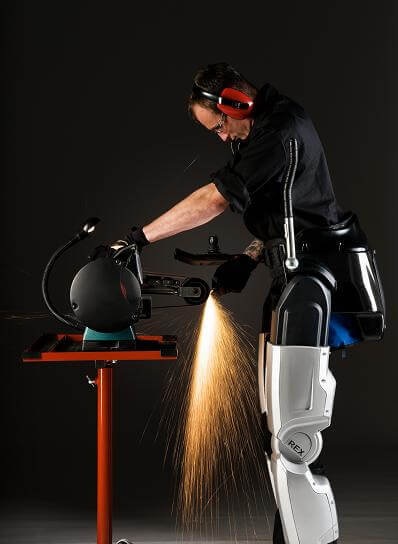
rex-bionic-legs-hayden-allen

Ok, so having machine legs and being a machinist is pretty damn cool. Not $150,000 cool, but still.

[image credit: Rex Bionics]
[video credits: Rex Bionics, Arco Medical Technologies]
[source: Rex Bionics site and Facebook page]



Related Stories


Connect With Us

.

Post a Comment

Sort By:

Comments

  • User Picture

    All these systems are very well, but none of them mention anything about where the injury level of the patient lies. My On has a t4 injury and is paralyzed from the mid chest down. So how do these devices help him in standing and maintaining balance? The REX looks like the only chance at the moment but is very bulky and heavy. Can anyone come up with any suggestions?

  • User Picture

    Yes, it’s very expensive now. So were microwave ovens, personal computers and color TVs when they first came out. Now, a lot of people have access to these things. The same thing will happen in this case. Those who can afford these robotic legs will buy them. That will encourage further development which will make them cheaper and better.

  • User Picture

    Yes, it’s very expensive now. So were microwave ovens, personal computers and color TVs when they first came out. Now, a lot of people have access to these things. The same thing will happen in this case. Those who can afford these robotic legs will buy them. That will encourage further development which will make them cheaper and better.

  • User Picture

    I applaud the developers of the robotic legs but most of us would sure like to see this guy succeed!

    Stem Cell Rock Star

    UC Irvine’s Hans Keirstead is a charismatic, tradition-bending, action-figure of a researcher who not only wants to heal the sick, but change the way academic scientists do business. Is the world ready for him?
    By Patrick J. Kiger

    The UC Irvine stem cell researcher who startled the world by enabling paralyzed rats to walk—and aims someday soon to do the same for humans—is in his second-floor office at the Gillespie Neuroscience Research Facility, where the afternoon sun streaming through the window accentuates his tanned, finely chiseled features and the highlights of his lush mane.

    http://www.orangecoastmagazine.com/article2.aspx?id=23896

  • User Picture

    I applaud the developers of the robotic legs but most of us would sure like to see this guy succeed!

    Stem Cell Rock Star

    UC Irvine’s Hans Keirstead is a charismatic, tradition-bending, action-figure of a researcher who not only wants to heal the sick, but change the way academic scientists do business. Is the world ready for him?
    By Patrick J. Kiger

    The UC Irvine stem cell researcher who startled the world by enabling paralyzed rats to walk—and aims someday soon to do the same for humans—is in his second-floor office at the Gillespie Neuroscience Research Facility, where the afternoon sun streaming through the window accentuates his tanned, finely chiseled features and the highlights of his lush mane.

    http://www.orangecoastmagazine.com/article2.aspx?id=23896

  • User Picture

    I think the primary difference is the magnitude to which the system assists the wearer. Rex appears to be a complete assistance system, including balance and full weight carrying. Rewalk on the other hand appears to be more of a passive assist system where it is only functioning to get the right leg at the right position in time to the wearers own motion. It doesn’t appear to be able to support their entire weight, and seems to operate off of simple patterns activated by the wrist controls. Because Rewalk isn’t doing nearly as much physical work, the system can be lighter and therefore more nimble.

  • User Picture

    I think the primary difference is the magnitude to which the system assists the wearer. Rex appears to be a complete assistance system, including balance and full weight carrying. Rewalk on the other hand appears to be more of a passive assist system where it is only functioning to get the right leg at the right position in time to the wearers own motion. It doesn’t appear to be able to support their entire weight, and seems to operate off of simple patterns activated by the wrist controls. Because Rewalk isn’t doing nearly as much physical work, the system can be lighter and therefore more nimble.

  • User Picture

    The Rex system lets the user use both hands while standing upright. The Re-walk does not. The Re-walk appears much faster than the Rex and more able to take on uneven ground or stairs.

  • User Picture

    The Rex system lets the user use both hands while standing upright. The Re-walk does not. The Re-walk appears much faster than the Rex and more able to take on uneven ground or stairs.

Get Our Newsletter

Popular On The Hub

Singularity

Martin Ford Asks: Will Automation Lead to Economic Collapse?

Written by: Aaron Saenz 716 days ago

lights-in-the-tunnel

Will the future be filled with cool technologies and endless opportunities or will our own creations lead to eventual doom? [...]

Robots

5 Axis Robot Carves Metal Like Butter (Video)

Written by: Aaron Saenz 605 days ago

metal-helmet-machine

Industrial robots are getting precise enough that they’re less like dumb machines and more like automated sculptors producing artwork. Case [...]

Genetics

Designer Babies – Like It Or Not, Here They Come

Written by: Keith Kleiner 1009 days ago

designer-babies

Long before Watson and Crick famously uncovered the structure of DNA in 1953, people envisioned with both horror and hope [...]

Stem Cells, Gadgets, Robots, Longevity, Health, Artificial Intelligence, Genetics, Body Implants, Cyborgs, Science, Technology, Singularity, The Future!