Quantcast

Robot Learns How to Flip Pancakes…but Not on the First Try (video)

by Aaron Saenz July 27th, 2010 | Comments (6)

Share
Share by email
Import Addresses
Send To A Friend Close


Save time! Click Here to select directly from your AOL, Gmail, Hotmail, or Yahoo! Address Book
Ad
 
robot-flips-pancakes

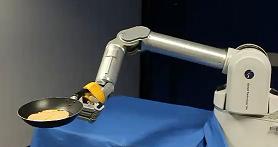
A WAM arm learns how to flip a pancake with a lot of trial and error. Emphasis on the error.

One day robots will sell like hotcakes…especially if they can make you hotcakes. Scientists from the Italian Institute of Technology have successfully taught a Barrett WAM arm the time honored culinary skill of flipping pancakes. Petar Kormushev and Sylvain Calinon first trained the robot by actively moving its arm in a demonstration. From that point on, however, the robot learned by evaluating it’s own success and trying to improve upon it. A fake pancake was used so that it could be more easily tracked. Still, it took about 50 trials to get the basics down. The video of the project is hilarious. I just can’t get enough of watching an artificial pancake whiz about a room haphazardly. Check it out for yourself below.

The real story behind this project is not the pancakes, but the programming. We’ve seen other robots perform much better in the kitchen than this WAM. What makes Kormushev and Calinon’s attempt intriguing is that they relied on reinforcement learning – a process by which a program (like the one controlling the robot) tries to maximize its success. The robot didn’t simply repeat the example is was first given, it actively asked itself what it had done well, and what it would probably benefit from changing. The researchers used variations on this premise (most of which are beyond my programming knowledge) to help the robot quickly decide what works. 50 trials may sound like a lot (and it probably is) but the fact that the robot’s program was learning, and not simply repeating a defined set of tasks, is interesting. (This focus on learning is not a surprise when you consider that Kormushev is also working on the iCub child-like robot).  In the future, these techniques may help computers/robots learn tasks with a minimum of input and help them become proficient automatically over time. Flipping pancakes today, performing heart surgery tomorrow. Just don’t be one of the first 50 patients.

[screen capture and video credit: Kormushev and Calinon]
[source: Kormushev website]


Related Stories


Connect With Us

.

Post a Comment

Sort By:

Comments

  • User Picture

    50 tries really doesn’t seem like all that many, considering I tried until I just gave up.

  • User Picture

    50 tries really doesn’t seem like all that many, considering I tried until I just gave up.

  • User Picture

    There’s a great feature of machine learning: Once a robot has acquired a skill or knowledge, it can be transferred to other robots quickly and effortlessly. It doesn’t matter if the original skill was programmed, or learned after a thousand attempts — it can be shared so that every new robot is instantly as proficient as the first.

    Contrast that with humans. It may take an individual many decades to acquire proficiency in a subject or skill. And then to share that knowledge with a student will require long periods of instruction, training, and practice. And in the end, the student may still not be of the same caliber as the teacher.

    Imagine having hundreds of identical robots, and having each master one useful skill (like flipping a pancake). Since their knowledge can be shared instantly, every robot will immediately become proficient in all skills. A robot master chef will also be a master carpenter, surgeon, gardener, welder etc.

    This feature of artificial intelligence alone will be of trememdous significance to the future economy.

  • User Picture

    There’s a great feature of machine learning: Once a robot has acquired a skill or knowledge, it can be transferred to other robots quickly and effortlessly. It doesn’t matter if the original skill was programmed, or learned after a thousand attempts — it can be shared so that every new robot is instantly as proficient as the first.

    Contrast that with humans. It may take an individual many decades to acquire proficiency in a subject or skill. And then to share that knowledge with a student will require long periods of instruction, training, and practice. And in the end, the student may still not be of the same caliber as the teacher.

    Imagine having hundreds of identical robots, and having each master one useful skill (like flipping a pancake). Since their knowledge can be shared instantly, every robot will immediately become proficient in all skills. A robot master chef will also be a master carpenter, surgeon, gardener, welder etc.

    This feature of artificial intelligence alone will be of trememdous significance to the future economy.

  • User Picture

    Unfortunately, to flip a real pancake, you need a lot more height that than, which is the disadvantage of learning from an inflexible model pancake.
    However, that is my only criticism. One robot flipping a pancake from programming is unimpressive these days, however, one robot learning to flip a pancake relatively unaided. That _is_ impressive.
    Self-optimising subroutines are becoming truly incredible these days. I just can’t wait to see what they’re like in ten or twenty years’ time.

  • User Picture

    Unfortunately, to flip a real pancake, you need a lot more height that than, which is the disadvantage of learning from an inflexible model pancake.
    However, that is my only criticism. One robot flipping a pancake from programming is unimpressive these days, however, one robot learning to flip a pancake relatively unaided. That _is_ impressive.
    Self-optimising subroutines are becoming truly incredible these days. I just can’t wait to see what they’re like in ten or twenty years’ time.

Get Our Newsletter

Popular On The Hub

Singularity

Martin Ford Asks: Will Automation Lead to Economic Collapse?

Written by: Aaron Saenz 716 days ago

lights-in-the-tunnel

Will the future be filled with cool technologies and endless opportunities or will our own creations lead to eventual doom? [...]

Robots

5 Axis Robot Carves Metal Like Butter (Video)

Written by: Aaron Saenz 605 days ago

metal-helmet-machine

Industrial robots are getting precise enough that they’re less like dumb machines and more like automated sculptors producing artwork. Case [...]

Genetics

Designer Babies – Like It Or Not, Here They Come

Written by: Keith Kleiner 1009 days ago

designer-babies

Long before Watson and Crick famously uncovered the structure of DNA in 1953, people envisioned with both horror and hope [...]

Stem Cells, Gadgets, Robots, Longevity, Health, Artificial Intelligence, Genetics, Body Implants, Cyborgs, Science, Technology, Singularity, The Future!