

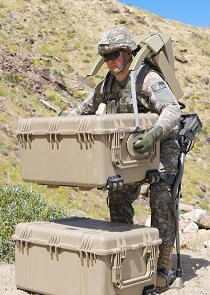
The problem with military technology is that people like to use it to fight wars. Lockheed Martin recently announced in a press release that they had received $1.1 million and the go ahead from the US Army to perform lab tests on their HULC exoskeleton at the end of this year. The Human Universal Load Carrier is a powered and wearable device that supports weight, allowing a soldier to transport up to 200 lbs (~91kg) without feeling it. With a revamped structure (which Lockheed describes as ‘ruggedized’), longer battery life, and better sizing, HULC could be on the quick path to adoption into the field. But, honestly, I think the military applications are impractical. The range, power, and reliability of these devices doesn’t lend them to being taken out for days or weeks of a mission. I’m much more interested in a single line from the press release: “Lockheed Martin is also exploring exoskeleton designs to support industrial and medical applications.”
The US is fighting wars in harsh, unforgiving environments, and Afghanistan particularly has an abundance of rugged high altitude terrain. Hauling hundreds of pounds of weight in these regions can defeat a soldier before he or she ever sees an enemy combatant. That’s why an exoskeleton designed for hauling sounds so good to Army brass. Keep soldiers rested by literally taking a great weight off their shoulders.
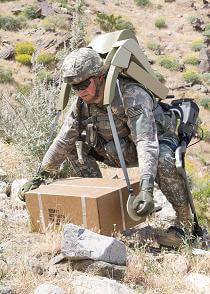
Yet as I mentioned when I discussed HULC earlier in the year, there are some hurdles to military application that are unlikely for the device to ever overcome. First among these is battery life. Lockheed Martin is pursuing a 72 hour battery, but the original HULC had an active run time of just one hour (now a little more, how much so Lockheed doesn’t exactly state). Even at three days, however, the device would be limited in range. And while the HULC bears its own 53 lb weight while active, when deactivated and disassembled for carrying, a soldier bears that mass on his own. Second, the HULC is fairly agile, but 200 lbs is a lot of added inertia for a soldier even if the extra weight is being lifted by the machine. The exoskeleton, though potentially useful, is another device that could fail a soldier in the field, potentially leaving gear (or even personnel) stranded. Finally, turning soldiers into mules may not make a lot of sense when robots, vehicles, or honest to goodness real-life mules might be a more cost-effective solution.
So I don’t see the HULC being a great fieldable Army device anytime soon. Yet Lockheed Martin is going to perform an eight week lab test by the end of 2010, and probably see preliminary field tests in 2011. I hope though that during that process testers realized the true benefit of this device: hauling old people around.
The world is getting older. Industrialized countries exceedingly so. Japan is starting to face problems with adequately caring for its elderly, and the EU and US will be there in the next decade or two. We need systems that can help healthcare workers lift someone out of chairs and beds, or carry around medical supplies all day without getting tired. This is where exoskeletons can really help – in places where power supplies are not a critical issue and where minor errors in a device won’t get you shot (probably…there are some pretty well armed elders). The problem of elder-care cannot be exaggerated. We’re talking trillions of dollars worldwide in the next few decades. If that’s not military-level spending, it’s pretty damn close.
Additionally, a commercial version of HULC could be used in all sorts of industries to augment human workers. We lose billions in GDP each year to workplace injuries, and some of that could be avoided if those with physically challenging tasks had help lifting. And efficiency is bound to rise when one worker can stay on his or her feet and lift heavy loads for hours without getting tired. There’s a lot of money to be saved. Simple as that.
Exoskeletons are popular pursuits, and we’ve seen others aiming for Army work before. But it’s always the commercially minded exos that really get my attention. Whether its to augment medical workers, serve as a medical device, or expand human capabilities, the peace-time exoskeleton just makes more sense to me than the warring one. Drones and other robots could make our soldiers more powerful far more quickly than powered suits. Just this once maybe Lockheed Martin could skip the military applications and head right to where the real opportunities are: industry and medical. It won’t be as exciting, but it has a much better chance of working.
[image credits: Lockheed Martin]
[source: Lockheed Martin Press Release]




Comments
The medical aspects of the technology aka lifting fat person from one bed to another or helping contractor lift more stuff at a time does not nearly come close to the importance of a better soilder this is just the first step the beginning of a much bigger and more important technology. This technology is still in its infancy but with future development imagine this suit, enhancing soilders strength and survivability. Now the real benifit of the soilder being able to move and lift that extra weight where it will really make a difference is coating the soilder in armour. Imagine a soilder who can be shot in chest with RPG get tossed back on his ass ten feet pick up his gun and shoot the guy that just shot him now tell me that would not help bring more of our men and women back alive. The battery is a problem and reliability will probably be a problem for now but thats why its still in the lab for the technology to be refined. The true strength in this technology is allowing the soilder to be equiped with better armor there by increasing his survivability, also allowing you to incorporate other gear on the soilder such as a helmet equipped with night vision and heat vision again this is still decades away.
Providing soldiers with stronger body armor and the ability to carry heavier weapons and sensory systems would be a good use for exoskeletons.
But then again one can question how such a thing would work out on the battlefield.
You would basically end up turning infantry soldiers into tanks.
And while the extra protection, firepower, and sensors could certainly provide an edge, they will still eventually be defeated by more powerful weapons which will then become vital, and standard weaponry for any armed force.
Providing soldiers with stronger body armor and the ability to carry heavier weapons and sensory systems would be a good use for exoskeletons.
But then again one can question how such a thing would work out on the battlefield.
You would basically end up turning infantry soldiers into tanks.
And while the extra protection, firepower, and sensors could certainly provide an edge, they will still eventually be defeated by more powerful weapons which will then become vital, and standard weaponry for any armed force.
Muling supplies is just a nice use of creating an intermediate exoskeleton. A useful prototype to building the in-house knowledge base for what the army real after; the wet dream of having Starcraft marine lookalikes. Sure it won’t happen in the next 5 to 10 years, but the US army wants to get there first.
I think the author of this article is pointing out that the real device now only has 1 hour of run time.
Also, remember that vehicles’ brakes have improved greatly over time with disc, power brakes, ESC and so forth. Does the HULC have an effective brake system?
I think the author of this article is pointing out that the real device now only has 1 hour of run time.
Also, remember that vehicles’ brakes have improved greatly over time with disc, power brakes, ESC and so forth. Does the HULC have an effective brake system?
The 72 hour limitation is not as bad as you think. Consider other consumables the person needs to carry if they are to survive more then 72 hours without resupply. The primary culprit is of course water: at least 2-3 gallons per day in hot arid climates like Afghanistan or Iraq. Likewise, 2-3 MREs needed to patrol for a day account for 2-3 pounds. Add them all together, and you’ll see that you need to carry about 40 pounds of consumables to be active for 72 hours. If you think you’ll need to operate without resupply for longer, then you’ll need proportionally more food and water – which when added on top of normal military kit of arms/ammo/body armor/misc supplies rapidly becomes unsustainable.
Bottom line is that outside specific situations (like special forces operating on long distance patrols without resupply behind enemy lines), the modern infantrymen is rarely restricted to what he can carry on his back for longer then 72 hours.
As far as inertia argument goes, it applies to any vehicle driven or operated by a man. A humvee, a tank or a fighter jet all have very different response parameters then a human body, and their operators have to be specially trained – no doubt as the HULC operators will have to be trained.
The 72 hour limitation is not as bad as you think. Consider other consumables the person needs to carry if they are to survive more then 72 hours without resupply. The primary culprit is of course water: at least 2-3 gallons per day in hot arid climates like Afghanistan or Iraq. Likewise, 2-3 MREs needed to patrol for a day account for 2-3 pounds. Add them all together, and you’ll see that you need to carry about 40 pounds of consumables to be active for 72 hours. If you think you’ll need to operate without resupply for longer, then you’ll need proportionally more food and water – which when added on top of normal military kit of arms/ammo/body armor/misc supplies rapidly becomes unsustainable.
Bottom line is that outside specific situations (like special forces operating on long distance patrols without resupply behind enemy lines), the modern infantrymen is rarely restricted to what he can carry on his back for longer then 72 hours.
As far as inertia argument goes, it applies to any vehicle driven or operated by a man. A humvee, a tank or a fighter jet all have very different response parameters then a human body, and their operators have to be specially trained – no doubt as the HULC operators will have to be trained.