Quantcast

China’s 10 Day Traffic Jam – Exponential Growth at its Worst

by Aaron Saenz August 25th, 2010 | Comments (22)

Share
Share by email
Import Addresses
Send To A Friend Close


Save time! Click Here to select directly from your AOL, Gmail, Hotmail, or Yahoo! Address Book
 
china-traffic-jam

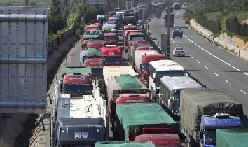
The G110 outside of Beijing.

Now for a traffic update – if you’re on the G110 highway north of Beijing, don’t expect to do anywhere for a few days! A massive traffic jam has been clogging the G110 since sometime on August 14th, and has stretched to more than 60 miles at its longest. Thousands of commuters have been stuck on the road for days, living off of water and food sold to them by vendors wandering through the semi-parked cars. The jam is undoubtedly related to construction efforts on the G110 and which are not scheduled to be completed until mid-September. While there are some reports that the 10+ day traffic jam is starting to clear up, it may only be a matter of time before it forms again. What’s behind this driver’s nightmare? Explosive growth in both car ownership and the transportation of coal. Problems like these make you wonder if we’re getting closer to a technological singularity, or just wading deeper into a mire of materialism.

The construction on the G110 that began in August was necessary due to an increase in the number of large trucks that used the highway to transport goods. A large portion of these trucks are carrying coal, the fuel powering China’s recent economic growth. NPR reports that increases in the Beijing area coal traffic may be due to the smuggling of coal from Mongolia along a route with little bureaucratic oversight. Whether or not the coal is part of illicit trade, it is certainly a part of the Chinese mega-traffic jam.
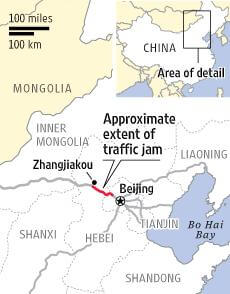
china-traffic-jam-map

A traffic jam more than 60 miles long? Ouch.

The other major part is increased car ownership. According to the LA Times, the Beijing area is adding cars at an astonishing rate of 1900 per day! Average speeds in the city during commuting times have slowed to less than 15 miles per hour (~25 kph). The number of drivers on the road is essentially negating the benefit of traveling in cars. Might as well ride a bike.

Logistical problems like this traffic jam are a little disheartening to someone who hopes that developments in technology will help solve many of the world’s leading problems. How are we going to solve world hunger, or avoid an energy crisis when we can’t even manage traffic. The mega-jam also shows that widespread adoption of a (newer) technology like the car (and maybe coal for that matter) can lead to large negative side-effects for which we may not be prepared.

But maybe that’s why we need to think more about accelerating technologies and exponential growth. China could have been massively expanded their highway systems years ago if they had been able to accurate project the rates of car adoption and truck traffic. Likewise, we may be able to avoid technology based problems if we can predict how that technology will grow in the years ahead. So look upon the Chinese Mega Traffic Jam and tremble my friends. If we don’t plan for the future we could be stuck in a similar situation. Only with robots.

[image credit: Associated Press, Wall Street Journal]
[source: NY Times, WSJ, LA Times, NPR]



Related Stories


Connect With Us

.

Post a Comment

Sort By:

Comments


  • And I thought Los Angeles had a traffic problem.

  • User Picture

    Late to the party. Your conclusion misses the boat entirely. China didn’t need to build more lanes of highway — they needed to (a) build more rail to handle the freight, particularly coal, and/or (b) build fewer coal fired power plans, using renewables instead. Shipping coal — which is heavy, doesn’t spoil, and doesn’t require advanced cargo containers on roads is asinine: it destroys the roads as damage is a function of weight cubed, it’s fuel intensive to use a truck instead of rail or barge, and it’s even an unnecessary waste of manpower.

    If China could have seen in to the future, the infrastructure improvement to deal with this isn’t more lane-miles of road, it’s getting the cargo off of the highway in the first place.

  • User Picture

    I never seen such a scenario in my life. But I think this thing should be declare in news also so that people will cancel there plan to freak out. It’s a government responsibility to announce such a problem. At least they should aware of all this things. I also sometimes faced such a problems.
    http://www.usfordtrucks.com/

  • User Picture

    “”don’t expect to do anywhere for a few days”"

    should be

    “”don’t expect to go anywhere for a few days”"

  • User Picture

    “”don’t expect to do anywhere for a few days”"

    should be

    “”don’t expect to go anywhere for a few days”"

  • User Picture

    Why don’t they use some of the lanes on the other side of the freeway?

  • User Picture

    Why don’t they use some of the lanes on the other side of the freeway?

  • User Picture

    We need the intelligent car. Each car communicates with all the other cars, which are around it. The cars develop sworm ingelligence and avoid traffic jams.

  • User Picture

    We need the intelligent car. Each car communicates with all the other cars, which are around it. The cars develop sworm ingelligence and avoid traffic jams.

  • User Picture

    Government officials looking into the world of system dynamics, http://systemdynamics.org/wiki, will get insight on what the impact of exponential growth will be.

    Only few governments do that yet – time for change

  • User Picture

    Government officials looking into the world of system dynamics, http://systemdynamics.org/wiki, will get insight on what the impact of exponential growth will be.

    Only few governments do that yet – time for change

  • User Picture

    I thought this was going to be China’s 2nd Great Wall (of Traffic). Damn there’s a lot of trucks in that photo! I bet it would take years to clear the traffic….

  • User Picture

    I thought this was going to be China’s 2nd Great Wall (of Traffic). Damn there’s a lot of trucks in that photo! I bet it would take years to clear the traffic….

  • User Picture

    @Sean & Chad,
    I had the same question too…

    This reminds me of an episode of Doctor Who where they visit “New Earth” in the distant future, only to encounter a traffic jam that moves at a pace of a couple of kilometers/year…

    ****SPOILER****

    …and then it turns out that the traffic jam circles the entire planet, forming a complete, unmoving circle.

  • User Picture

    @Sean & Chad,
    I had the same question too…

    This reminds me of an episode of Doctor Who where they visit “New Earth” in the distant future, only to encounter a traffic jam that moves at a pace of a couple of kilometers/year…

    ****SPOILER****

    …and then it turns out that the traffic jam circles the entire planet, forming a complete, unmoving circle.

  • User Picture

    More often than not, a large city like Beijing will experience population growth and subsequent increase in automobile traffic. It’s relatively easy for real-estate developers and city officials to accommodate the population growth with urban and suburban sprawl. Build up and build out. Yet, expanding infrastructure isn’t so straightforward, as this story illustrates. Traffic jams are a part of life in many large cities. During “rush hour” it is completely normal to drive only a fraction of the speed limit on a highway due to traffic congestion.

    Yet, what about cyclists and pedestrians? I’d like to see a renewed concern for those commuters who can ride a bike to work, school, stores, etc. Proposals for urban bike paths are often flaunted by major cities that try to appear “progressive” and “cool”. The sad truth is that often these bike paths are slow to get moving. Plans, proposals, and promises abound, but often the projects for bike paths are stalled in the development phase.

    What’s more unfortunate is that governments seldom pay all costs associated with such a fundamental infrastructure feature as bike paths. What seems to be the case for many cities in my region (e.g., Cincinatti OH & Louisville KY) is that private interests and non-profits take the initial steps towards bike path development, and carry out the project with more or less aid from the municipal government.

    Doesn’t it strike anyone else as odd, that private interests are obliged to build bike paths in cities, for the benefit of all its citizens?

    I also should mention, that commuter cycling is a great alternative to automobile transportation and should be pushed vigorously. It is not a panacea, to be sure. Yet, with adequate infrastructure, the numbers of bicycle commuters would swell, and the automobile traffic congestion would accordingly ease.

  • User Picture

    More often than not, a large city like Beijing will experience population growth and subsequent increase in automobile traffic. It’s relatively easy for real-estate developers and city officials to accommodate the population growth with urban and suburban sprawl. Build up and build out. Yet, expanding infrastructure isn’t so straightforward, as this story illustrates. Traffic jams are a part of life in many large cities. During “rush hour” it is completely normal to drive only a fraction of the speed limit on a highway due to traffic congestion.

    Yet, what about cyclists and pedestrians? I’d like to see a renewed concern for those commuters who can ride a bike to work, school, stores, etc. Proposals for urban bike paths are often flaunted by major cities that try to appear “progressive” and “cool”. The sad truth is that often these bike paths are slow to get moving. Plans, proposals, and promises abound, but often the projects for bike paths are stalled in the development phase.

    What’s more unfortunate is that governments seldom pay all costs associated with such a fundamental infrastructure feature as bike paths. What seems to be the case for many cities in my region (e.g., Cincinatti OH & Louisville KY) is that private interests and non-profits take the initial steps towards bike path development, and carry out the project with more or less aid from the municipal government.

    Doesn’t it strike anyone else as odd, that private interests are obliged to build bike paths in cities, for the benefit of all its citizens?

    I also should mention, that commuter cycling is a great alternative to automobile transportation and should be pushed vigorously. It is not a panacea, to be sure. Yet, with adequate infrastructure, the numbers of bicycle commuters would swell, and the automobile traffic congestion would accordingly ease.

  • User Picture

    That’s the first question I had, Sean. There must be factors that are causing people to still get on that road. Perhaps that’s the only road into the city from that direction.

    I guess this is what can happen when you have unchecked growth, but you’d think heavy-handed government like China’s would be able to do something about this.

  • User Picture

    That’s the first question I had, Sean. There must be factors that are causing people to still get on that road. Perhaps that’s the only road into the city from that direction.

    I guess this is what can happen when you have unchecked growth, but you’d think heavy-handed government like China’s would be able to do something about this.

  • User Picture

    Is communication and news in China in such a state that after days of a traffic jam cars were continuing to add to it? I feel like if I heard about a traffic jam that bad I would probably take the scenic route…

  • User Picture

    Is communication and news in China in such a state that after days of a traffic jam cars were continuing to add to it? I feel like if I heard about a traffic jam that bad I would probably take the scenic route…

Get Our Newsletter

Popular On The Hub

Singularity

Martin Ford Asks: Will Automation Lead to Economic Collapse?

Written by: Aaron Saenz 716 days ago

lights-in-the-tunnel

Will the future be filled with cool technologies and endless opportunities or will our own creations lead to eventual doom? [...]

Robots

5 Axis Robot Carves Metal Like Butter (Video)

Written by: Aaron Saenz 605 days ago

metal-helmet-machine

Industrial robots are getting precise enough that they’re less like dumb machines and more like automated sculptors producing artwork. Case [...]

Genetics

Designer Babies – Like It Or Not, Here They Come

Written by: Keith Kleiner 1009 days ago

designer-babies

Long before Watson and Crick famously uncovered the structure of DNA in 1953, people envisioned with both horror and hope [...]

Stem Cells, Gadgets, Robots, Longevity, Health, Artificial Intelligence, Genetics, Body Implants, Cyborgs, Science, Technology, Singularity, The Future!