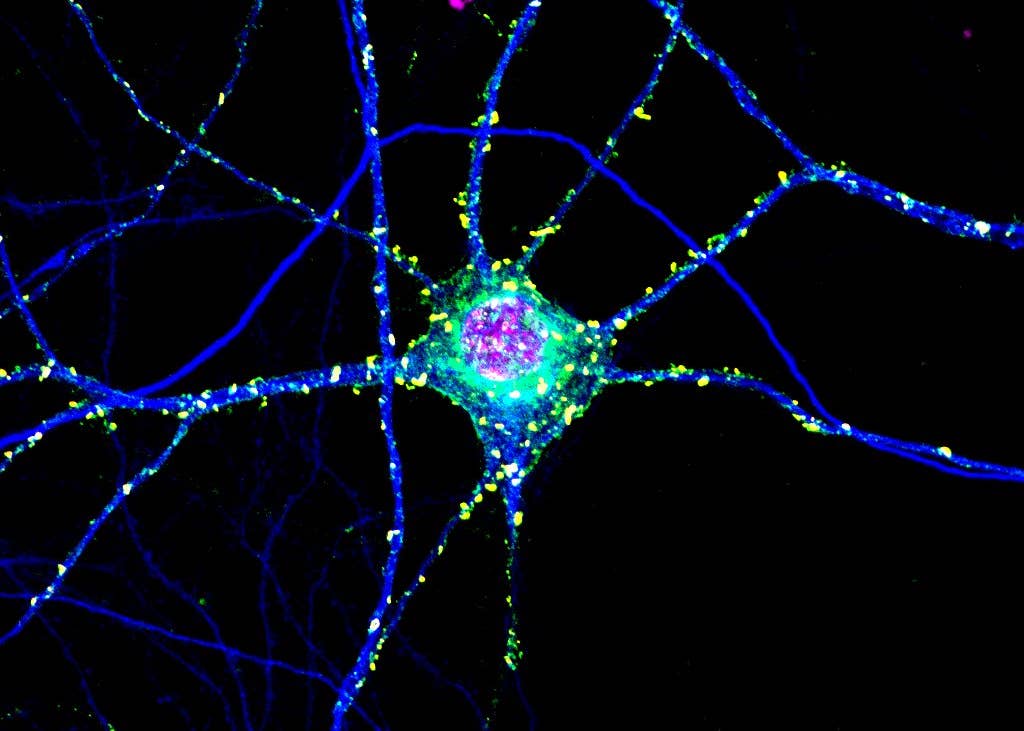
A new study measures how our tendency to use Internet search engines is changing the way our brains use information.
The debate about whether or not computers are making us dumber, largely speculative to this point, has recently gotten a healthy dose of scientific data. Last week scientists at Columbia University published a report showing that our dependency on Google for information has changed how we think.
The study involved a series of experiments that tested how much people rely on readily-available information in lieu of committing it to memory. In the first experiment students were given true-or-false statements after which they were presented a series of colored words for which they had to match each word to its color. Typically reaction times for this task are slower if the word relates to what the person is thinking–if the question involves an ostrich, matching “bird” to its color would take longer than matching “ladder” to its color, for example. Interestingly, they found that reaction times for words related to the Internet, such as “Google” or “Yahoo,” got slower reactions times, indicating that the students were thinking about looking the answers up online. When presented with any factual question, to Google is now a human instinct.
The next set of experiments showed that the students’ memory suffered if they were told that whatever they learned would be saved on the computer, as if they resisted “saving” the data to their own memory if it was already being saved in the computer’s. But then something interesting happened. Even though they couldn’t recall the facts, they recalled very well the specific computer folders into which the facts had been saved. Betsy Sparrow, lead author in the study, summed it up by saying that the students “were better at remembering where information was stored than the information itself.”
Roddy Roediger, a psychologist at Washington University in St. Louis, said in a commentary of the study, “…there is no doubt that our strategies are shifting in learning. Why remember something if I know I can look it up again? In some sense, with Google and other search engines, we can offload some of our memory demands onto machines.”
Offload…memory…machines. Sounds like science fiction, except it’s not fiction. It’s real. Today we live in a world where citizens have access to and are exposed to a staggering amount of information. Streams of information bombard us from all directions: Twitter, online news sites updated by the minute, televised media with news streams updated by the minute. And whatever we miss we can catch on our smartphones over lunch. This unprecendented barrage of information presents several challenges: deciding what information is relevant, what information is reliable, and when is enough enough. Some pundits have pointed to the Internet as the beginning of the end of quality contemplation. Even before the Internet novelist Michael Crichton referred to the Information Age as the dis-Information Age. More recently–and more emphatically–tech journalist Nicholas Carr seems to have dedicated his life to spreading the gospel of the evil Internet. His latest book, “What The Internet Is Doing To Our Brains” was a Pulitzer Prize finalist.
If you don’t have the time to read his book in between Tweets, Carr’s thoughts are summarized in a nice, condensed, easily-skimmable online essay from a 2008 issue of the Atlantic. He begins the essay, entitled “Is Google Making Us Stupid?” bemoaning the fact that he and his friends can’t read anymore. Well, not like they used to. They’re thoughts are all scattered and, dammit, one of his friends has just given up reading books altogether. He says that the Internet made them do it. They’ve simply skimmed too many headlines, blogs and articles, and clicked on too many links that unscrupulously led to more headlines, blogs and articles.
Seriously?
Carr should hang out at my house. I’m online all the time, reading all sorts of stuff. Yes, I skim all the time–that is, until I find an article that I’m interested in. Carr points to a study that looked at how people conducted research online. Predictably, the users skimmed, “bounced” to other sites, and rarely revisited a site they’d already looked at. Reminds me of when I was doing research. I’d type in the keywords “cortex” and “motor control” and get a list of titles that I would skim. If something caught my saccade-crazy eye I’d open the abstract and skim that. If that was interesting I’d skim the article. If I thought I missed something, I would read. It. More. Slowly. This past weekend I read the first of Issac Asimov’s Foundation books. Was awesome. Unlike Carr I wasn’t afflicted with a sudden skimming-induced inability to concentrate and left to wonder what was on the Twitter feed instead of what’s Hari Seldon got up his sleeve.
Other people are not so quick to label the Google generation the new MTV generation (remember how watching disjointed music videos was supposed to turn our kids’ brains to mush?). Last year Harvard cognitive neuroscientist Stephen Pinker wrote an article in the New York Times that addressed the rising panic over Internet-induced chronic ADD. His basic message was relax, we’ve heard this all before: “the printing press, newspapers, paperbacks and television were all once denounced as threats to their consumers’ brainpower and moral fiber.” A crucial discord between Pinker’s and Carr’s theses is the malleability of the brain. While Carr writes “The human brain is almost infinitely malleable,” Pinker writes, almost in response, that “Critics of new media sometimes use science itself to press their case, citing research that shows how ‘experience can change the brain.’ But cognitive neuroscientists roll their eyes at such talk. Yes, every time we learn a fact or skill the wiring of the brain changes; it’s not as if the information is stored in the pancreas. But the existence of neural plasticity does not mean the brain is a blob of clay pounded into shape by experience.” Suffice it to say that “experience does not revamp the basic information-processing capacities of the brain.”
It might surprise you to know that the IQ of the human race is actually increasing over time. We’re getting smarter despite the less-than-learned distractions of MTV, video games, Twitter, Facebook, and Googling everything from where to eat to who was the 1979 American League batting champion (Fred Lynn). Pinker does acknowledge, however, that because we have Twitter, Facebook and the world through Google at our fingertips that an impulse is there that wasn’t before. Like the students who instinctively wanted to go online when they were asked about an Ostrich, we take all our queries to the great all-knowing oracle named Google.
And that’s a bad thing?
I say certainly not. Yes, our cognitive strategies are a changin’, but I say that’s a good thing. It’s clear how technology changes our physical lives, less clear how it changes our mental lives. When was the last time you memorized a phone number? The more we can offload our cognitive work to computers the better. It’s what neuroscientist Rodolfo Llinas meant when he spoke of human consciousness spreading to computers. Asimov predicted that computers would one day relieve us of all the mundane, phone number-like facts and leave our minds free to exercise their highest function: creativity.
It’ll be interesting to see what other technology-induced cognitive quirks are revealed through studies like the Columbia one. I, for one, will be watching with anticipation, not apprehension. Come to think of it, maybe something new has already come out. Gotta go check Twitter!
[image credits: chaobin.me and Prism Decision Systems]
image 1: Homer
image 2: Kurzweil


“It might surprise you to know that the IQ of the human race is actually increasing over time.” This is one statement you have to be careful when generalizing. Yes, we’re getting smarter in the sense that we’re getting better at the tasks that IQ tests measure. In part, this is because our educational systems are being tuned to produce better IQ test results. Playing games also helps practice the skills needed to do well on IQ tests. But that doesn’t mean we aren’t getting worse at things that IQ tests can’t, well, test. I’m not saying we are, necessarily, or that these skills are necessarily relevant anymore in the world we’ve created for ourselves, but it’s something to keep in mind when discussing general intelligence: it’s very hard to pin down and measure.
Excellent point. Intelligence is such a hard thing to define, let alone quantify. But it’s what we got, and whatever it’s measuring, we’re getting better at it. It’s an interesting phenomenon called the Flynn effect and there are a number of theories to explain it. But the fact is, we don’t know. One theory is exposure to the new types of media over the 20th century. That’d be consistent with the Internet making us smarter, not dumber.
I think the main theory behind this idea is that having an infinite reference to all or most known data will make the individual too lazy to think and analyze facts for themselves, without said reference. I disagree. Information Overload is quite a daunting thing to deal with, often the most common reaction to finding out you could do or know anything is ‘what now?’. Steering through these mountains of information is anything but lazy work, one must constantly filter out bad info, reconstruct spread out information and make inferences to understand the undisclosed. Long story short, if you think the internet is making you dumber… You’re doing it wrong.
Each generation is smarter then the last because of the information before them. I think back to Newton’s famous quote about “standing on the shoulder of giants.” Now we have so much information so easily accessible, that route memorization is not only unimportant, but detrimental. What needs to be taught is information processing. Since so much information can be stored and easily accessed the most most important thing is getting what you want out of that information, and searching through the information.
“We’re getting smarter despite the less-than-learned distractions of MTV, video games”
Ok, now I’m going to have to start citing DoD numbers stating that longterm exposure to video games DRASTICALLY increases the ability to react to unexpected situations and environments where little or no information is readily known. They even have a name for it: Adaptive(or Fluid) Intelligence. Also most 8hour+/day gamers have a reaction speed that is TRIPLE that of the average jet fighter pilot.
Perhaps our high tech understanding of music and entertainment IS what is making us smarter. Remember when all you did was watch TV on your day off? No matter what we decide, I think we can agree that no matter what we are doing, its more productive than watching the simpsons.
I dont know how to edit my comments so sry for double post, I also dont know the rules here on urls but I’ve seen people link relevant info successfully, So I will try to share this, a research essay I wrote on the subject for a class.
http://www.geekprojex.com/2010/02/11/video-games-and-effective-learning/
Thanks for sharing.
Why are you so sure technology will continue progressing? Why are you certain that we will always have access to the internets?
Even if we didn’t there are books and other written information. If it is easier to remember knowledge one way then another then you shouldn’t try to fight it. IMO if the technology does fail or all books are burned the little one can memorize will not help much, plus there’s probably bigger problems going on in that society if such atrocities are occurring.
“Never memorize something that you can look up.”
— Albert Einstein
This is nothing new
We are adapting to the information age, which is exactly what should be expected. We should not be memorizing facts, but we should learn processes, techniques, procedures. Not 1 + 1 = 2, but rather ‘what is addition?’
About 45 years ago, I learned to do a lot of math in my head. With calculators everywhere, no one needs to do that these days. Understanding HOW to use a certain type of math is very important. But can we reach that understanding without practice?
We have an incredible amount of information available. Knowing how to use that information to make decisions is the most important thing that we can learn.
All of us ‘skim’ the data. How many read to the end of anything? Don’t bother to write a 300 page book, most people seldom read anything longer than one page. I have a friend that has written 30 books. The last 15 or so are only 30 pages long.
We need a faster way to ingest knowledge. A one minute video is great, if done well.
Absolutely! I always maintain that my success as a “consultant expert” in my industry is not because I “know” all the answers, it is because I know where to “look up” the answers. Smartphones and Google just made me a better consultant, with much quicker “recall” (read “search capability”).
This is why it is so important to teach kids how to use the technology to become more discerning users of information, rather than preventing them from using smartphones at school because it is considered “cheating” in our standard “memorisation process” we call an education. Check out the Quest-to-Learn website (http://q2l.org/) to see this philosophy in operation in a New York school.
Did you know that in the next year the human race will generate as much information as the entire human race has produced throughout its entire history. I can’t memorize all that! I want Google plugged directly in to my subconscious, so I can set it to doing searches in the background. Peter F Hamilton calls it the “E-Butler” in his novels.
“…they found that reaction times for words related to the Internet, such as “Google” or “Yahoo,” got slower reactions times, indicating that the students were thinking about looking the answers up online.”
How exactly do they get THAT indication? To me, that’s like saying “The little boy, when given a choice between a popsicle and an ice cream cone, chose the ice cream, indicating that he had curly hair.” Like wtf?
The slower reaction times could be for any number of reasons. I mean I’m not gonna lie, I stopped reading after that sentence because that’s the most ludicrous thing I’ve ever heard, so if that’s explained later in the article I apologize, but wowza. What a statement.
one item i recently noticed with my Google Maps application is that it no longer orients to a North/South/East/West direction, but instead the direction that I am driving, etc. This is frustrating because I prefer to view it like a map, not some idiotic GPS (I hate GPS devices, I just use the map to navigate myself).
In some ways, it is dumbing us down, but it also enables us to do new things as well. Mostly, however, it is a way for corporations to “lock us in” to be dependent on *their* products, thus creating a sustained revenue. This is where capitalism rears its ugly head and demonstrates that we need government to take over pretty much everything. We are beyond the point that we can revert to a purely agrarian society or maintain our lives without some precedence given to the higher organization. We are a world organization at this point, and hopefully it is clear enough that we cannot afford another world war.
Cheers,
Duke