Google Digitizes The Dead Sea Scrolls – Like Taking a Time Machine To 2000+ Years Ago

Share
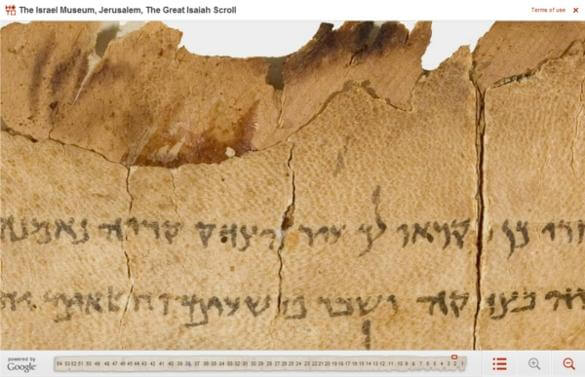
An elite team of tech specialists have taken one of the world's most precious historic relics and given it to people for free. Sound like the latest Hollywood heist film? Or maybe a retelling of Robin Hood? No, it's just Google's way of bringing the world's cultural treasures into the digital age. In collaboration with the Israel Musuem, Jerusalem, Google has made ultra high resolution images of The Dead Sea Scrolls available for anyone to explore online. (Some with embedded English translations.) Sealed away in caves more than 2000 years ago, the scrolls were rediscovered by accident in 1947, and represent some of the oldest known copies of biblical texts. Now you can browse through them as easily as you read Singularity Hub. Check out the introductory video for the project below. At up to 1.2 billion pixels, the scans of The Dead Sea Scrolls are in such rich detail that you can see them better than were you to look at them in person with your own eyes. Once again we've been shown how the digital age is not only granting us unparalleled access to the treasures of the world, it's doing so in a way that is better and quicker as well.
The Dead Sea Scrolls are maintained by the Israel Museum, Jerusalem, and have been on display since 1965 at Shrine of the Book. They were photographed in extremely high resolution by Ardon Bar-Hama, who has made his name through successes with such specialty projects. Google took Bar-Hama's work and made it easily explorable online, with users able to zoom in and browse the documents. Together these three groups were able to transform one of the world's most precious and fragile historical texts into a digital system open to be viewed by billions of people.
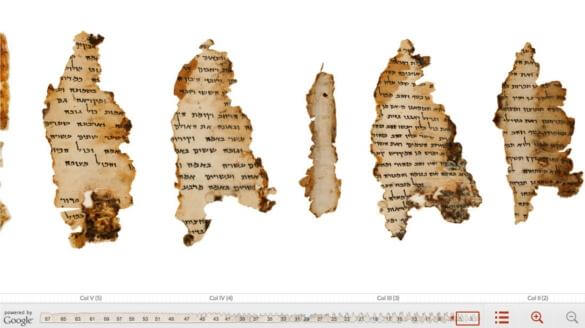
There are five scrolls available to be viewed in the Digital Dead Sea Scrolls project: The Great Isiah Scroll, The Temple Scroll, The War Scroll, The Community Rule Scroll, and The Commentary on Habakkuk Scroll. While burgeoning Hebrew scholars and historians may be able to read the most and understand the most from mostly complete scrolls like Great Isiah or Community Rule, everyone can get a feel for the age and delicacy of these artifacts simply by zooming in and seeing the fine flecks of material missing from their edges, and the crusted lines of their surfaces. The ability to ancient explore physical objects like this, regardless of what they happen to say, is truly amazing.
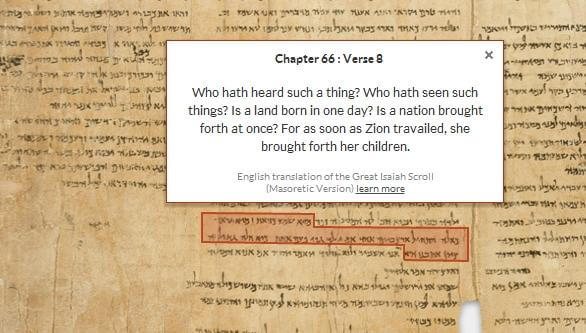
But reading them is also pretty neat. For English speakers like myself, one of the more exciting prospects of the Digital Dead Sea Scrolls project is the ability to read English translations superimposed directly over the parchment surface. While this feature is currently only available on one of the scrolls (The Great Isiah Scroll), Google is really maximizing its impact - now regular English Google searches online can bring up Dead Sea Scroll texts and images. Because the Book of Isiah is a well known text, these embedded English pop-ups are based on translations not specific to the scroll itself (Masoretic), but they are still very interesting to read as you browse through the high resolution images. The variations between texts, though small, are important I'm sure, but it's really just the ability to see the ancient document before you and get a rough idea of what it's saying that is truly mind-blowing.
Be Part of the Future
Sign up to receive top stories about groundbreaking technologies and visionary thinkers from SingularityHub.

Google's commitment to the digitization of information is always stunning. Sure, sometimes it lands them in court, but their intention seems pure. As we've discussed before, the Google Art Project brings more than a thousand priceless works of art into the homes of anyone with a computer. The search engine giant has also worked to digitize the Yad Vashem Holocaust photo collection and exhibits at the Prado Museum in Madrid. Now, as they announce their part in the Digital Dead Sea Scrolls project they are also soliciting new partners in their quest. Soon we should see many more historical and cultural artifacts preserved forever in online digital collections.
It takes millions of dollars to preserve the physical objects, thousands of dollars for people to travel and see them. Most of the world gets by on a few dollars a day or much less. By digitizing and distributing these collections openly on the internet, Google is democratizing the great treasures of the world. There's something so profoundly beautiful and noble about this work, that it actually brings a tear to my eye. A billion points to Google, Ardon Bar-Hama, and the Israel Museum for bringing the Dead Sea Scrolls to the world. Everyone else: take some time and enjoy these amazing images. They are true examples of how the marvels of our modern age will preserve and enhance all the marvels that have come before. I can't wait to see which collection enters the digital age next.
[image and video credits: Google]
Related Articles
US Launches $215 Million Race to Build an Error-Corrected Quantum Computer by 2028

Heat Is an Orbital Data Center’s Greatest Foe. These Tiles Dump It at the Source.

Europe Approves Bionic Eye to Restore Vision Lost to Blindness
US Launches $215 Million Race to Build an Error-Corrected Quantum Computer by 2028
Heat Is an Orbital Data Center’s Greatest Foe. These Tiles Dump It at the Source.
Europe Approves Bionic Eye to Restore Vision Lost to Blindness
What we’re reading