



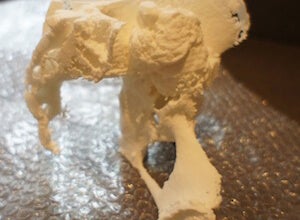
While necessity is the mother of invention, frustratingly high costs can motivate us to ask if there’s another way. Mark Frame, an orthopedic surgeon in training, came up with a new way to make bone replicas that help surgeons plan their procedures. Not that anything was wrong with the replicas they had, but at hundreds or even thousands of pounds apiece, Frame searched for a cheaper way to get the same result. His first production, a plastic bone of a patient’s arm, cost just £77. And everything he needed was right there on the Internet.
Monklands Hospital in Scotland where Frame works typically enlists a bone prototyping shop at a local university to make their models based on CT scan images. They’d put in for a model of a patient who’d fractured his arm. Because of costs they ordered a truncated portion of the bone. The sub-optimal model still cost them more than $1,200.
How Frame came to find a way to make a complete model for £77 is due in no small part to his enthusiasm for “any new tech or gadgets.” In particular, he “couldn’t fail to have noticed this upsurge in talk about 3D printing,” he blogged on the website for Shapeways, the Netherlands-based 3D printing company he used to make his models.
But, as 3D printers don’t normally handle CT scan images, Frame had to find a way to convert the images into a format the printers could use. And, of course, the final product had to be just as precise as those surgeons normally use. To accomplish this he used OsiriX, an image processing package specific for the kinds produced by imaging equipment, such as CT scanners. As OsiriX is open source software that runs on mac OS, Frame was able to use it free of charge. He then used a program called MeshLab – also open source, and free, for Mac – to clean up the image and make them medical quality. Finally, this image was sent to Shapeways for printing. Seven days later the model bone arrived in the mail. All for £77.
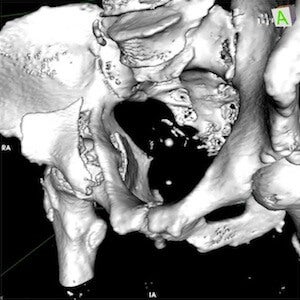
Verification showed that he had indeed made an identical copy of the real bone. And not only did the model prove a valuable anatomical guide, the hard plastic used to cast the model, Frame found, was great for practicing procedures with the actual drills, saws, and screws they used in operations.
“All in all Shapeways has opened up rapid prototyping to everyone no matter what the budget,” he writes in the blog.
They’ve since gone on to make a model of an entire pelvis, which cost them £150. With the old method the models themselves would sometimes cost just as much as the procedure, and so they wouldn’t make them. With Frame’s method cost becomes a non-issue.
What do veteran orthopedic surgeons at Monklands Hospital think of the trainee’s scheme? Not only at Monklands but surgeons at hospitals in the West of Scotland have asked for his help in ordering models. The more models, the less change of a complication during surgery. Frame has actually written up the procedure and has submitted it to the World Journal of Science Technology so that surgeons worldwide can benefit and save lots of cash. In these times of budget cuts and struggling hospitals, it’s sure to get real popular real fast. And if you don’t feel like bothering with the paper, Frame and colleagues have started a company that makes the models for you. Just send 3D-OM your CT scan and they’ll send you back your model. Heck, it’s so cheap now, if you’ve got a CT scan you might just want to get the model for fun.
So yet another part of our world – and our bodies – is forged from a 3D printer. Toys, robots, sculptures, even human kidneys. I wonder what imaginative people like Mark Frame will think of next. And maybe there’s a lesson to be learned here. Maybe, instead of simply following the status quo we should ask ourselves if there are better ways to get something done. Frame didn’t invent anything, he just had the creativity to bring together existing technologies in a new way. What new uses and technologies are sitting under our noses right now, waiting for us to merge disparate instruments into a new, unitary whole. One thing’s for sure, we have a lot to work with.
[image credits: Shapeways]
images: Shapeways