Chinese ‘Starchild’ Alleged To Have X-Men-Like Cat Vision

Share

Although the notion is revolting to many, at some point in the future we'll have the know-how and the tools to genetically modify our bodies to make us stronger, better looking, more intelligent. In Dahua, in south China, the strange properties of one boy's eyes has made him an Internet sensation. Headlines abound label him a one-of-a-kind, real life X-Man, miraculously given the gift of cat-like vision through genetic mutation.
In all likelihood, however, his miracle probably only extends as far as being able to see at night a little bit better than average, and even this has not been properly documented. In all likelihood, this is more a case of wishful thinking, overactive imagination, and the desire for attention.
Nong Yousui’s blue eyes are an anomalous, but not entirely unseen, occurrence among Chinese children. They are rare enough, however, to trigger worry among Yousui’s parents. Doctors promptly allayed their worries, saying that the boy’s vision was fine.
Years later, Yousui finds himself the center of an online frenzy. His blue eyes, it turns out, give him night vision powers right out of the pages of X-Men. A YouTube video that was shot back in 2009 just surfaced this year about the boy and his special abilities, going viral and earning him the nickname “Starchild.” To date the video’s gotten over three and a half million views.
According to the video Youshi’s “eyes were like cats’ eyes.” Shine a flashlight on them at night and they would flash back, producing their own blue-green, neon-like light. One of Youshi’s teachers recounts how the boy had a amazing sight at night, good enough catch crickets without a flashlight. After word spread about his visual acuity, a curious journalist stopped by to perform a slightly more quantitative test. She placed him in a room and shut out most of the light, enough that the journalist couldn’t see the people around her. Youshi was then shown cards and asked to identify them – he could. She wrote down questions to see if he could still answer them – he answered all of them correctly. His eyes not only looked like those of a cat, they performed like them too.
Watch the video and see if you're similarly convinced.
So how catlike are Yousui’s eyes really?
The part of a cat’s eye, and the eyes of other animals like dogs, horses and deer, that gives them that eerie night glow is a layer of cells called the tapetum lucidum. The cells of the tapetum lucidum are reflective and rest just beneath the retina. Us humans, who lack a tapetum lucium, have just our retinas to catch incoming light and enable us to see. Incoming light that misses the cat’s photoreceptor cells reflects off the tapetum lucidum back onto the retina, so any photon stands a much better chance at being detected upon entering a cat’s eye compared to a human’s. Thus cats see better at night than we do.
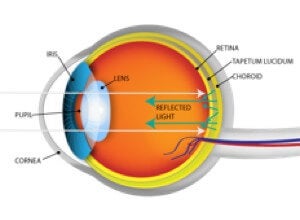
A reflective layer of cells beneath the retina called the tapetum lucidum causes many nocturnal species' eyes to shine when light is shined upon them and helps them to see in low light.
Be Part of the Future
Sign up to receive top stories about groundbreaking technologies and visionary thinkers from SingularityHub.

That is, better than most, but not all of us, if we believe the Chinese report. Predictably, not everyone does.
James Reynolds, a pediatric ophthalmologist at State University of New York in Buffalo, weighed in at Life's Little Mysteries, pointing out that no single mutation would produce a whole sheet of new and specialized cells. Such a new addition could only occur over time – evolutionary time – not spontaneously in one child. “Evolutionarily, mutations can result in differences that allow for new environmental niche exploitation. But such mutations are modified over long periods. A functional tapetum in a human would be just as absurd as a human born with wings. It can’t happen.”
If it could, we might reasonably expect to find one of William Paley's watches randomly assembled in the middle of the woods.
A second ophthalmologist, University of Florida’s Dennis Brooks, was a little more reserved in his skepticism, arguing that we won’t really know one way or the other until Yousui is examined by an expert. Given the boy’s publicity, it’s hard to imagine, were he the first human to grow a tapetum lucidum, Chinese ophthalmologists wouldn’t have jumped at the chance to verify it to the world.
So what can we say about Yousui beyond he’s a young boy with abnormally good eyesight? Wait a second. Based on anecdotal evidence from a room that a reporter finds dark, I’m not so sure we’ve even established anything abnormal at all.
Except maybe the hype, that is.
Image credits: stephenhannardadguk via youtube and cameratechnica

Related Articles

Epigenetic Editing Could Wipe Out Chronic Hepatitis B Infections
Google DeepMind Gives AI-Designed Proteins a Watermark

This Week’s Awesome Tech Stories From Around the Web (Through October 3)
Epigenetic Editing Could Wipe Out Chronic Hepatitis B Infections
Google DeepMind Gives AI-Designed Proteins a Watermark
This Week’s Awesome Tech Stories From Around the Web (Through October 3)
What we’re reading