Blazing Fast Staubli Robot Picks 200 Items Per Minute

Share
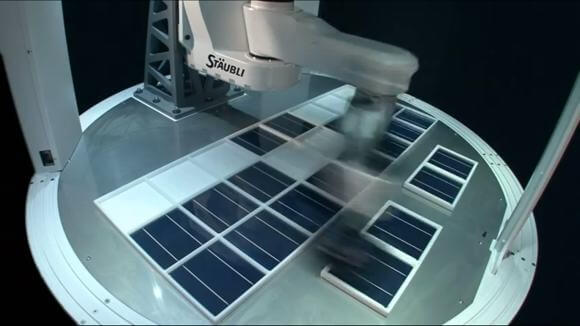
[Source: StaubliGroup via YouTube]
Even John Henry, had he been a factory picker instead of a steel driver, couldn’t keep up with this robot. The Switzerland-based TP80 Fast Picker robot by Stäubli Robotics can sort your prescription bottles, Tic-Tac boxes – anything under 1 kilogram – at a blazing speed of 200 picks per minute. Line sorters and quality inspectors beware.
The TP80 has a work area of 1.6 meters. And working this fast, precision is key unless you want a stockpile of shattered merchandise. That's why its movements don't veer more than 0.05 mm off course. The 200 picks per minute rate is reached when its handling very light loads limited to 0.1 kilograms. It slows down to a still superhuman 170 picks per minute when handling its max of 1 kilogram.
It’s built for packaging applications in the various industries such as food, pharmaceutical, cosmetics or photovoltaics. Perfect if you need to pack lunches for a small army or switch out some cells on your stock of solar panels.
While TP80 represents yet another robot soon to run humans off manufacturing and packaging sorting lines, it still has some catching up to do if it's wants to be the world's fastest. ABB's Flexpicker can handle a blurring 450 items per minute and has the strength to move items weighing up to 3 kilograms. And Adept's four armed Quattro can move 300 items per minute. One advantage of having a TP80, however, is that it can be mounted on a much lighter base than parallel robots, making it easier and less costly to install.
Here’s a few high speed handling videos. Watching the TP80 handle the photovoltaic cells, I can’t help but think it would probably be an impressive blackjack dealer too.
Be Part of the Future
Sign up to receive top stories about groundbreaking technologies and visionary thinkers from SingularityHub.

[Videos: StaubliGroup via YouTube]

Peter Murray was born in Boston in 1973. He earned a PhD in neuroscience at the University of Maryland, Baltimore studying gene expression in the neocortex. Following his dissertation work he spent three years as a post-doctoral fellow at the same university studying brain mechanisms of pain and motor control. He completed a collection of short stories in 2010 and has been writing for Singularity Hub since March 2011.
Related Articles

Chatbots ‘Optimized to Please’ Make Us Less Likely to Admit When We’re Wrong

Google DeepMind Plans to Track AGI Progress With These 10 Traits of General Intelligence

Tech Companies Are Blaming Massive Layoffs on AI. What’s Really Going On?
Chatbots ‘Optimized to Please’ Make Us Less Likely to Admit When We’re Wrong
Google DeepMind Plans to Track AGI Progress With These 10 Traits of General Intelligence
Tech Companies Are Blaming Massive Layoffs on AI. What’s Really Going On?
What we’re reading