The Kaiser Permanente BioBank – 100k Volunteers and Growing
Share

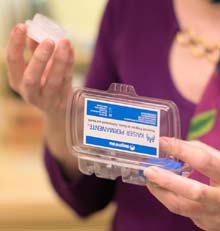
It stands to reason that if you want to perform genetic research, you are going to need some genetic samples. While you could always go out and collect your own, Kaiser Permanente is doing much of the work for you. Since the end of 2008, the healthcare provider has been gathering a collection of DNA samples and medical histories from thousands of its customers as part of their Research Program on Genes, Environment, and Health (RPGEH). The goal is to create a database that will enable researchers to discover links between our genes and the diseases we develop. As of the end of summer, KP has collected more than 100,000 saliva samples and their corresponding health records from volunteers. By 2013, they hope to reach half a million. That's a lot of spit.
BioBanks are large collections of genetic and medical information. They are formed by convincing huge numbers of volunteers to submit DNA samples and answer detailed surverys about their health and where they live. All that effort comes with a big payoff: the data in a BioBank can be used to find statistical correlations between genes and increased risks of diseases, and to determine how those risks are affected by the factors in someone's environment. With a large enough BioBank, and the time to analyze it, scientists could discover the effects of our genetic code, and lead the way to new treatments for all manner of illnesses. They could also predict negative reactions to medications or even find new environmental links to disease.
The first 100,000 samples for the KP biobank is focused on Northern California residents with an average age of 65. As such, it is uniquely poised to study how diseases deteriote our bodies as we age, as well as study the aging process itself. Kaiser is pairing up with UC San Francisco to determine the length of telomeres in the samples. Telomeres are the redundant blocks of genetic information seated at the ends of chromosomes. Elizabeth Blackburn, who won the 2009 Nobel Prize in Medicine for her work on telomeres, is associated with the project. Data from the KP biobank may then be a boone to longevity researchers like those associated with the Methuselah Foundation. Further volunteers will include those 18 years and older.
While the biobank is a privately collected resource it should be available to many smaller research teams even at unaffiliated universities. Initial funding for the project was a $8+ million grant from the Robert Wood Johnson Foundation’s Pioneer Portfolio, subsequently boosted by a US National Institute of Health (NIH) grant of about $25 million. The DNA processing is handled by Affymetrix, based in Santa Clara, who will analyze the samples for single nucleotide polymorphisms. SNPs are the single genetic variations that scientists link to many important traits. (Many readers will recognize the importance of SNPs from our discussions of 23andMe and the DNA Electronics handheld gene analyzer - SNP Dr.) Affymetrix will look at about 700,000 SNPs for each sample. Understandably, KP expects it will take another 2 years before the biobank is ready for most research applications.
If you are interested in contributing to the KP biobank, you can begin the survey on the RPGEH website. Samples will only be taken from Northern California Kaiser Permanente customers aged 18 or older. All collected data is "de-identified" in several stages so that volunteers can be assured of their anonymity and that no information discovered will affect their coverage. Prospective volunteers are encouraged to read the Winter 2009 newsletter to learn more.
Be Part of the Future
Sign up to receive top stories about groundbreaking technologies and visionary thinkers from SingularityHub.

Of course, Kaiser isn't the first to build a substantial biobank. The UK already has 500,000 samples collected, though not tested, another sign of that country's dedication to getting to the top of the biotechnology field. Mayo Clinic has a much smaller biobank (near 20,000) that is specifically tailored to their research interests. 23andMe, the personal genomics company, has been pursuing a "research revolution", gathering DNA samples and allowing volunteers and donors to select which diseases the data will be applied to first.
While the specter of privacy invasion looms near any large collection of personal information, I am very much in favor of these biobanks. Small research teams simply do not have the resources to collect data sets of these sizes but could greatly benefit from the larger statistical samples. The greater the number of teams active in genetics, the greater the benefit we will all receive from their discoveries. Whether at Kaiser Permanente, or some other biobank, the anonymous but detailed donations of genetic material should help everyone live healthier and happier lives.
[photo credit: Kaiser Permanente, RPGEH]
[video credit: ABC The View From The Bay]

Related Articles
Companies Could Soon Staff ‘Stubbornly Local’ Jobs With Workers 4,000 Miles Away

AI Collapses on a Classic Psychology Test. What It Reveals Could Stall Human-Level AI.

Can Psychedelics Reboot Aging Brains? We’re About to Find Out
Companies Could Soon Staff ‘Stubbornly Local’ Jobs With Workers 4,000 Miles Away
AI Collapses on a Classic Psychology Test. What It Reveals Could Stall Human-Level AI.
Can Psychedelics Reboot Aging Brains? We’re About to Find Out
What we’re reading