Lumino Adds Third Dimension to Microsoft Surface (Video)
Share
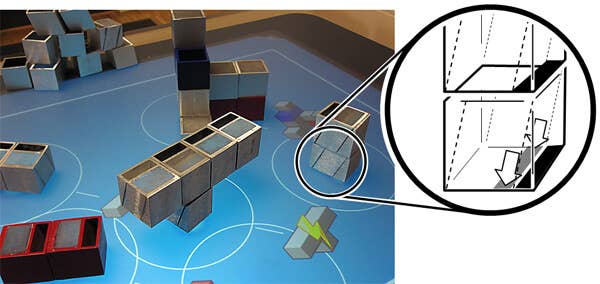
It never fails: give scientists a new bit of technology and they'll find a way to use it to play with blocks. Maybe it's all the Legos we enjoyed as children. In any case, researchers at the University of Potsdam's Hasso Plattner Institute have developed Lumino, a system of blocks that interact with Microsoft Surface. The table sized touchscreen has had many interesting features, but never true 3D manipulation. Lumino changes all that by letting Microsoft Surface see through the shapes it uses. Each block is identified by markings and these markers are transferred through lower level blocks to the touchscreen via embedded fiber optics. This lets a user stack up to 10 layers of Lumino blocks to create a 3D shape that can interact with Microsoft Surface's software. Developers suggest it may have powerful applications in architecture and design. Check out the video from New Scientist after the break.
We've seen many different next generation human-computer interface (HCI) devices. Most focus on including a tactile/kinetic interaction to give humans a more intuitive means of manipulating digital information. Lumino does that and provides a truly dynamic 3D environment, something that with which other systems have struggled. The blocks used in Lumino do not contain any electronic or mechanically moving pieces, they are essentially just hard shapes filled with fiber optics. This simplicity sets Lumino apart from photoelastic techniques which rely on an added overhead camera. Still, watching the demonstration doesn't leave me with the impression that I really need a Lumino system, or even Microsoft Surface. It will likely take several rounds of invention, redesigning, and marketing before these next gen HCI systems are sophisticated enough to provide an experience that is obviously superior in day to day applications to what we use now. When that happens, sign me up for some high tech building blocks. I'll want to play, too.
Be Part of the Future
Sign up to receive top stories about groundbreaking technologies and visionary thinkers from SingularityHub.

https://c.brightcove.com/services/viewer/federated_f9/2227271001
[photo credit: University of Potsdam]
[video credit: New Scientist]

Related Articles
These Mini Brains Just Learned to Solve a Classic Engineering Problem
Brain Implants Let Paralyzed People Type Nearly as Fast as Smartphone Users

Hackers Are Automating Cyberattacks With AI. Defenders Are Using It to Fight Back.
These Mini Brains Just Learned to Solve a Classic Engineering Problem
Brain Implants Let Paralyzed People Type Nearly as Fast as Smartphone Users
Hackers Are Automating Cyberattacks With AI. Defenders Are Using It to Fight Back.
What we’re reading