Materials repair themselves automatically and repeatedly, similar to the way cuts heal

Share

Small cracks that develop within the fiberglass bodies of modern cars and planes can quickly turn into irreversible damage, which undermines their structural integrity. Unfortunately, the materials used to construct these vehicles, called fiber-reinforced composites, are challenging to repair using conventional methods.
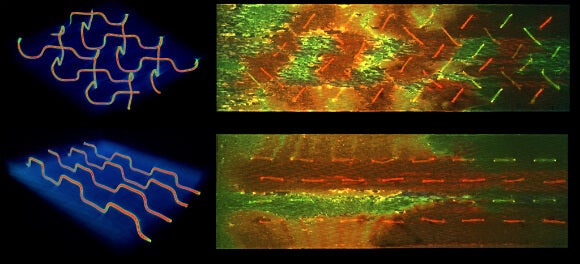
A new system developed by researchers at the Beckman Institute at the University of Illinois at Urbana-Champaign embeds a 3D vascularized network within the composite, akin to the way blood vessels embed tissue in the human body. This network enables these composites to repair themselves automatically when the material is damaged.
"When a fracture occurs, this ruptures the separate networks of healing agents, automatically releasing them into the crack plane -- akin to a bleeding cut," said Jason Patrick, a Ph.D. candidate in civil engineering and lead author on the paper. "As they come into contact with one another in situ, or within the material, they polymerize to essentially form a structural glue in the damage zone."
Be Part of the Future
Sign up to receive top stories about groundbreaking technologies and visionary thinkers from SingularityHub.

After testing over multiple cycles, the researchers report that cracks healed successfully with nearly 100 percent efficiency. "The beauty of this self-healing approach is, we don't have to probe the structure and say, this is where the damage occurred and then repair it ourselves," said Patrick.
Nancy Sottos, materials science and engineering professor and co-corresponding author, added, "Creating the vasculature integrates seamlessly with typical manufacturing processes of polymer composites, making it a strong candidate for commercial use."
Read more at the Beckman Institute: Repeated self-healing now possible in composite materials
[images: Beckman Institute, flickr/Morgan]

I enjoy all types of futurology. I especially enjoy staying up to date with the latest advancements in machine learning and artificial intelligence. You can usually find me roaming the depths of the internet.
Related Articles
MIT Mined Bacteria for the Next CRISPR—and Found Hundreds of Potential New Tools
US Issues Grand Challenge: The First Fault-Tolerant Quantum Computer by 2028

This Week’s Awesome Tech Stories From Around the Web (Through April 4)
MIT Mined Bacteria for the Next CRISPR—and Found Hundreds of Potential New Tools
US Issues Grand Challenge: The First Fault-Tolerant Quantum Computer by 2028
This Week’s Awesome Tech Stories From Around the Web (Through April 4)
What we’re reading