Know What Chemical Elements Are Inside Your Smartphone? A Good Chunk of the Periodic Table
Share
Ever wonder what that mini monolithic-shaped computer you carry around in your pocket is made of?
Gallium? Check. Arsenic? Check. Lead and tin? Check and check. Good thing all that is safely housed inside and you're not gonna eat it for lunch.
Hot on the tail of Apple's iPhone 6 announcement, the American Chemical Society has produced a video titled "What's in your iPhone?" that delves into some of the chemical elements used to make smartphones. Check it out:
This video is part of a series called Reactions that explores the chemicals of everyday life. In this episode, the video pulls information from a Compound Interest blog post on smartphone composition written a few months back.
Be Part of the Future
Sign up to receive top stories about groundbreaking technologies and visionary thinkers from SingularityHub.

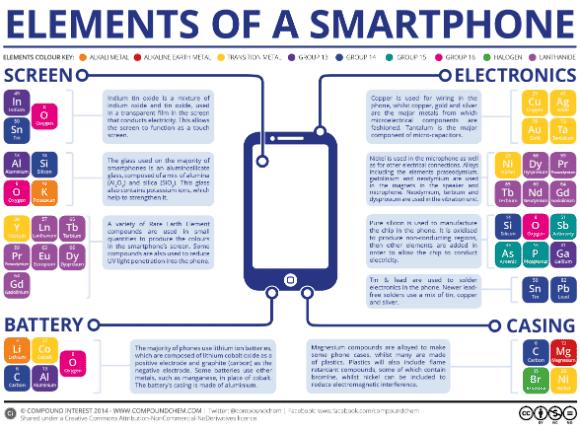
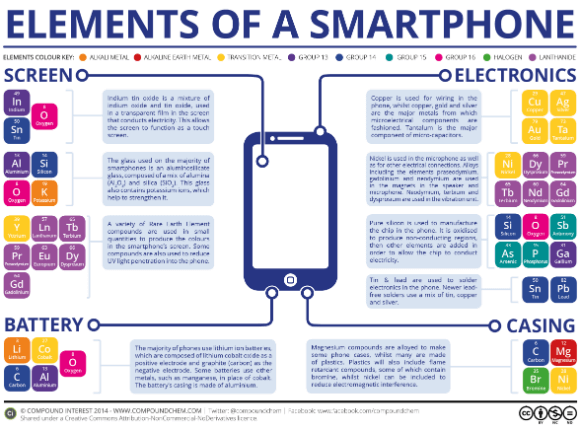
Andy Brunning, who runs the blog, does a great job describing the complex process behind modern phone manufacturing, including this nice infographic revealing exactly where all the chemical elements reside:
It's hard to believe how many precious metals go into the electronics we use everyday. In fact, for every million cellphones processed,over 17 tons of copper along and 1/3 of a ton of silver can be recovered from e-waste, among other precious metals like gold and palladium.
In light of this insatiable consumption, every few months someone comes along to predict when major resources like rare metals will run out due to our thirst for glowy gadgets. Scarce or not, rare elements are big business and have inspired the launch of a few companies interested in mining asteroids for these metals.
With Apple's report that 4 million iPhone 6 preorders were placed within the first 24 hours, you can bet that the chemistry of smartphones will only become more complex as advanced materials and technology increasingly find their ways into our hands...literally.

David started writing for Singularity Hub in 2011 and served as editor-in-chief of the site from 2014 to 2017 and SU vice president of faculty, content, and curriculum from 2017 to 2019. His interests cover digital education, publishing, and media, but he'll always be a chemist at heart.
Related Articles

AI Companies Are Betting Billions on AI Scaling Laws. Will Their Wager Pay Off?

Super Precise 3D Printer Uses a Mosquito’s Needle-Like Mouth as a Nozzle
Is the AI Bubble About to Burst? What to Watch for as the Markets Wobble
AI Companies Are Betting Billions on AI Scaling Laws. Will Their Wager Pay Off?
Super Precise 3D Printer Uses a Mosquito’s Needle-Like Mouth as a Nozzle
Is the AI Bubble About to Burst? What to Watch for as the Markets Wobble
What we’re reading