World’s Smallest Snowman Just 10 Microns Wide (Video)
Share

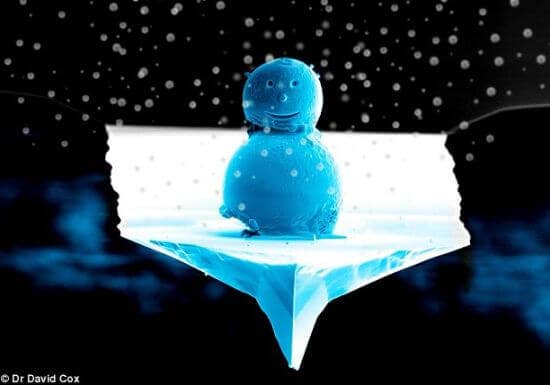
Everyone has a different way of enjoying the winter holidays. Some light candles, some sing songs, and others construct microscopic snowmen. David Cox from the National Physical Laboratories in the UK built a 'snowman' which was just 10 microns (0.01mm) in diameter out of two tin beads bonded together with platinum. The face of the snowman was carved using an ion beam, and the nose (just 1 micron across) was made of platinum deposited using a similar ion beam. Cox even simulated a snowy landscape using blue light. NPL incorporated the microscopic snowman as part of their season's greetings video. You can see it in full after the break.
The tiny snowman was more than just a reminder of winter fun, it was a demonstration of the precision and capabilities of NPL. Tin beads like those seen in the snowman are used to help fine tune atomic force microscopes (AFMs). In fact, the base that the beads are resting on in the image is the silicon cantilever from an AFM. These ultraprecise microscopy tools are what allowed IBM to image a molecule for the first time, and NPL has equally lofty goals for its own research. What I find most fascinating about the little snowman, however, is that someone had time to make it. We've reached a point where microscopy and microscopic manipulation are advanced enough that making a 10 micron figuring out of tin isn't a huge expenditure of resources. There's still quite a ways (about a factor of 100) before I'd characterize this as true nanotechnology, but fun stunts like this show that a future of nano-manipulation isn't that far away.
Be Part of the Future
Sign up to receive top stories about groundbreaking technologies and visionary thinkers from SingularityHub.

[photo credits: David Cox, NPL]
[video credit: NPL]

Related Articles
MIT Mined Bacteria for the Next CRISPR—and Found Hundreds of Potential New Tools
US Issues Grand Challenge: The First Fault-Tolerant Quantum Computer by 2028

This Week’s Awesome Tech Stories From Around the Web (Through April 4)
MIT Mined Bacteria for the Next CRISPR—and Found Hundreds of Potential New Tools
US Issues Grand Challenge: The First Fault-Tolerant Quantum Computer by 2028
This Week’s Awesome Tech Stories From Around the Web (Through April 4)
What we’re reading