Singularity Surplus: Cyborg Edition
Multi-jointed mind-controlled prosthetic arm; prosthetic gets to girl who needs it; steer a wheelchair with your eyes.

Share
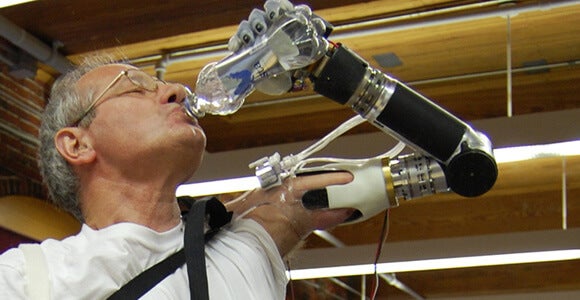
Late last week, the FDA approved a prosthetic limb controlled by the patient’s own intent to move that for the first time allows simultaneous movement of multiple joints (in this case hand and wrist). The approved version of DEKA Arm System, which was tested on 36 veterans, detects the wearer’s intended movements using EMG electrodes. Others have explored connecting DEKA and other advanced prosthetics directly into the patient’s nervous system.
Be Part of the Future
Sign up to receive top stories about groundbreaking technologies and visionary thinkers from SingularityHub.

Hanger Clinic’s somewhat simpler bebionic hand is already on the market, but, like most such devices, it’s prohibitively expensive. Torri Biddle, a 19-year-old Ohio woman who was born missing the lower part of her right arm, had always dreamed of getting a bionic hand. With the help of her friends, a non-profit called Invisible Children, the reality show “The Buried Life” and Hanger Prosthetics, Biddle got a custom-fitted hand earlier this month.
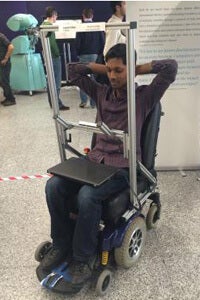
What if instead of physically connecting a machine to the nervous system, we could let users control them with eye movements? The method has plenty of science to back it up but has been hard to make user-friendly. Equipment sensitive enough to track eyes precisely is expensive, and can confuse normal behaviors with intentional signals. Aldo Faisal at the Imperial College of London has devised a system that uses two off-the-shelf cameras, instead of one specialized device, and winks, instead of blinks. At a recent conference, the system was put to use to steer a wheelchair.

Cameron received degrees in Comparative Literature from Princeton and Cornell universities. He has worked at Mother Jones, SFGate and IDG News Service and been published in California Lawyer and SF Weekly. He lives, predictably, in SF.
Related Articles

The US Plans to Break Ground on a Permanent Moon Base by 2030. Here’s What It Will Take.

In a First, Researchers Use Stem Cells and Surgery to Treat Spina Bifida in the Womb

Hackers Are Automating Cyberattacks With AI. Defenders Are Using It to Fight Back.
The US Plans to Break Ground on a Permanent Moon Base by 2030. Here’s What It Will Take.
In a First, Researchers Use Stem Cells and Surgery to Treat Spina Bifida in the Womb
Hackers Are Automating Cyberattacks With AI. Defenders Are Using It to Fight Back.
What we’re reading