Floating Babies and Zero-Gravity Birth: What Space Pregnancy Might Actually Involve
Could a pregnancy be conceived and carried safely in space? And what would happen to a baby born far from Earth?
Image Credit
Glitch Lab App on Unsplash
Share
As plans for missions to Mars accelerate, so do questions about how the human body might cope. A return trip to the red planet would give more than enough time for someone to become pregnant and even give birth. But could a pregnancy be conceived and carried safely in space? And what would happen to a baby born far from Earth?
Most of us rarely consider the risks we survived before birth. For instance, about two thirds of human embryos do not live long enough to be born, with most losses happening in the first few weeks after fertilization; often before a person even knows they’re pregnant. These early, unnoticed losses usually happen when an embryo either fails to develop properly or to implant successfully in the wall of the womb.
Pregnancy can be understood as a chain of biological milestones. Each one must happen in the right order and each has a certain chance of success. On Earth, these odds can be estimated using clinical research and biological models. My latest research explores how these same stages might be affected by the extreme conditions of interplanetary space.
Microgravity, the near-weightlessness experienced during spaceflight, would make conception more physically awkward but probably wouldn’t interfere much with staying pregnant once the embryo has implanted.
However, giving birth, and looking after a newborn, would be far more difficult in zero gravity. After all, in space, nothing stays still. Fluids float. So do people. That makes delivering a baby and caring for one a much messier and more complicated process than on Earth, where gravity helps with everything from positioning to feeding.
At the same time, the developing fetus already grows in something like microgravity. It floats in neutrally buoyant amniotic fluid inside the womb, cushioned and suspended. In fact, astronauts train for spacewalks in water tanks designed to mimic weightlessness. In that sense, the womb is already a microgravity simulator.
But gravity is only part of the picture.
Radiation
Outside Earth’s protective layers, there’s a more dangerous threat: cosmic rays. These are high-energy particles—“stripped-down” or “bare” atomic nuclei—that race through space at nearly the speed of light. They’re atoms that have lost all their electrons, leaving just the dense core of protons and neutrons. When these bare nuclei collide with the human body, they can cause serious cellular damage.
Here on Earth, we’re protected from most cosmic radiation by the planet’s thick atmosphere and, depending on the time of day, tens of thousands to millions of miles of coverage from the Earth’s magnetic field. In space, that shielding disappears.
When a cosmic ray passes through the human body, it may strike an atom, strip its electrons, and smash into its nucleus, knocking out protons and neutrons and leaving behind a different element or isotope. This can cause extremely localized damage—meaning that individual cells, or parts of cells, are destroyed while the rest of the body might remain unaffected. Sometimes the ray passes right through without hitting anything. But if it hits DNA, it can cause mutations that increase the risk of cancer.
Even when cells survive, radiation can trigger inflammatory responses. That means the immune system overreacts, releasing chemicals that can damage healthy tissue and disrupt organ function.
In the first few weeks of pregnancy, embryonic cells are rapidly dividing, moving, and forming early tissues and structures. For development to continue, the embryo must stay viable throughout this delicate process. The first month after fertilization is the most vulnerable time.
Be Part of the Future
Sign up to receive top stories about groundbreaking technologies and visionary thinkers from SingularityHub.

A single hit from a high-energy cosmic ray at this stage could be lethal to the embryo. However, the embryo is very small—and cosmic rays, while dangerous, are relatively rare. So a direct hit is unlikely. If it did happen, it would probably result in an unnoticed miscarriage.
Pregnancy Risks
As pregnancy progresses, the risks shift. Once the placental circulation—the blood flow system that connects mother and fetus—is fully formed by the end of the first trimester, the fetus and uterus grow rapidly.
That growth presents a larger target. A cosmic ray is now more likely to hit the uterine muscle, which could trigger contractions and potentially cause premature labour. And although neonatal intensive care has improved dramatically, the earlier a baby is born, the higher the risk of complications, particularly in space.
On Earth, pregnancy and childbirth already carry risks. In space, those risks are magnified—but not necessarily prohibitive.
But development doesn’t stop at birth. A baby born in space would continue growing in microgravity, which could interfere with postural reflexes and coordination. These are the instincts that help a baby learn to lift its head, sit up, crawl, and eventually walk: All movements that rely on gravity. Without that sense of “up” and “down,” these abilities might develop in very different ways.
And the radiation risk doesn’t go away. A baby’s brain continues to grow after birth, and prolonged exposure to cosmic rays could cause permanent damage—potentially affecting cognition, memory, behavior, and long-term health.
So, could a baby be born in space?
In theory, yes. But until we can protect embryos from radiation, prevent premature birth, and ensure babies can grow safely in microgravity, space pregnancy remains a high-risk experiment—one we’re not yet ready to try.
This article is republished from The Conversation under a Creative Commons license. Read the original article.
Arun Vivian Holden is emeritus professor of computational biology at the University of Leeds. The computational biology laboratory constructs detailed computer models of muscular organs—the beating heart, and the pregnant uterus—that are based on data from membrane, cell and tissue experiments, and from clinical data. These models are validated by their prediction of normal organ behavior, and abnormal behaviors seen in disease. They are applied to dissect, in space and time, physiological and pathological mechanism, to prescreen drugs, and to contribute to the drug design and discovery process, and the design of physical interventions.
Related Articles
NASA Unveils Its $20 Billion Moon Base Plan—and a Nuclear Spacecraft for Mars
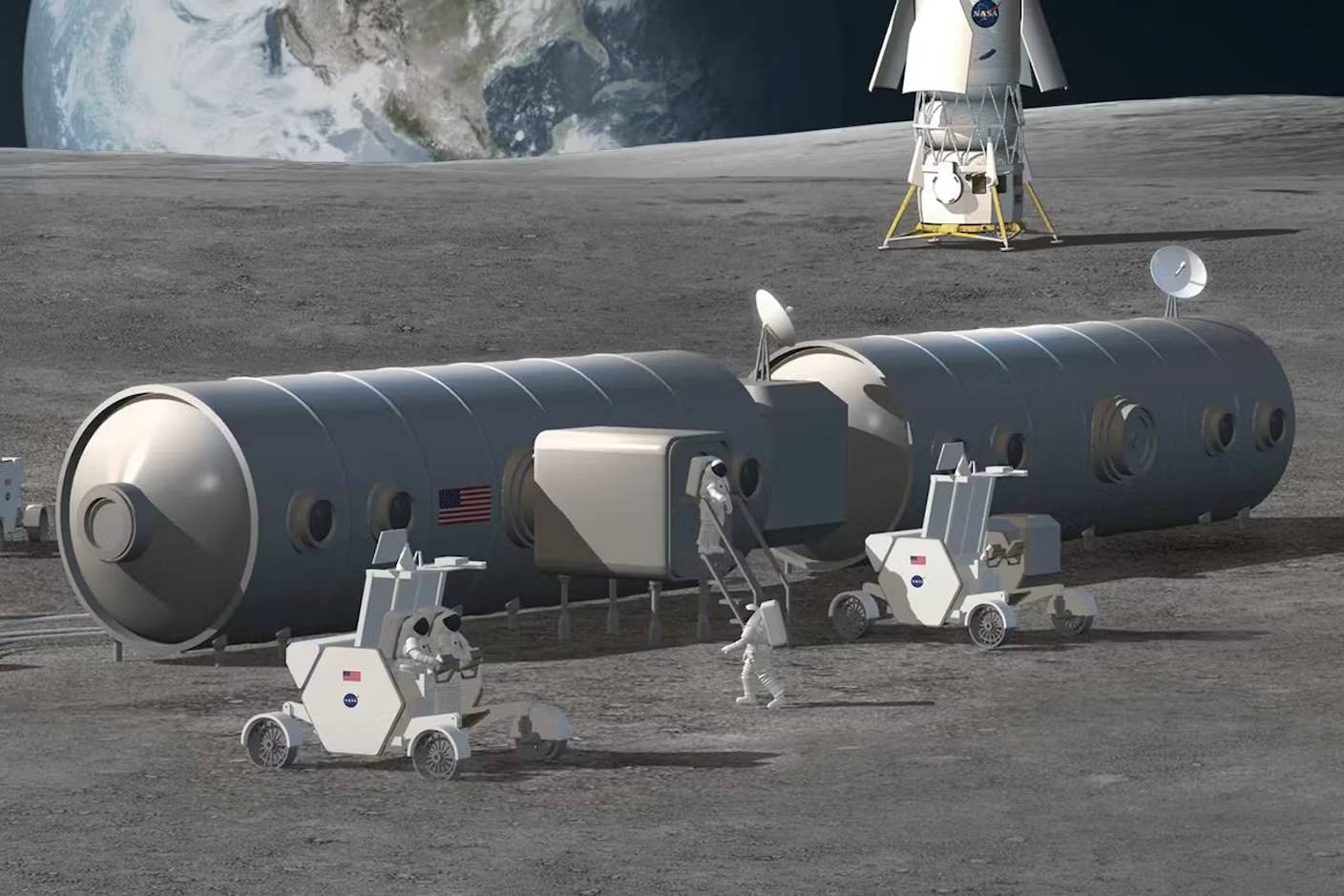
The US Plans to Break Ground on a Permanent Moon Base by 2030. Here’s What It Will Take.
More Space Junk Is Plummeting to Earth. Earthquake Sensors Can Track It by the Sonic Booms.
NASA Unveils Its $20 Billion Moon Base Plan—and a Nuclear Spacecraft for Mars
The US Plans to Break Ground on a Permanent Moon Base by 2030. Here’s What It Will Take.
More Space Junk Is Plummeting to Earth. Earthquake Sensors Can Track It by the Sonic Booms.
What we’re reading