This AI Model Predicts Whether Fusion Power Experiments Will Work
Accurate predictions could accelerate the design of new experiments and bring practical fusion power closer.
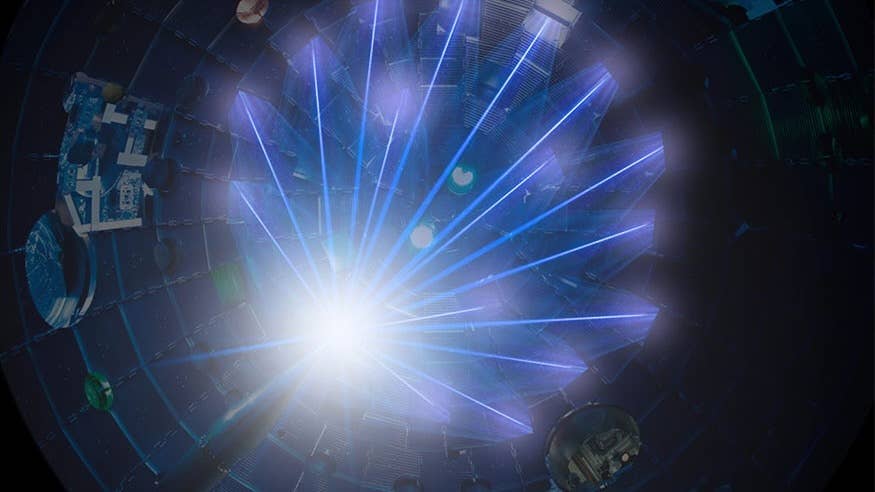
Image Credit
Lawrence Livermore National Laboratory
Share
While AI chatbots grab most of the attention, deep learning is also quietly revolutionizing science and engineering. A new AI model that can help predict the outcome of fusion power experiments could accelerate the technology’s arrival.
Achieving nuclear fusion involves some of the most extreme conditions known to nature, which makes designing and operating fusion reactors incredibly challenging. Simulations of key processes typically require huge amounts of time on supercomputers and are still far from perfect.
But AI is starting to accelerate progress in this area. Google DeepMind made headlines in 2022 when it trained a deep-learning model to control the roiling plasma inside a fusion reactor. And now, the scientists behind the first fusion experiment to show a net gain of energy have revealed that, thanks to AI, they were already pretty confident of success before they flicked the switch.
In a new paper in Science, researchers at Lawrence Livermore National Laboratory outline a generative machine learning model that they used to predict a 74 percent chance the experiment at the US National Ignition Facility would lead to net energy gain. The team say having an accurate prediction model could accelerate the design of new experiments and help them make decisions about how to upgrade hardware.
“This outcome demonstrates a promising approach to predictive modeling of ICF experiments and provides a framework for developing data-driven models for other complex systems,” write the authors.
The National Ignition Facility is taking a slightly unusual approach to achieving fusion. The most popular reactor design is a tokamak. This is a doughnut-shaped chamber wrapped in ultra-powerful magnets that contain a super-heated plasma in which atoms fuse together to generate energy.
In contrast, the National Ignition Facility is using an approach known as “inertial confinement fusion.” This involves firing extremely powerful lasers at a millimeter-sized capsule containing the hydrogen isotopes deuterium and tritium. The capsule implodes under pressure and causes the hydrogen atoms to fuse, generating power.
On December 5, 2022, researchers at the facility fired a 2.05-megajoule laser at a fuel pellet that then generated 3.15 megajoules of energy: It was the first time a fusion experiment produced more energy than it took to initiate it.
These experiments are incredibly expensive, so it would be useful to have good predictions about how they’re likely to go—and for this experiment they did. The team used a novel predictive model that relied on advanced statistical techniques and deep learning to learn from both simulation and experimental data.
Be Part of the Future
Sign up to receive top stories about groundbreaking technologies and visionary thinkers from SingularityHub.

Older approaches involve creating physics-based simulations and then tweaking them to match data from prior experiments. Researchers can make predictions about very small design changes using this method, but the authors say it struggles to accurately simulate more substantial modifications.
Their new approach uses Bayesian inference—a form of statistical analysis that provides probabilistic predictions—to analyze data from previous ignition experiments at the facility. This produces a generative AI model that can make predictions about future experiments.
Because there have only been a limited number of these tests, the researchers wanted to supplement existing test data with data from simulations. However, directly analyzing the simulations using Bayesian inference would be extremely computationally expensive.
Instead, they trained a deep neural network on a database of 150,000 simulations, which could then be efficiently analyzed using Bayesian inference. This resulted in a generative model informed by both experimental and simulation datasets that can accurately model how specific design changes will impact the outcome of future experiments.
The prediction of a 74 percent probability of success may still sound a bit fuzzy. But to put things in context, the authors note the model only predicted a 0.5 percent chance of success for the preceding experimental design.
This model is obviously highly specific to the unique design of the National Ignition Facility’s experimental set up, but the researchers say the broad approach could be adaptable to other complex problems where data is sparse. And it is already being used to optimize design decisions as the researchers continue to chase ever higher energy outputs from their fusion experiments.

Related Articles
US Solar Surged 35% in 2025, Overtaking Hydro for the First Time
Meta Will Buy Startup’s Nuclear Fuel in Unusual Deal to Power AI Data Centers
Your ChatGPT Habit Could Depend on Nuclear Power
US Solar Surged 35% in 2025, Overtaking Hydro for the First Time
Meta Will Buy Startup’s Nuclear Fuel in Unusual Deal to Power AI Data Centers
Your ChatGPT Habit Could Depend on Nuclear Power
What we’re reading