A Humanoid Robot Is Now on Sale for Under $6,000—What Can You Do With It?
The price tag is orders of magnitude cheaper than most robots in its class, which can run into tens or even hundreds of thousands of dollars.
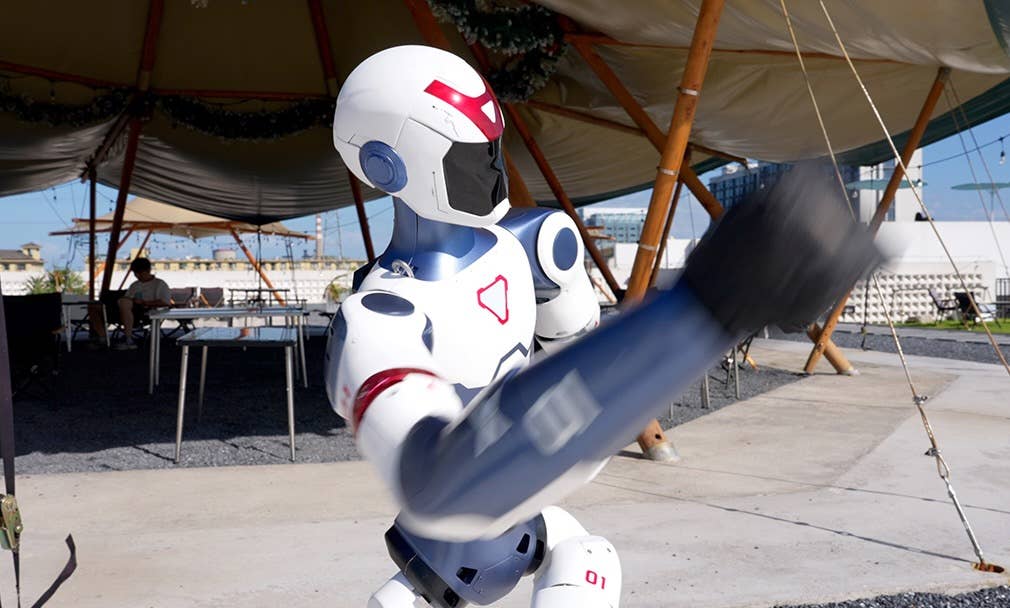
Image Credit
Unitree
Share
You might have noticed that humanoid robots are having a bit of a moment. From Tesla’s Optimus to Figure AI’s Figure 02, these machines are no longer just science fiction—they’re walking, and in some cases, cartwheeling into the real world.
Now China’s Unitree Robotics, best known for its nimble quadruped robots, has unveiled something that’s turning heads: the Unitree R1.
For one thing, it’s a humanoid robot priced at under $6,000. That’s not pocket change, but it’s orders of magnitude cheaper than most robots in its class, which can run into tens or even hundreds of thousands of dollars.
The R1 packs serious mobility, sensors, and AI potential into a package that could fit in a university lab, a workspace—or even, if you’re adventurous, your living room.
What Can the R1 Do?
The Unitree R1 is around 1.2 meters tall and weighs roughly 25 kilograms (similar to a packed suitcase). This makes it compact and relatively easy to move around. It’s equipped with 24 to 26 degrees of freedom (think of these as “joints” that allow it to bend, twist, and rotate), giving it a surprisingly human-like range of motion. It can walk, squat, wave, balance, kick and—according to Unitree’s own demos—pull off athletic tricks like cartwheels.
It’s loaded with sensors: cameras to see in 3D, microphones to hear where sounds are coming from, and wireless connections to talk to other devices. Its built-in computer can handle both what it sees and hears at the same time, and you can even give it extra computing power if you buy Nvidia’s Jetson Orin, a high-performance computer often used in AI projects which retails for about $249. It’s like adding a “turbo boost” that lets the robot handle more demanding tasks such as advanced image recognition, real-time decision-making, or running complex software like the real-time 3D graphics platform Unreal Engine.
Battery life is about an hour, with a quick-release system that lets you swap in a fresh battery. That’s not a full day’s work, but it’s enough for short bursts of training, testing, or demonstration. At least for most research teams, that’s plenty.
Here’s the thing: while the R1’s hardware is impressive, the software is still finding its feet. For example, Unitree’s website says that users need to “understand the limitations” of humanoid robots before making a purchase, reflecting constraints to the robot’s autonomy. This is not unique to Unitree; it’s the state of the humanoid robotics field as a whole. The challenge isn’t just making a robot move; it’s making it understand, adapt and interact safely in unpredictable real-world environments.
Right now, much of what we see in humanoid demos is either scripted routines or teleoperation (remote control). But in research labs, there’s exciting work happening to bridge that gap—from task-specific AI such as teaching a robot to sort packages, to fundamental skills like maintaining balance, responding to uneven terrain, and fine-tuning finger dexterity for delicate object handling.
Humanoid robots like the R1 provide a platform where all these capabilities can be tested in one body. The hardware says: “I can do it.” The software still has to figure out how.
Be Part of the Future
Sign up to receive top stories about groundbreaking technologies and visionary thinkers from SingularityHub.

Why a Humanoid Form?
Why is it necessary to have humanoid robots at all? Why not just make machines purpose-built for specific tasks? The truth is, there’s a strong argument for both approaches. The humanoid form has a big advantage in social acceptance. People are used to seeing other humans, so a machine with two arms, two legs, and a head tends to feel more relatable than a box on wheels or an industrial arm.
In settings like elderly care, hospitality or public assistance, a humanoid robot might be easier for people to interact with—especially if it can use gestures, facial cues, or natural conversation.
On the practical side, humanoids are designed to operate in environments built for humans—climbing stairs, opening doors, using tools. In theory, this means you don’t have to rebuild your home, office, or factory for these robots to work there.
But are they always the most practical solution? Not necessarily. A robot with wheels can be faster and more energy-efficient on flat surfaces. A specialized arm can be stronger and more precise in a factory. Humanoids often sacrifice peak efficiency for versatility and familiarity. For many applications, that trade off might be worth it. For others, maybe not.
The Unitree R1 isn’t about replacing people—it’s about making humanoid robotics more accessible. By lowering costs, it opens the door for universities, small companies, and even hobbyists to explore everything from AI vision and balance control to dexterous hand movements and creative performances.
Imagine students developing a robot that can walk around a care home, carrying out small helpful tasks. Or a research team teaching it to work alongside humans in a warehouse without needing elaborate safety cages to protect the humans. Or even artists and performers using it to take part in a show.
The whole robotics community is in a golden age of experimentation. Different AI modes are being tested—some focused on single, repetitive tasks; others on general adaptability. Some robots are learning to squat and maintain balance under sudden pushes. Others are developing precise finger movements for tool use. It’s a worldwide collaborative puzzle, and humanoids like the R1 give researchers a flexible piece to work with.
For now, the R1 is not “the robot that will change everything.” But it’s a signpost pointing toward a future where robots like it are much more common, much more capable, and perhaps … a little more human.
This article is republished from The Conversation under a Creative Commons license. Read the original article.

Related Articles
The Dawn of the Age of the Exoskeleton
This Robot Dog Crushed a Marathon Without Stopping to Recharge
Anthropic’s Claude Can Now Autonomously Run Science Experiments With Lab Equipment
The Dawn of the Age of the Exoskeleton
This Robot Dog Crushed a Marathon Without Stopping to Recharge
Anthropic’s Claude Can Now Autonomously Run Science Experiments With Lab Equipment
What we’re reading