Scientists Hope 3D-Printed Skin Can Bring On-Demand Treatment for Serious Injuries
New bioprinting techniques make it possible to 3D print skin with complex networks of blood vessels.
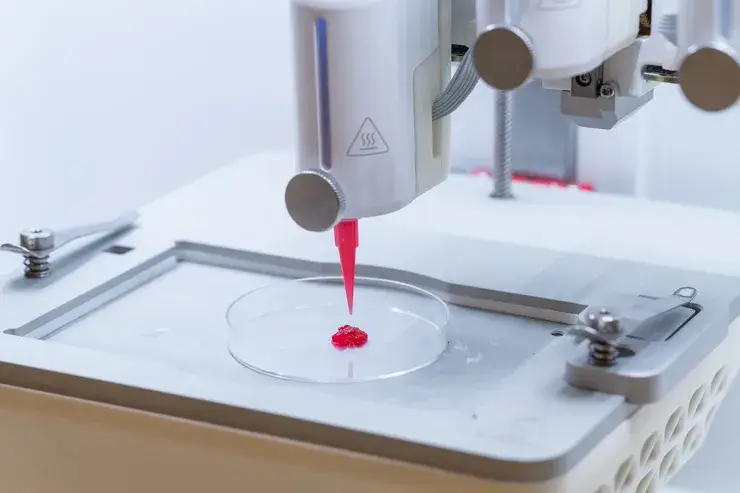
Image Credit
Magnus Johansson / Linköping University
Share
Bioprinting holds the promise of producing tissues and organs on demand, but efforts have been held back by our inability to create the networks of blood vessels required to sustain them. Two complementary new technologies could now solve the problem for advanced skin grafts.
The skin is probably one of the body’s most underappreciated organs. Not only does it provide a crucial barrier against germs, toxins, and radiation, but it also helps regulate temperature and water loss and acts as a vital sensory organ mediating our sense of touch and pain.
Serious injuries to the skin, in particular burns, are usually treated by transplanting a thin layer of epidermis, the top layer of skin, from elsewhere on the body. But many of the structures supporting the skin’s critical functions, such as blood vessels, nerves, and hair follicles, are actually found in the layer below, known as the dermis.
It’s usually impossible to transplant the dermis because it would leave behind a wound as severe as the one being treated. So, traditional skin grafts normally don’t restore full function and can lead to severe scarring.
Now, researchers from Linköping University in Sweden have developed two new bioprinting techniques—essentially 3D printing with biological materials—that could produce skin grafts perfused with blood vessels that replicate the complex structure of the dermis. The first approach involves injecting a cell-laden gel into a wound that can then grow into functional tissue. The second uses hydrogel threads to create channels that can become blood vessels.
“The dermis is so complicated that we can’t grow it in a lab. We don’t even know what all its components are. That’s why we, and many others, think that we could possibly transplant the building blocks and then let the body make the dermis itself,” Johan Junker at Linköping University, who led the study, said in a press release.
The researchers first developed a specially designed “bioink” containing cells known as fibroblasts. These are the most common cells in the dermis and produce important dermal ingredients such as collagen, elastin, and hyaluronic acid, according to Wired.
The researchers grew these cells on tiny beads of gelatin and then mixed them with hyaluronic acid to create a gel. Pressure turns the gel into a liquid that can be extruded through the nozzle of a 3D printer before becoming gel-like again.
Be Part of the Future
Sign up to receive top stories about groundbreaking technologies and visionary thinkers from SingularityHub.

The researchers used this “skin in a syringe,” as they’ve dubbed their invention, to create small disks that they then transplanted under the skin of mice. In results published in Advanced Healthcare Materials, the researchers reported the living cells produced various substances crucial for growing a new dermis, such as collagen, and new blood vessels even grew in the graft.
The ability to grow new blood vessels will be key if we’re to make usable skin grafts. Creating functional vascular networks has been a long-standing challenge in tissue engineering efforts, as without them it’s impossible to deliver nutrients and oxygen into larger, more complex structures.
The second technique the researchers developed could go even further towards solving this problem. In another paper, published in the same journal, they showed they could print threads of a water-based substance known as a hydrogel into tissues.
These threads can be arranged in complex patterns and then dissolved by the application of a simple enzyme, according to Wired, leaving a tube-like cavity in which new blood vessels could be grown. By combining the two technologies it should eventually be possible to create a fully functional artificial dermis.
As ever, getting these technologies out of the lab will be a long and uncertain journey. But they bring us one step closer to an on-demand treatment for the most serious skin injuries.

Related Articles
MIT Mined Bacteria for the Next CRISPR—and Found Hundreds of Potential New Tools
Forget Antibiotics: These Killer Cells Wipe Out Deadly Superbugs in a Day
Reviving Brain Activity After ‘Cryosleep’ Inches Closer in Pioneering Study
MIT Mined Bacteria for the Next CRISPR—and Found Hundreds of Potential New Tools
Forget Antibiotics: These Killer Cells Wipe Out Deadly Superbugs in a Day
Reviving Brain Activity After ‘Cryosleep’ Inches Closer in Pioneering Study
What we’re reading