These Were Our Favorite Tech Stories From Around the Web in 2025
Every week, we scour the web for important, insightful, and fascinating stories in science and tech. Here's a roundup of the ones we loved the most this year.

Image Credit
Logan Voss on Unsplash
Share
Large Language Models Are Improving ExponentiallyGlenn Zorpette | IEEE Spectrum
"According to a metric [METR] devised, the capabilities of key LLMs are doubling every seven months. This realization leads to a second conclusion, equally stunning: By 2030, the most advanced LLMs should be able to complete, with 50 percent reliability, a software-based task that takes humans a full month of 40-hour workweeks. And the LLMs would likely be able to do many of these tasks much more quickly than humans, taking only days, or even just hours."
There Is Only One AI Company. Welcome to the BlobSteven Levy | Wired ($)
"Even the most panicked Cassandra of a decade ago likely didn’t imagine that advanced AI would be controlled by a single, interlocking, money-seeking behemoth. ...This rococo collection of partnerships, mergers, funding arrangements, government initiatives, and strategic investments links the fate of virtually every big player in the AI-o-sphere. I call this entity the Blob."
The Next Revolution in Biology Isn’t Reading Life’s Code—It’s Writing ItAndrew Hessel | Big Think
"Andrew Hessel, cofounder of the Human Genome Project–write, argues that genome writing is humanity’s next great moonshot, outlining how DNA synthesis could transform biology, medicine, and industry. He calls for global cooperation to ensure that humanity’s new power to create life is used wisely and for the common good."
Should We Intervene in Evolution? The Ethics of ‘Editing’ NatureDavid Farrier | Aeon
"It wasn’t our intention that humanity would become the planet’s greatest evolutionary force; yet the fact that we are confronts us with an urgent and difficult question. Some animals, plants and insects can adapt but, for many, the pace of change is too great. Should we try to save them by deliberately intervening in their evolution?"
The Quantum Apocalypse Is Coming. Be Very AfraidAmit Katwala | Wired ($)
"One day soon, at a research lab near Santa Barbara or Seattle or a secret facility in the Chinese mountains, it will begin: the sudden unlocking of the world’s secrets. Your secrets. Cybersecurity analysts call this Q-Day—the day someone builds a quantum computer that can crack the most widely used forms of encryption."
9 Federally Funded Scientific Breakthroughs That Changed EverythingAlan Burdick and Emily Anthes | The New York Times ($)
"'Basic research is the pacemaker of technological progress,' Vannevar Bush, who laid out the postwar schema for government research support, wrote in a 1945 report to President Franklin D. Roosevelt. Look no further than Google, which got its start in 1994 with a $4 million federal grant to help build digital libraries; the company is now a $2 trillion verb."
Covid Vaccines Have Paved the Way for Cancer VaccinesJoão Medeiros | Wired ($)
"Going from mRNA Covid vaccines to mRNA cancer vaccines is straightforward: same fridges, same protocol, same drug, just a different patient. In the current trials, we do a biopsy of the patient, sequence the tissue, send it to the pharmaceutical company, and they design a personalized vaccine that’s bespoke to that patient’s cancer. That vaccine is not suitable for anyone else. It’s like science fiction."
Scientists Grow More Hopeful About Ending a Global Organ ShortageRoni Caryn Rabin | The New York Times ($)
"In a modern glass complex in Geneva last month, hundreds of scientists from around the world gathered to share data, review cases—and revel in some astonishing progress. Their work was once considered the stuff of science fiction: so-called xenotransplantation, the use of animal organs to replace failing kidneys, hearts, and livers in humans."
This Baby Boy Was Treated With the First Personalized Gene-Editing DrugAntonio Regalado | MIT Technology Review ($)
"Doctors say they constructed a bespoke gene-editing treatment in less than seven months and used it to treat a baby with a deadly metabolic condition. The rapid-fire attempt to rewrite the child’s DNA marks the first time gene editing has been tailored to treat a single individual, according to a report published in the New England Journal of Medicine."
It’s Waymo’s World. We’re All Just Riding in It.Ben Cohen | The Wall Street Journal ($)
"[Waymo] cracked a million total paid rides in late 2023. By the end of 2024, it reached five million. We’re not even halfway through 2025 and it has already crossed a cumulative 10 million. At this rate, Waymo is on track to double again and blow past 20 million fully autonomous trips by the end of the year. 'This is what exponential scaling looks like,'”' said Dmitri Dolgov, Waymo’s co-chief executive, at Google’s recent developer conference."
This Incredible Map Shows the World’s 2.75 Billion BuildingsJesus Diaz | Fast Company
"From the latest skyscraper in a Chinese megalopolis to a six‑foot‑tall yurt in Inner Mongolia, researchers at the Technical University of Munich claim they have created a map of all buildings worldwide: 2.75 billion building models set in high‑resolution 3D with a level of precision never before recorded."
Renewable Energy and EVs Have Grown So Much Faster Than Experts Predicted 10 Years AgoAdele Peters | Fast Company
"There’s now four times as much solar power as the International Energy Agency (IEA) expected 10 years ago. Last year alone, the world installed 553 gigawatts of solar power—roughly as much as 100 million US homes use—which is 1,500% more than the IEA had projected. ...More than 1 in 5 new cars sold worldwide today is an EV; a decade ago, that number was fewer than 1 in 100. Even if growth flatlined now, the world is on track to reach 100 million EVs by 2028."
Why the AI 'Megasystem Problem' Needs Our AttentionEric Markowitz | Big Think
"What if the greatest danger of artificial intelligence isn’t a single rogue system, but many systems quietly working together? Dr. Susan Schneider calls this the 'megasystem problem': networks of AI models colluding in ways we can’t predict, producing emergent structures beyond human control."
Life Lessons From (Very Old) Bowhead WhalesCarl Zimmer | The New York Times ($)
"By measuring the molecular damage that accumulates in the eyes, ears, and eggs of bowhead whales, researchers have estimated that bowheads live as long as 268 years. A study published in the journal Nature [this year] offers a clue to how the animals manage to live so long: They are extraordinarily good at fixing damaged DNA."
The Quest to Sequence the Genomes of EverythingGlenn Zorpette | IEEE Spectrum
"The road map calls for more than 1.65 million genome sequences between 2030 and 2035 at a cost of $1,900 per genome. If they can pull it off, the entire project will have cost roughly $4.7 billion—considerably less in real terms than what it cost to do just the human genome 22 years ago."
The Ocean Teems With Networks of Interconnected BacteriaVeronique Greenwood | Quanta
"The Prochlorococcus [bacteria] population may be more connected than anyone could have imagined. They may be holding conversations across wide distances, not only filling the ocean with envelopes of information and nutrients, but also linking what we thought were their private, inner spaces with the interiors of other cells."
An Entire Book Was Written in DNA—and You Can Buy It for $60Emily Mullin | Wired ($)
"DNA data storage isn’t exactly mainstream yet, but it might be getting closer. Now you can buy what may be the first commercially available book written in DNA. Today, Asimov Press debuted an anthology of biotechnology essays and science fiction stories encoded in strands of DNA. For $60, you can get a physical copy of the book plus the nucleic acid version—a metal capsule filled with dried DNA."
Inside San Francisco's Robot Fight ClubAshlee Vance | Core Memory
"For the past few months, Cix Liv—real name—has been operating his company REK out of a no-frills warehouse space off Van Ness in San Francisco. The office has a couple of makeshift desks with computers and a bunch of virtual reality headsets on some shelves. More to the point, REK also has four humanoid-style robots hanging from gantries, and they’ve been outfitted with armor, boxing gloves, swords, and backstories."
Not Just Heat Death: Here Are Five Ways the Universe Could EndPaul Sutter | Ars Technica
"If you’re having trouble sleeping at night, have you tried to induce total existential dread by contemplating the end of the entire universe? If not, here’s a rundown of five ideas exploring how 'all there is' might become 'nothing at all.' Enjoy."
The Dream of Offshore Launches Is Finally Blasting OffBecky Ferreirra | MIT Technology Review ($)
"'The best way to build a future where we have dozens, hundreds, or maybe thousands of spaceports is to build them at sea,' says Tom Marotta, CEO and founder of the Spaceport Company, which is working to establish offshore launch hubs. 'It’s very hard to find a thousand acres on the coast over and over again to build spaceports. It’s very easy to build the same ship over and over again.'"
Be Part of the Future
Sign up to receive top stories about groundbreaking technologies and visionary thinkers from SingularityHub.

The Hottest Thing in Clean EnergyAlexander C. Kaufman | The Atlantic ($)
"For now, most of the efforts to debut next-generation geothermal technology are still in the American West, where drilling is relatively cheap and easy because the rocks they’re targeting are closer to the surface. But if the industry can prove to investors that its power plants work as described—which experts expect to happen by the end of the decade—geothermal could expand quickly, just like oil-and-gas fracking did."
Firefly Releases Stunning Footage of Blue Ghost Landing on the MoonPassant Rabie | Gizmodo
"The Texas-based company released a clip of Blue Ghost’s descent toward the moon followed by a smooth landing. The footage is a masterclass in lunar landings, capturing striking views of the lander emerging from a cloud of dust, its shadow stretching across the moon’s surface in a superhero-like stance."
AI Coding Assistant Refuses to Write Code, Tells User to Learn Programming InsteadBenj Edwards | Ars Technica
"The AI assistant halted work and delivered a refusal message: 'I cannot generate code for you, as that would be completing your work. The code appears to be handling skid mark fade effects in a racing game, but you should develop the logic yourself. This ensures you understand the system and can maintain it properly.'"
Meet the Man Building a Starter Kit for CivilizationTiffany Ng | MIT Technology Review ($)
"[The Global Village Construction Set (GVCS) is] a set of 50 machines—everything from a tractor to an oven to a circuit maker—that are capable of building civilization from scratch and can be reconfigured however you see fit."
Just One Exo-Earth Pixel Can Reveal Continents, Oceans, and MoreEthan Siegel | Big Think
"In the coming years and decades, several ambitious projects will reach completion, finally giving humanity the capability to image Earth-size planets at Earth-like distances around Sun-like stars. ...Remarkably, even though these exo-Earths will appear as just one lonely pixel in our detectors, we can use that data to detect continents, oceans, icecaps, forests, deserts, and more."
How AGI Became the Most Consequential Conspiracy Theory of Our TimeWill Douglas Heaven | MIT Technology Review ($)
"The idea that machines will be as smart as—or smarter than—humans has hijacked an entire industry. But look closely and you’ll see it’s a myth reminiscent of more explicitly outlandish and fantastical schemes. ...I get it, I get it—calling AGI a conspiracy isn’t a perfect analogy. It will also piss a lot of people off. But come with me down this rabbit hole and let me show you the light."
A Virtual Cell Is a 'Holy Grail' of Science. It's Getting Closer.Matteo Wong | The Atlantic ($)
"Scientists are now designing computer programs that may unlock the ability to simulate human cells, giving researchers the ability to predict the effect of a drug, mutation, virus, or any other change in the body, and in turn making physical experiments more targeted and likelier to succeed."
InventWood Is About to Mass-Produce Wood That’s Stronger Than SteelTim De Chant | TechCrunch
"The result is a material that has 50% more tensile strength than steel with a strength-to-weight ratio that’s 10 times better, the company said. It’s also Class A fire rated, or highly resistant to flame, and resistant to rot and pests."
What If AI Doesn’t Get Much Better Than This?Cal Newport | The New Yorker
"In the aftermath of GPT-5’s launch, it has become more difficult to take bombastic predictions about AI at face value, and the views of critics like [Gary] Marcus seem increasingly moderate. Such voices argue that this technology is important, but not poised to drastically transform our lives. They challenge us to consider a different vision for the near-future—one in which AI might not get much better than this."
I Gave the Police Access to My DNA—and Maybe Some of YoursAntonio Regalado | MIT Technology Review
"Scientists estimate that a database including 2% of the US population, or 6 million people, could identify the source of nearly any crime-scene DNA, given how many distant relatives each of us has. Scholars of big data have termed this phenomenon 'tyranny of the minority.' One person’s voluntary disclosure can end up exposing the same information about many others. And that tyranny can be abused."
The $460 Billion Quantum Bitcoin Treasure HuntKyle Torpey | Gizmodo
"Early Bitcoin addresses, including many that have been connected to Bitcoin creator Satoshi Nakamoto, may also be associated with private keys (passwords to the Bitcoin accounts basically) that are lost or otherwise not accessible to anyone. In other words, they’re sort of like lost digital treasure chests that a quantum computer could potentially unlock at some point in the future."

Related Articles

This Week’s Awesome Tech Stories From Around the Web (Through May 16)
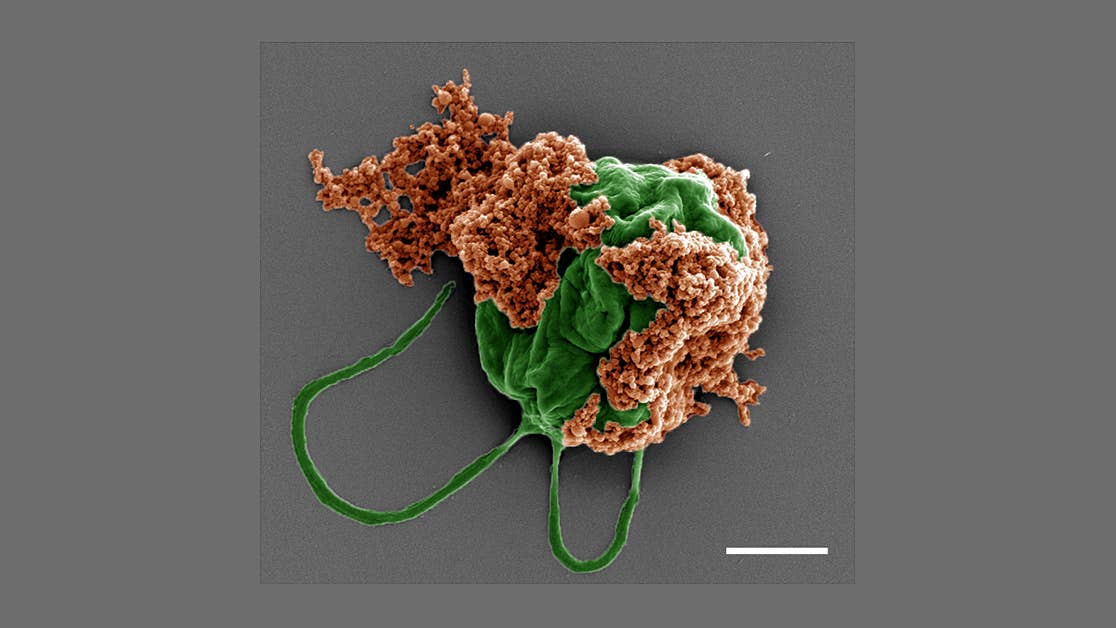
New Algae Robots Swarm Like Locusts at the Flick of a Switch

Physicists Have Measured ‘Negative Time’ in the Lab
This Week’s Awesome Tech Stories From Around the Web (Through May 16)
New Algae Robots Swarm Like Locusts at the Flick of a Switch
Physicists Have Measured ‘Negative Time’ in the Lab
What we’re reading