New Device Detects Brain Waves in Mini Brains Mimicking Early Human Development
The flower-shaped device wraps around brain organoids and maps nearly all electrical activity.
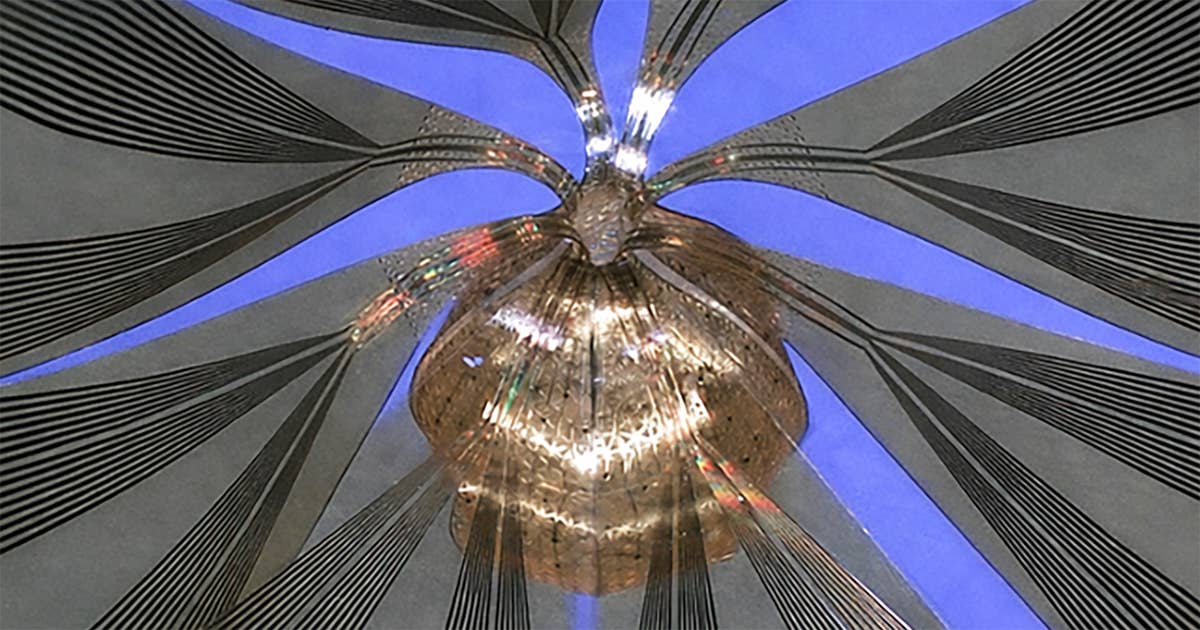
Image Credit
Northwestern University
Share
Pea-sized brain blobs are a chatty bunch. Packed with neurons that spark with electrical activity, brain organoids—or “mini brains”—are a now popular way to study the human brain.
Some organoids model the brain’s wiring during early development. Others, made from patients’ skin cells, retain DNA mutations that could lead to schizophrenia or autism. Scientists studying mini brains hope to find patterns associated with diseases and test ways to fix them.
But it’s harder to record activity in organoids than neurons lying flat in a dish. Traditional electrode arrays are too large and stiff. More recent soft electronics are a better fit, but they can only record a fraction of each organoid at a time. This makes it difficult to figure out how all the neurons work together and could miss key aspects of the way the brain functions as a whole.
Recently, a team at Northwestern University and collaborators offered up a unique solution: A pop-up electrode mesh that envelopes entire mini brains. Each device starts out as a flower-like lattice before transforming into a breathable 3D net that gently wraps around brain organoids. The device’s 240 microelectrodes simultaneously capture electrical activity from nearly the entirety of an organoid’s surface, providing a birds-eye view of overall function.
Using the device, the team detected brain-wave-like electrical oscillations rippling across the organoids. Thanks to its porous design, the mesh allows nutrients—and drugs—to flow through. In several tests using drugs known to spike or lower neural activity, the device readily picked up changes across the mini brain, hinting at its potential as a drug testing platform.
“This advance is really about building the right tools…we can now record from and stimulate hundreds of locations across [an organoid’s] surface at once. This allows us to study neural activity at the level of whole networks rather than isolated signals,” said study author Colin Franz in a press release.
Listening In
Technologies that tap into and alter brain activity have exploded in variety and efficiency. Some sit on top of the brain, under the skull, to monitor large areas. Others directly record a vast number of single neurons as they fire away. Trusty non-invasive methods like electroencephalograms (EEG) have mapped whole-brain activity for over a century.
Recording from mini brains is different. Recording devices meant for the human brain are far too bulky. Those designed for cells in petri dishes break if they’re bent.
“Integrated circuits in consumer electronics are perfectly planar, sitting on wafer-based substrates,” said study author John Rogers. “That conventional layout represents a very significant geometrical mismatch relative to the spherical shapes of these organoids.”
Scientists have recently turned to mesh-like electrode systems that are more flexible, such as a basket-like design inspired by Japanese paper folding. Another, shaped like a flower, turns into an electrode-studded claw to grasp organoids. Most of these can record single cells as the organoids develop without changing their shape or cellular and genetic makeup.
Researchers already use these designs to eavesdrop on a variety organoids. But the devices struggle to capture whole-brain dynamics. Some have just a few dozen electrodes; others cover only a small region. To truly decipher mini brain activity, scientists need full-coverage hardware.
Shape Shifter
The new device is like a draw-string coin purse. It starts out completely flat like a flower and then gradually cinches itself into a soft, flexible mesh that envelops the mini brain.
Matching the mesh to the organoid’s shape without damage is one challenge. Another is to ensure all 240 electrodes are distributed across a mini brain’s entire surface.
Be Part of the Future
Sign up to receive top stories about groundbreaking technologies and visionary thinkers from SingularityHub.

The team turned to a design that allows electrodes to move in predictable ways as the device changes shape. When flat, the device is smaller than a US quarter. Once converted into a 3D purse, its electrodes are evenly spread out. Each one is only 10 microns across, roughly the size of a single cell. The shape-shifting mechanism works like a pop-up book. Each petal of the flower is carefully tailored to bend into differently sized purses and shapes to minimize gaps between the electrodes and the organoid surface.
The device’s mesh allows nutrients to flow into the organoid but prevents cells from spreading past the pores and beyond the reach of the electrodes.
“The device’s structure needs to support these metabolic processes to sustain the viability of the tissue,” said Rogers. “Basically, the organoid needs to breathe. The hardware must not significantly constrain or suffocate it.”
Rhythm Nation
The device covered roughly 91 percent of the surface of an average-sized mini brain after 60 days in culture. Because the team knew each electrode’s location, they were able to reconstruct the neural oscillations to create a 3D widescreen view of the organoid’s activity.
In one case, triggering activity in a small region led to highly synchronized, wave-like activity across most surface neurons. The activity patterns, previously undetectable in brain organoids, mimicked those seen in developing human brains.
These synchronized waves broke down dramatically after a dose of botulinum toxin, which is known to dampen brain activity by inhibiting chemical connections between neurons. This suggests their wiring is similar to that of our brains.
The device also captured brain-wide activity changes due to a neurochemical imbalance. Watching these kinds of changes could help scientists study a wide range of diseases such as Parkinson’s, multiple sclerosis, and amyotrophic lateral sclerosis (ALS).
The system also worked with other established observation methods. For example, it reliably recorded electrical signals in tandem with a technology that tracks brain chemicals. The system also responded to light beams activating groups of neurons (an approach called optogenetics).
Mixing and matching different strategies, including wholly new approaches, like the one in this study, could yield a more in-depth understanding of mini brains—and in turn, our own.

Dr. Shelly Xuelai Fan is a neuroscientist-turned-science-writer. She's fascinated with research about the brain, AI, longevity, biotech, and especially their intersection. As a digital nomad, she enjoys exploring new cultures, local foods, and the great outdoors.
Related Articles

What We Actually See—and Don’t See—Shows Consciousness Is Only the Tip of the Iceberg
These Mini Brains Just Learned to Solve a Classic Engineering Problem

This Brain Pattern Could Signal the Moment Consciousness Slips Away
What We Actually See—and Don’t See—Shows Consciousness Is Only the Tip of the Iceberg
These Mini Brains Just Learned to Solve a Classic Engineering Problem
This Brain Pattern Could Signal the Moment Consciousness Slips Away
What we’re reading