Scientists Revive Failing Cells With Mitochondria Transplants
A new tool that tethers healthy mitochondria to ailing cells has shown promise in mice with inherited blindness.
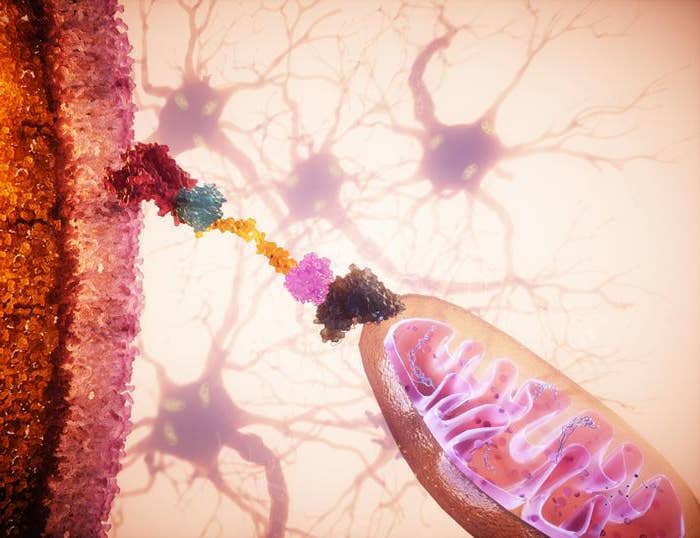
Image Credit
© IOB, 2026
Share
Our cells produce energy in biological power plants called mitochondria. These energy-makers have minds of their own. They operate using a unique set of DNA and can travel outside cells. Like astronauts, they often escape in fatty bubbles, land on other cells, explore them, and sometimes literally fuse with native mitochondria in their new homes.
This makes mitochondrial diseases hard to treat. Few gene editing tools can reach them and fix genetic typos. Even without mutations, mitochondria falter with age, contributing to diabetes, Alzheimer’s disease, heart failure, and other medical scourges.
But an experimental fix is gaining traction. Researchers are shuttling healthy mitochondria into cells—essentially transplanting them—to restore energy production and reboot metabolism.
There’s a major roadblock, however. Getting healthy mitochondria to the right cells is challenging. Scientists at the Institute of Molecular and Clinical Ophthalmology Basel have now developed a system that tethers donated mitochondria to their targets.

Called MitoCatch, the scientists engineered matching proteins and attached them to donor mitochondria and recipient cells. Like hook-and-eye fasteners, the binders pull the two partners into close contact. From there—by mechanisms that are still mysterious—the new mitochondria ride in on fatty bubbles, disembark inside the cell, and get to work.
In the study, the researchers delivered mitochondria to multiple cell types, and an injection of mitochondria saved vulnerable retinal cells in mice with inherited blindness.
“As a therapy, mitochondria transplantation has been hindered by the lack of tools to target healthy mitochondria directly to disease-affected cells,” wrote Samantha Krysa and Jonathan Brestoff at Washington University School of Medicine, who were not involved in the study.
MitoCatch overcomes this barrier.
Domesticated Bacteria
Roughly two billion years ago, an ancestral cell ate a bacterium. But rather than digesting it, the cell formed an unlikely alliance with its erstwhile prey. The bacterium converted oxygen into energy for the host, and received protection and nutrients in return. Over time, the bacterium gave up its independence and became a critical part of our cells: mitochondria.
Unlike other cell structures called organelles, mitochondria carry 37 unique genes that encode the core components of their energy-making machinery. Their stripped-down genome leaves little margin for error and is especially vulnerable to mutation. It’s also shielded by a double membrane, making it difficult to reach using conventional biotech tools.
But mitochondria have a superpower: They can leave host cells. Research from the last two decades shows that many cells export some mitochondria into the cellular void. The practice could be a way to rid themselves of damaged mitochondria or to deliver healthy ones to struggling neighbors, like an intercellular care package.
This quirk led to the idea of mitochondrial transplantation. Here, healthy mitochondria are injected into tissue or the bloodstream to treat damaged cells. Early results are encouraging. Transplant extends the healthy lifespan of mice with mitochondrial defects, limits injury after stroke or heart attack, accelerates wound healing in people, and hints at benefits for obesity.
Because nearly every human cell depends on mitochondria for energy—and falters when they break—transplantation could unlock treatments for a broad range of diseases hard to treat today. That is, if healthy replacements can reach their destination.
“Being able to deliver mitochondria efficiently to the right cell types has been a key hurdle for this therapeutic strategy,” wrote Krysa and Brestoff.
Be Part of the Future
Sign up to receive top stories about groundbreaking technologies and visionary thinkers from SingularityHub.

Catch Me if You Can
MitoCatch relies on a cellular “handshake.” All cell surfaces are densely studded with proteins, some universal, others unique to specific cell types. These proteins interact with surrounding molecules to drive biological processes. During infection, for example, antibodies latch onto proteins on bacteria to trigger an immune attack. CAR T cell therapy outfits T cells with protein “binders” so they can better recognize and eliminate cancer cells, senescent cells, or cells involved in autoimmune disorders. In each case, success hinges on matched protein pairs snapping together like hook-and-eye fasteners.
The new system works on the same principle and has three designs. MitoCatch-M helps donor mitochondria recognize markers unique to different types of recipient cells. MitoCatch-C flips the approach, modifying recipient cells with binders that better capture mitochondria. And a third version uses a “bispecific” tether that simultaneously grips mitochondria and target cells. Once in close proximity, mitochondria are packaged in fatty bubbles that drift into the cell.
Then comes a brief moment of terror.
Many of these bubbles are routed to the cell’s waste processing organelle, where their cargo is completely destroyed. The mitochondria must escape before it’s too late.
In cultured brain, retinal, heart, skin, and immune cells, the tailored mitochondria largely avoided death. How they managed this up for debate, and the team is trying to work it out now. But once inside, the donor mitochondria fused with the cell’s native mitochondrial network.
This “suggests that MitoCatch can be used to enhance the efficacy of mitochondria transplantation substantially,” wrote Krysa and Brestoff.
Of course, cells in a dish aren’t the same as those in bodies. In another test, the team injected the engineered mitochondria into the eyes of mice with a hereditary condition where a single mitochondrial genetic defect destroys cells in the retina, resulting in gradual vision loss.
Over 10 days, the healthy mitochondria revamped treated cells’ metabolisms, reduced damage, and boosted survival and response to light. Whether this translates to better vision remains to be seen, but the treatment didn’t trigger an immune response, a promising sign it might be safe. To be clear, the transplanted mitochondria didn’t correct the underlying mutation. Instead, they supplied enough working versions of the gene to bring energy production back to life.
It’s “a proof-of-principle that mitochondria transplantation can be used to correct mutations encoded in the mitochondrial genome that cause a severe form of vision loss,” wrote Krysa and Brestoff.
MitoCatch isn’t ready for prime time. It requires extensive genetic engineering, making the system difficult to translate for routine treatment. It’s also still unclear how long transplanted mitochondria last in their new hosts and whether they have a lasting benefit.
These early results highlight the ways scientists can boost the therapy’s potential. With more work, we may have a new way to tackle previously untreatable mitochondrial disorders.

Related Articles
Blind Patients Recover Partial Vision in Gene Therapy Trial

The Evolving Quest to Build Life in a Lab
Radical New Tactic Would Stop Deadly Cancers Before They Start
Blind Patients Recover Partial Vision in Gene Therapy Trial
The Evolving Quest to Build Life in a Lab
Radical New Tactic Would Stop Deadly Cancers Before They Start
What we’re reading