Orbital Airbag Could Shield Earth From Devastating Solar Storms
A planetary defense system would blunt solar storms with hundreds of tons of gas. Emerging heavy-lift rockets could deploy it in under two months.
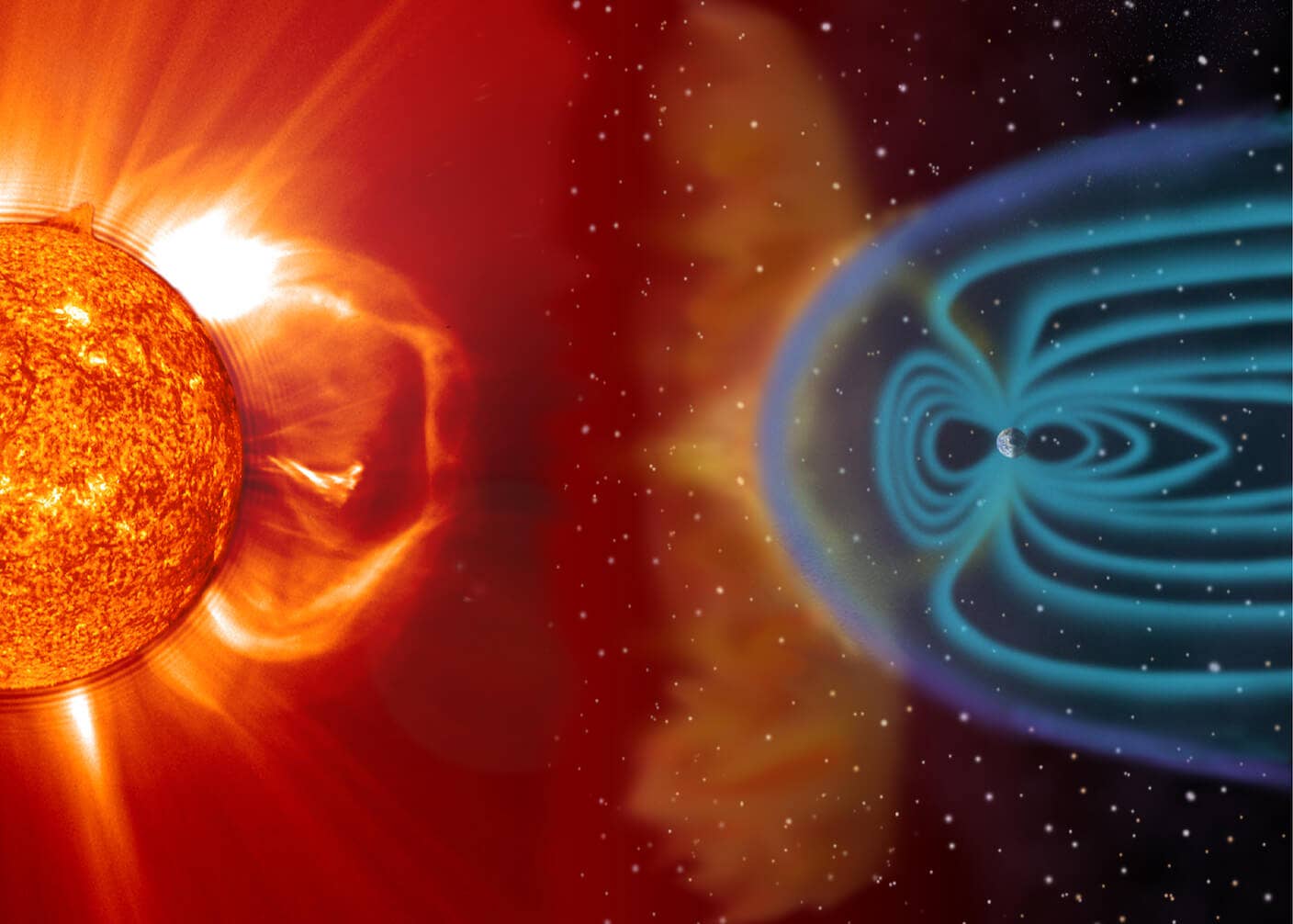
Image Credit
NASA
Share
Extreme space weather could wreak havoc on the satellites, communications networks, and electrical grids that modern society depends on. Researchers have now proposed an ambitious space-based planetary defense system that would weaken solar storms before they hit Earth.
The sun regularly emits massive pulses of radiation, energetic particles, and magnetic fields that interact with the Earth’s own magnetic field. This activity is the source of auroras like the northern lights, but the most violent eruptions can cause geomagnetic storms with the power to disrupt GPS and radio communications and fry electrical equipment.
While the impact of most of these events is limited, there is precedent for more catastrophic outcomes. In 1859, the Carrington Event, the most powerful solar storm ever recorded, knocked out telegraph lines across North America and Europe. In today’s highly electrified world, a similar event could cause between $2.4 and $3.4 trillion in damage to the power grid alone.
Now, researchers at Boston University and the University of Michigan have come up with a potential solution. In a paper published in Space Weather, they propose a constellation of satellites called StormWall that would release hundreds of tons of gas into orbit to blunt the force of an incoming solar storm.
"It's as if you could install an airbag in the magnetosphere," co-author Daniel Welling, a space physicist from the University of Michigan, told Science.
Solar storms have the potential to sow chaos because they weaken the magnetic shield protecting Earth from space radiation. Powerful enough storms disrupt the Earth’s magnetic field and cause it to reconnect to the sun’s, allowing energy from the solar storm to pour into the magnetosphere.
The Earth already has a natural defense against this—a doughnut-shaped reservoir of ionized gas, or plasma, sitting just above the atmosphere. When the planet’s magnetic field is disturbed, a plume of this plasma flows toward the sun and slows the rate at which the magnetic fields reconnect.
Be Part of the Future
Sign up to receive top stories about groundbreaking technologies and visionary thinkers from SingularityHub.

StormWall would turbocharge this process by releasing massive amounts of artificial plasma into the outer atmosphere. The researchers sketch out a system involving a constellation of satellites orbiting about 22,000 miles from Earth. The satellites would carry canisters of lithium, barium, or sodium gases to be ejected when a large solar storm is inbound. The gases, rapidly ionized by solar radiation, would add to the planet’s natural plasma shield.
Based on simulations, the researchers estimate that releasing around 400 tons of gas could reduce the strength of a major geomagnetic storm by over 50 percent. Crucially, the intervention would be swift and reversible. The plasma cloud could be in position by the time a storm hits, and it would dissipate just a few hours later.
Launching this much material into orbit would be a big undertaking, but the researchers say it could be within reach of emerging heavy-lift vehicles like SpaceX’s Starship or China’s Long March 9 rocket. They calculate that six launches could deploy the full constellation in under two months.
Outside experts have been broadly positive. Allison Jaynes, a space physicist at the University of Iowa, told Science the idea was “highly innovative and appears to be quite feasible in the near term.”
But getting the satellites into orbit is only part of the puzzle. Accurate and timely space weather forecasts would also be a prerequisite. And gaining international buy-in for a system that would drastically alter the near-Earth space environment, even if only temporarily, could be challenging.
The researchers flag potential side effects that need more study, including the generation of electromagnetic waves as the released material ionizes. Still, given the devastation a Carrington-sized event could unleash on the modern world, the potential downsides may be worth the risk.

Related Articles
Google DeepMind Gives AI-Designed Proteins a Watermark
Star Catcher Is About to Beam Power Between Two Satellites for the First Time

How Would AI Actually Kill All Humans? Here Are the Top 5 Scenarios
Google DeepMind Gives AI-Designed Proteins a Watermark
Star Catcher Is About to Beam Power Between Two Satellites for the First Time
How Would AI Actually Kill All Humans? Here Are the Top 5 Scenarios
What we’re reading