Companies Could Soon Staff ‘Stubbornly Local’ Jobs With Workers 4,000 Miles Away
Companies once moved whole factories overseas to reduce labor costs. Now, workers a world away can operate local excavators, forklifts, and even humanoid robots with an internet connection.
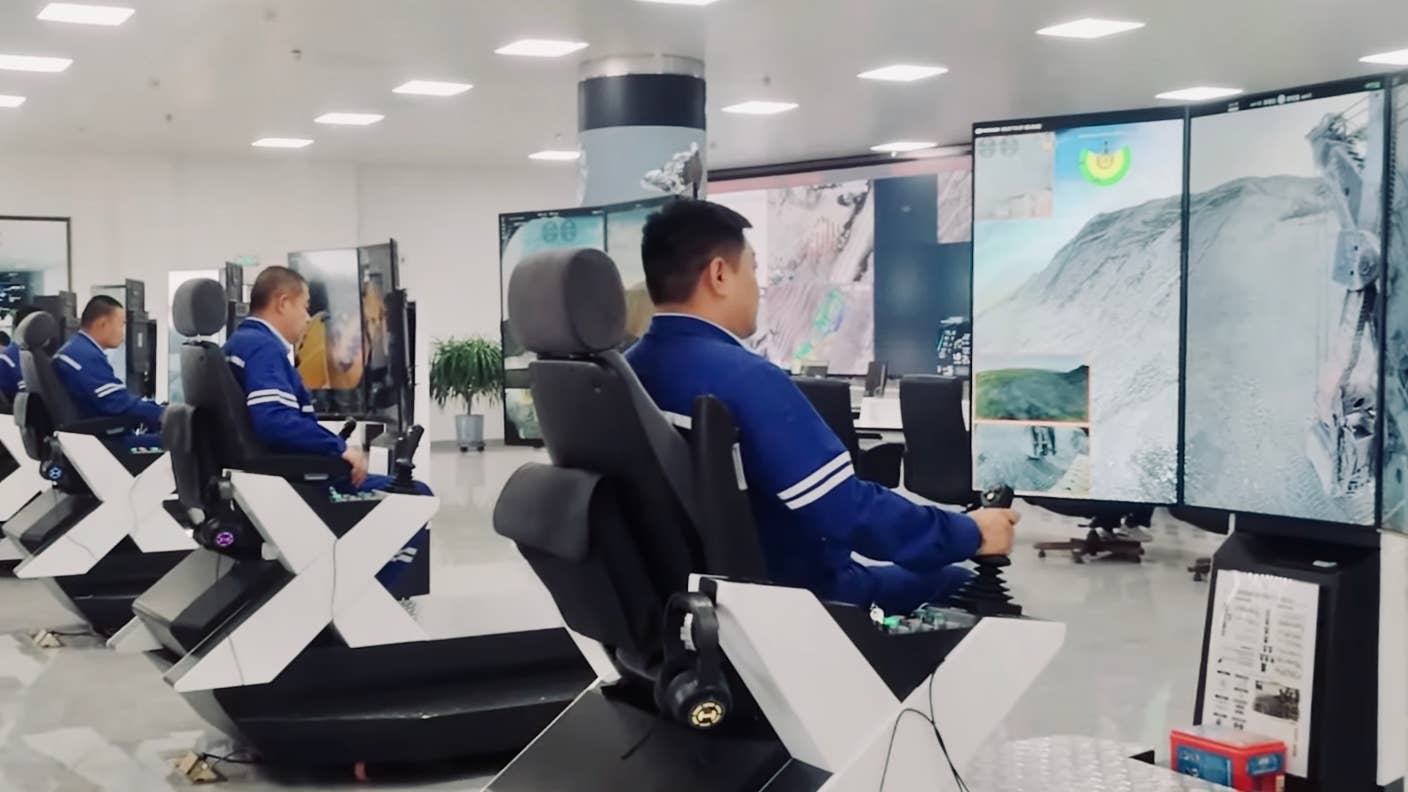
Image Credit
BuilderX
Share
Packaging potassium sulfate, a fertilizer vital to the planet’s food supply, is visually striking—not because of what you see, but because you don’t see much at all. In China’s Xinjiang region, home to the world’s largest deposit of the mineral, piling it up in warehouses creates dust clouds so severe that workers are forced to drive heavy machinery by feel.
Some companies are now turning to a technology that not only offers a way to see through the dust but also keeps workers from entering the warehouse at all. The system, developed by BuilderX Robotics, a Chinese tech company, uses cameras that are like night-vision for dusty areas. More significantly, operators drive excavators, loaders, and other machines from a remote office filled with rows of videogame-like stations. All they need is a 5G or satellite connection.
The ability to control physical machines from a distance is called teleoperation, and it could become a significant force of change in the global economy.
In Japan, the shelves of over 300 convenience stores are being restocked by robots monitored and sometimes controlled by workers in the Philippines. Düsseldorf airport was slated to begin testing shuttles driven by remote workers in May. A startup in Atlanta is offering robot security guards operated by remote staff, and last summer, a surgeon in France performed a teleoperated procedure on a patient in India.
While offshoring teleoperated jobs to overseas workers hasn’t yet become routine, Mark Graham, professor of internet geography at the University of Oxford, suggests the technology is worth our attention because it might enable companies to expand on their well-established habit of outsourcing jobs to places where labor is cheaper.
The use of remote labor isn’t new, Graham told SingularityHub. But teleoperation extends the logic of outsourcing to tasks that were previously thought to be “stubbornly local.”
“The novelty is less about the existence of remote labor and more about the kinds of work that can now be pulled into a planetary labor market,” he said. “Once that happens you can expect the usual pressures around labor arbitrage, control, and fragmentation to follow.”
It’s not clear we’re ready for the consequences.
BuilderX Robotics is a global leader in teleoperation for heavy machinery and a good expression of the changes ahead. Shaolong Sui, a graduate of Stanford University with a degree in mechanical engineering, founded the company in 2018 as a response to labor shortages in the construction industry in Asia.
“A shortage of trained operators isn’t a problem only in developed countries,” he told me. “Young people here in China don’t want to do this work. It’s dusty and dangerous.”
Rather than focusing on full robotic autonomy, which many construction companies have pursued over the past decade, Sui identified teleoperation as a more realistic way to move operators from harsh environments to safer conditions. Making use of the proliferation of low-cost sensors and 5G at the time, Sui completed a prototype in 2019. Today, his company offers teleoperation for 14 different industrial machines, including excavators, loaders, and bull dozers.
In our conversation, it was clear he hopes to improve working conditions for manual laborers. I lost track of the number of times he mentioned removing operators from dangerous worksites. “These workers deserve a better life,” he said.
BuilderX’s workstations do seem to have transformed some of the punishing work of an industrial site into a more white-collar experience, complete with tea and coffee break rooms and toilets down the hall. Sui said his solution allows construction firms to hire senior citizens or people with disabilities who, thanks to the videogame-like interface, can now operate heavy machinery. In another video, a Japanese woman who pilots an excavator proudly shows off her complex nail art, something she claims she couldn’t maintain when she worked in the field.
“Not only is this a much safer workplace, but the lifestyle benefits are that you can sit in an air-conditioned space, enjoy your tea, and when you go home, you’re still clean,” Sui said.
There’s no doubt the approach is safer for frontline workers like those in Xinjiang. Evidence suggests that high levels of potassium dust exposure can cause chronic bronchitis. While pulling someone from dangerous work is a good thing and that should be taken seriously, Graham told me, it doesn’t necessarily mean they’re free from exploitation.
“A worker can be removed from the physical site and still be subjected to intense surveillance, deskilling, isolation, fragmented contracts, algorithmic management, and downward pressure on wages. In other words, the risk can move rather than disappear,” he said.
Sui and Graham both agree there are plenty of forces that might slow the pace of outsourcing. Currently, none of BuilderX’s customers offshore work to overseas operators. But that doesn’t appear to be a technology constraint, as recently demonstrated by an operator in Poland controlling an excavator over 4,000 miles away in Beijing. On the technical side, latency—the delay between operator and machine—and reliability will shape the rate at which firms can choose to offshore workers. But it’s more likely to be limited by regulatory constraints in the form of licensing, insurance, and safety requirements.
That said, Graham believes the biggest force driving work overseas will be the same one that’s pushed clerical and service work offshore; the relentless pursuit to increase profit and reduce cost.
“If firms can hire people in lower-wage labor markets to operate expensive equipment thousands of miles away, many of them will try,” he said.
Be Part of the Future
Sign up to receive top stories about groundbreaking technologies and visionary thinkers from SingularityHub.

Most debates about AI and robotics focus on job loss due to automation. There is relatively little discussion about the risk of offshoring teleoperated work as the technology comes online. This is partly due to the hype surrounding physical AI, a Silicon Valley buzzword describing a world where fully autonomous robots cut humans out of the loop. But Graham says that when machines arrive people tend to incorrectly assume humans disappear.
“In many cases, what gets described as automation is really a reorganization of labor. Work gets broken apart, moved around, and hidden from view,” he says.
As is the case with AI, the robotics industry’s push toward full automation is still plenty reliant on a hidden system of faraway workers. Teleoperation provides training data for robots and is needed to help them deal with unexpected events. Consumer robotics startup 1X is selling a $20,000 humanoid that will sometimes need to be controlled by remote staff. It’s not clear how often future robots cleaning dishes in San Francisco kitchens will be steered by gig workers in Mumbai.
Robotaxi company Waymo already relies on human agents to assist, though not literally drive, vehicles stuck in difficult scenarios. The firm recently disclosed for the first time that some of these agents are based in the Philippines. This information, surfaced during US congressional testimony, immediately raised questions of oversight for safety-critical work: For instance, should a worker in Manila be required to get a California driver’s license?
Amid an already combustible US political environment, teleoperation could raise the heat even higher. Fueled by fears of Americans losing jobs to people overseas, Wyndham Hotels and Resorts, the parent company of La Quinta, was last year forced to respond to anger over a viral video depicting workers allegedly in India remotely handling check-in at one of their Miami hotels. As Graham points out, people tend to care more about outsourcing when it’s no longer hidden in a back office.
But outrage alone, he says, rarely defeats a business model that saves money. Due to network effects surrounding training, infrastructure, and other business process optimization, outsourced labor also tends to cluster in specific areas. This may already be happening in the case of Waymo, which could soon see the rise of something like a “driving district” in Manila. In the future, other types of teleoperated work could follow suit, giving companies a ready-made destination to shop for low-cost labor.
For Graham, it’s urgent that we begin requiring certification from independent bodies, which can better scrutinize a company’s production networks. At Oxford he directs Fairwork, a project aiming to improve labor practices in digital supply chains.
I asked Sui how he thinks his customers may reorganize their operations around this new ability to remotely control their machinery.
“We're working with traditional industries, and so it’s not just about adopting a new technology. There are significant management changes they will have to navigate. You could call this transformation friction because they will need time to digest this new capability step by step,” Sui said.
Despite the fact they could use the technology to outsource work across national borders, none of his customers are doing so just yet. Sui used open pit mines as an example. In this case, where fully developed towns with schools and hospitals have built up over decades, his customers still cluster their workforce next to the sites where they operate. Instead of driving into the mine, operators work from an office and go home clean at the end of a shift.
BuilderX has deployed its technology at more than 100 sites in China, Japan, and parts of Europe. It’s now expanding into new markets including South America and the Middle East. When asked whether he thinks his technology will be used for transnational outsourcing, there’s no hesitation. “Oh yes, I think this is coming in the very near future.”

Related Articles

The Evolving Quest to Build Life in a Lab
The Dawn of the Age of the Exoskeleton

We’ve Always Copied Nature. Now We Can Search It.
The Evolving Quest to Build Life in a Lab
The Dawn of the Age of the Exoskeleton
We’ve Always Copied Nature. Now We Can Search It.
What we’re reading