In a First, a Humanoid Robot Performed Live Surgery Under a Surgeon’s Control
The robot removed a pig's gallbladder with standard surgical tools in an ordinary operating room.
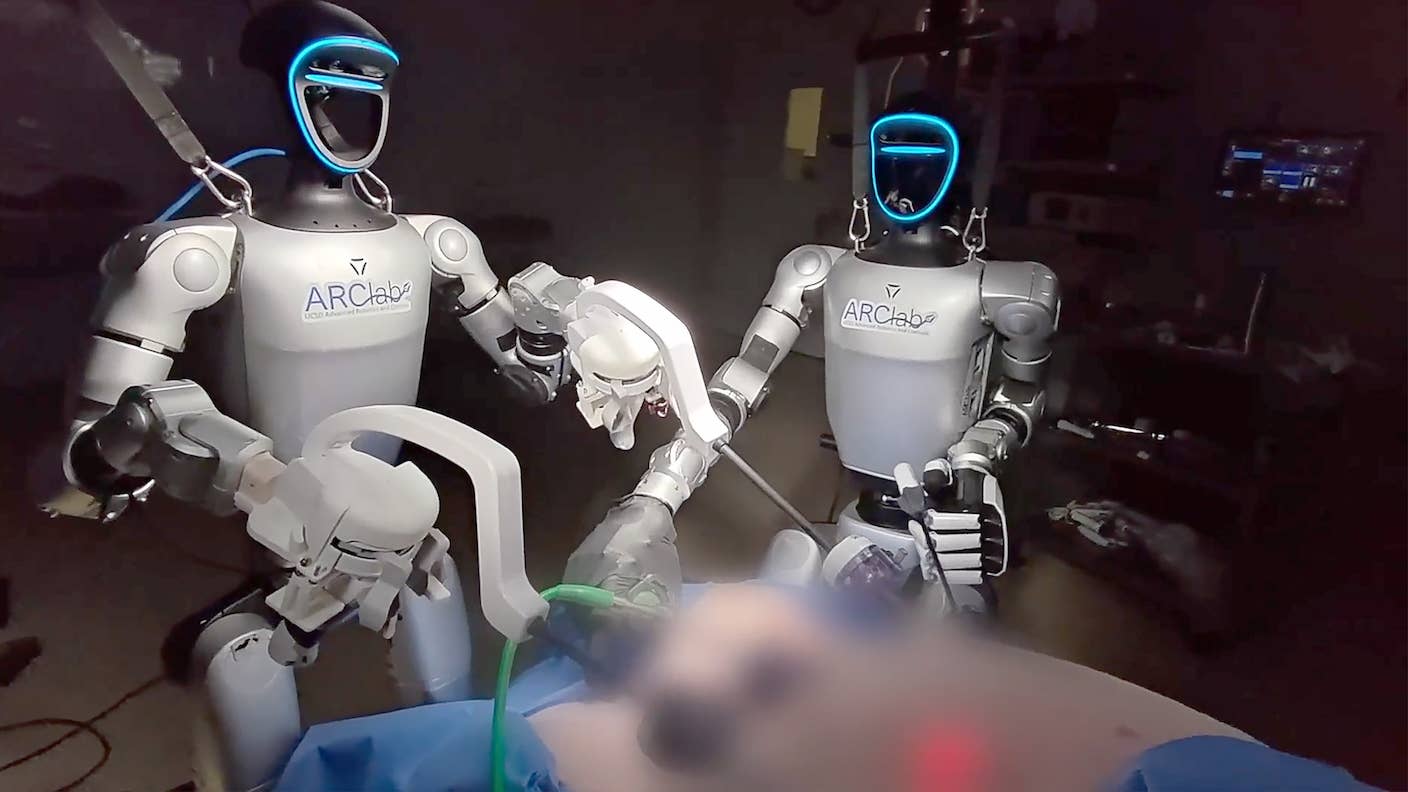
Image Credit
University of California, San Diego
Share
Watchers held their breath as the robot made its first incision. Hovering over its patient, an anesthetized pig, with a robotic assistant standing nearby, it navigated to the gallbladder and gently removed it.
The operation marked the debut of humanoid robots in a standard surgical setting. The robot, named Surgie, wasn't autonomous—it was controlled by an expert surgeon—but the study is a step toward using humanoid robots as collaborators in minimally invasive surgery.
“Remotely operated and autonomous humanoid robots have real potential for amplifying access to critical surgeries to which patients would otherwise not have access,” said study author Michael Yip at UC San Diego.
The study included two successful surgeries. Human surgeons remained on standby for emergencies, but the teleoperated robot completed the task with only minimal intervention.
Feedback from surgeons operating Surgie was positive. They reported less physical strain and frustration, along with better overall performance. But they also pointed to practical problems like intermittent overheating and the need to frequently reposition the robot.
Despite a long road ahead, humanoid robots “have a viable future,” said Yip. “You can imagine these robots being deployed in remote communities where staffing is challenging, or in austere environments like search and rescue scenarios where a massive deployment of field medicine is needed in a short period of time.”
Smooth Operator
Robots have assisted surgeons for years. With a human surgeon at the helm, they excel at delicate procedures requiring precision and dexterity. They’re especially well-equipped for laparoscopic surgery, a minimally invasive technique that uses tiny incisions to reduce pain, speed recovery, and lower the risk of infection.
Despite the promise, surgeons face tradeoffs when they use surgical robots. The robots are highly specialized and often require operating rooms to be redesigned to accommodate them.
A major reason for this is the way they’re built. Intuitive Surgical’s Da Vinci system, for example, uses a robot with multiple arms, each independently controlled from a remote console. Other systems, such as Versius from CMR Surgical, deploy several lightweight independent arms, each attached to a mobile base. The robots have to be carted near the patient.
Surgeons operate all these systems from a console using a magnified, high-definition, 3D view of the surgical field, which is often better than what they’d see with their own eyes. Da Vinci 5 adds sharper visuals and depth perception with two cameras, one for each eye. And because the cameras are held by a robot rather than a human assistant, the image is far more stable.
These platforms are already used in a range of operations. But they have weaknesses. Most require proprietary surgical instruments and methods to make extra space for robot docking and maneuvering during procedures. Staff training adds further complexity and cost, limiting where the systems can be deployed.
Humanoid robots, in contrast, are far more mobile and compact. Their human-like bodies could move through standard operating rooms, use conventional surgical instruments, and potentially be easier to incorporate into existing operating rooms.
The timing may also be right. Recent advances in electric components controlling their motion have made humanoid robots faster and more stable than their awkward, stumbling predecessors. Newer AI systems that predict full-body movement and provide feedback have improved robots’ balance and ability to adjust to real-world complexities. Humanoid robots are already stocking warehouses and winning marathons.
But surgery sets a higher bar.
We still don’t know how close humanoid robots are to meeting the requirements for surgical procedures, wrote the team. That’s what they set to find out.
Be Part of the Future
Sign up to receive top stories about groundbreaking technologies and visionary thinkers from SingularityHub.

Hello, Surgie
The new system consists of a surgeon's control console and the robot itself. The surgeon wears a stereoscopic headset with a magnified 3D view of the surgical field and controls the robot with an input device. The robot translates the surgeon’s commands into movements in real time.
The team chose the commercially available Unitree G1 for the job. Unlike Da Vinci, which was built for surgery, G1 is a more general-purpose humanoid with dexterous wrists and multiple joints. The researchers customized the robot’s hands so that it can rapidly switch between surgical tools. Standing just over four feet tall and weighing roughly 77 pounds, the robot takes up a fraction of the space needed by conventional surgical robots.
Precision is key for laparoscopic surgery. Surgical instruments must pivot around a fixed site at the incision, allowing them to move freely inside the body without stretching or tearing neighboring tissues. After extensively mapping Surgie’s movements, the team identified a safe set-up with enough range of motion for most minimally invasive surgeries.
Surgie passed standard robotics benchmarks evaluating surgical skill for both humans and robots. But the real challenge came next. The team performed two gallbladder removal surgeries in a standard operating room. Both operations followed a typical workflow, with a lead surgeon and an assistant responsible for placing the camera, cleaning lenses, and swapping instruments.
Surgie collaborated with the human assistant to locate, identify, and remove the gallbladder with minimal damage to surrounding tissues, including the liver. During part of one procedure, a second humanoid briefly took over camera handling while the human assistant stepped aside.
Both operations went relatively smoothly. One involved minor bleeding and bile leakage from the gallbladder, but both were easily managed. In interviews, surgeons said controlling humanoid robots felt intuitive, particularly because they had two arms and could use standard surgical tools.
“We were surprised at how well Surgie meshed with our workspace and workflow,” said study author Nikita Thareja.
The system is still in early development. Surgie's restricted reach required frequent repositioning and recalibration, adding more than three minutes each time. The robot also occasionally needed cooling breaks after overheating. In a real operating room, interruptions like these could increase risk by forcing surgeons to split their attention between the procedure and supervising the robot.
Still, Surgie has a leg up on conventional surgical robots: It can walk. Beyond assisting with an operation, it could potentially fetch surgical tools or help clean operation rooms between procedures.
The team is now refining the system to reduce control lag, particularly during long-distance teleoperation, and exploring ways to safely sterilize—or “scrub in”—a humanoid robot for the operating room.
“Our goal is an operating theater of the future, where humanoid robots and humans work side by side as an integrated team to deliver procedures to those in need, both in traditional hospital settings as well as in non-traditional, field medicine scenarios,” said Yip.

Related Articles
The Dawn of the Age of the Exoskeleton
This Robot Dog Crushed a Marathon Without Stopping to Recharge
Anthropic’s Claude Can Now Autonomously Run Science Experiments With Lab Equipment
The Dawn of the Age of the Exoskeleton
This Robot Dog Crushed a Marathon Without Stopping to Recharge
Anthropic’s Claude Can Now Autonomously Run Science Experiments With Lab Equipment
What we’re reading