Why Do Some People Never Get Cancer? The Answer May Be in Their Blood
Researchers will hunt for antibodies in the blood of people who lived past 100, drank heavily, or smoked—but avoided cancer.
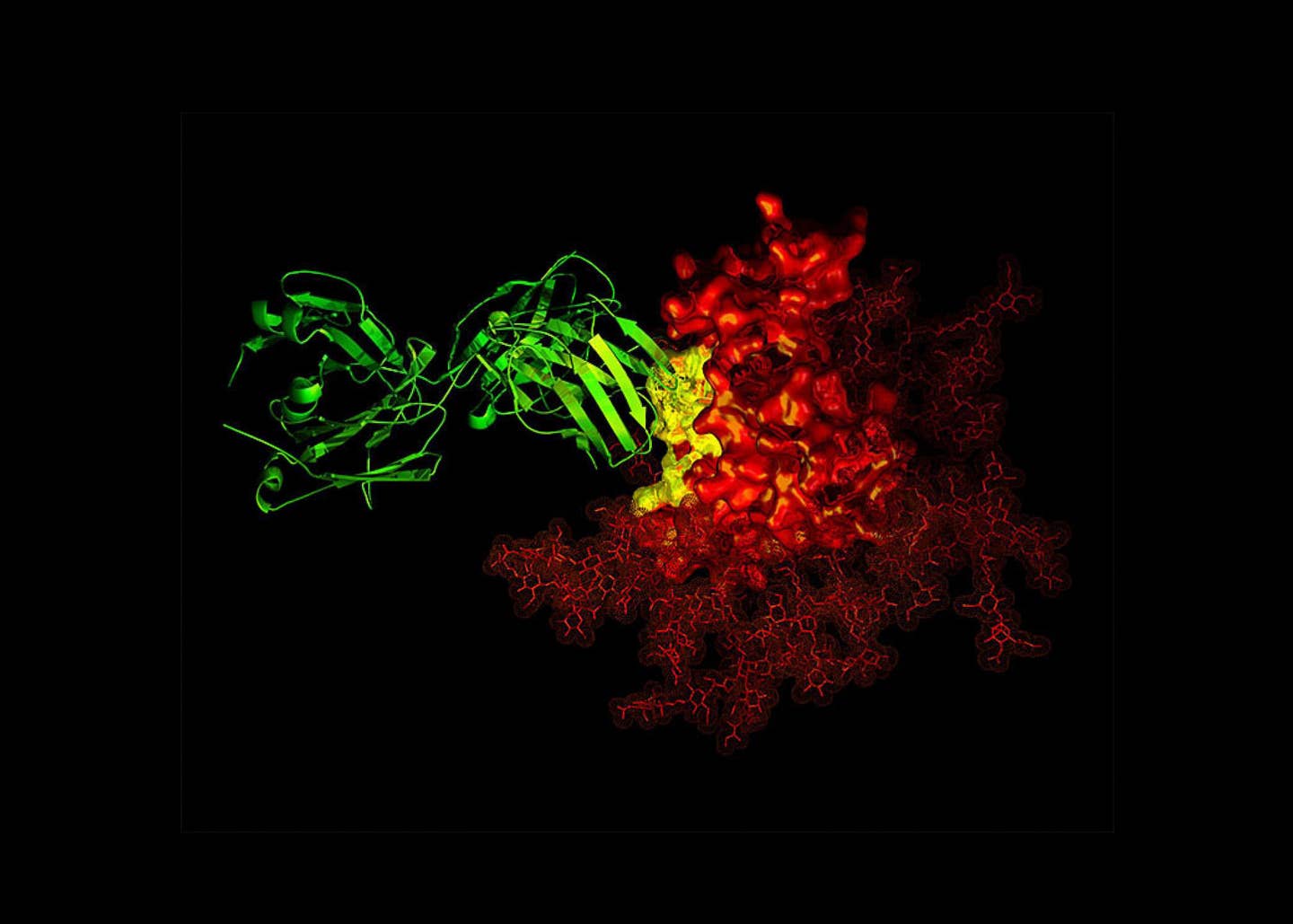
Image Credit
An antibody (green) latching onto HIV (red and yellow) / NIAD, NIH
Share
Jeanne Calment was over 122 years old when she passed away. The oldest person in history, she smoked for nearly a century, but never developed cancer.
Why does cancer grow, spread, and become deadly in some people but not others? Even twins, who share similar genes and lifestyles can differ widely in cancer risk. Many factors likely contribute, but a bold new study, called ATLAS, is investigating an unexpected player: autoantibodies.
These immune-system proteins roam our bodies, but instead of attacking pathogens, they mistakenly target healthy cells and tissues. They’re best known for their role in autoimmune diseases, but early evidence suggests they also fine-tune the immune system’s response to cancer. Some appear to weaken immune surveillance, allowing tumors to sprout and flourish. Others may boost anti-cancer immunity by tagging cancer cells for destruction.
Whether they’re friend or foe is far from clear. ATLAS researchers aim to find out by analyzing blood samples from diverse groups of people, including centenarians and people who have escaped cancer despite carrying high-risk gene variants or exposure to risk factors like smoking.
The project hopes to discover why some people are naturally resistant to cancer, which could lead to early diagnostic tests, new therapeutic targets, and more effective treatments. ATLAS may “uncover fundamental principles” of antibody immunity in cancer, wrote the team.
Immune Mayhem
Since the late 19th century, scientists have suspected the immune system helps keep cancer in check. The idea has since spawned powerful treatments. In CAR T cell therapy, for example, a patient’s own immune T cells are genetically enhanced to better recognize and destroy tumors to cure previously untreatable blood cancers. A similar strategy in macrophages, immune cells that tunnel into tumors and literally engulf them, is now entering early clinical trials.
Far less attention has been given to antibodies. These proteins normally fight pathogens, like viruses. But sometimes they go rogue, taking the form of autoantibodies that attack healthy proteins, DNA, and other molecules. Even healthy people carry a diverse collection of autoantibodies, but most bind only weakly and don’t seem to trigger biological effects.
For decades, these proteins were used mainly to diagnose autoimmune diseases such as rheumatoid arthritis, as they often appear years before symptoms emerge. But more recently, scientists have begun uncovering their broader impact on the immune system. Autoantibodies that attack cytokines, a type of immune signaling molecule, were implicated in roughly 20 percent of Covid-19 deaths, largely because they disabled antiviral defense.
Scientists have since linked them to worse outcomes in several other life-threatening viral diseases, increasing some people’s vulnerability as if they were immunocompromised. Beyond infections, they also neutralize cytokines that protect against inflammatory bowel disease.
Cytokines orchestrate many immune system activities, including inflammation, allergies, autoimmunity—and cancer. Although there’s still little direct evidence that autoantibodies themselves drive or prevent tumors, scientists have found many can recognize cancer-related proteins and are developing methods to detect them as an early sign of cancer.
If autoantibodies can reshape cytokine activity during viral infections, could they also determine who develops, or resists, cancer?
“These discoveries establish that autoantibodies can function as powerful, naturally occurring immune modifiers raising the possibility that similar antibodies may alter antitumor immunity,” wrote the ATLAS team.
Charting the Landscape
Because antibodies linger long after diseases have gone, they preserve a molecular record of a person’s immune history. Rather than focusing on a handful of candidates, ATLAS is going fishing: The study will chart the body’s entire antibody repertoire, including autoantibodies, seeking signatures linked to cancer susceptibility or resistance.
Be Part of the Future
Sign up to receive top stories about groundbreaking technologies and visionary thinkers from SingularityHub.

The team will first scan blood samples for autoantibodies. They’ll also catalog conventional antibodies, making note of the ones that directly recognize and attack cancers. All this data will go into a comprehensive cancer antibody atlas, giving researchers a resource to explore how different antibodies shape cancer.
To start, the team will study what they call “remarkable groups of people” whose immune systems may hold unusual clues. Among them are healthy centenarians. Although cancer risk usually skyrockets with age as DNA mutations accumulate, these individuals have somehow avoided the disease. Others have remained cancer-free despite smoking, heavy drinking, or carrying cancer-related gene variants such as the BRCA mutations for breast cancer. The team will also study pairs of identical twins where only one sibling developed cancer, allowing them to compare antibody signatures in people with nearly identical genetic blueprints.
Finally, the team plans to track people with cancer before, during, and after immunotherapy, to paint a picture of how immune responses evolve over the course of the treatment.
Ultimately, they expect to find three broad classes of antibodies: those that help or hinder cancers and those that appear largely neutral. Each could prove valuable.
Autoantibodies that blunt anti-cancer immunity could become drug targets. Scientists might make synthetic “decoy” antibodies to block them—in a way, fighting fire with fire. The findings could also inspire next-generation immunotherapies.
On the other hand, autoantibodies that help the immune system recognize cancers could become therapies themselves or complement existing therapies, such as checkpoint inhibitors, which boost the body’s immune response to cancer. These are much less toxic than chemotherapy, but only 20 percent of patients respond, perhaps because of immune differences.
Even seemingly neutral autoantibodies may be useful cancer biomarkers. Because antibody tests are already well-established, fast, and inexpensive, associated neutral antibodies could aid early detection, monitor whether treatments are working, or warn when a cancer is likely to return.
But correlation isn't causation.
Some antibodies may merely record a person's immune history rather than actively influencing cancer. To tease the two apart, the team plans to test promising candidates in cultured human cells and mice, to see whether they alter cancer growth or spread. Those experiments could reveal previously hidden molecular communications between the immune system and cancer and deepen our understanding of the deadly disease.
“We should be able to come up with a biomarker to predict who is likely to avoid cancer, [and] who is likely to develop cancer,” said ATLAS team member, Xin Lu at the University of Oxford. “Potentially we could come up with therapeutic, preventative agents [that are] antibody-based. And that would be fantastic.”

Related Articles
New AI Tool Could Help Scientists Make ‘Rare’ Cross-Disciplinary Leaps
The Oldest Living Land Animal Is 194. DNA May Now Reveal the Secret to His Longevity.

This AI Reconstructs What You’re Looking at From a Brain Scan
New AI Tool Could Help Scientists Make ‘Rare’ Cross-Disciplinary Leaps
The Oldest Living Land Animal Is 194. DNA May Now Reveal the Secret to His Longevity.
This AI Reconstructs What You’re Looking at From a Brain Scan
What we’re reading