Scrapping a New Gas Car for an Electric One Could Cut Emissions, Study Finds
The authors found most of the scenarios they investigated resulted in lower emissions, including cases where the gas car was barely a year old.
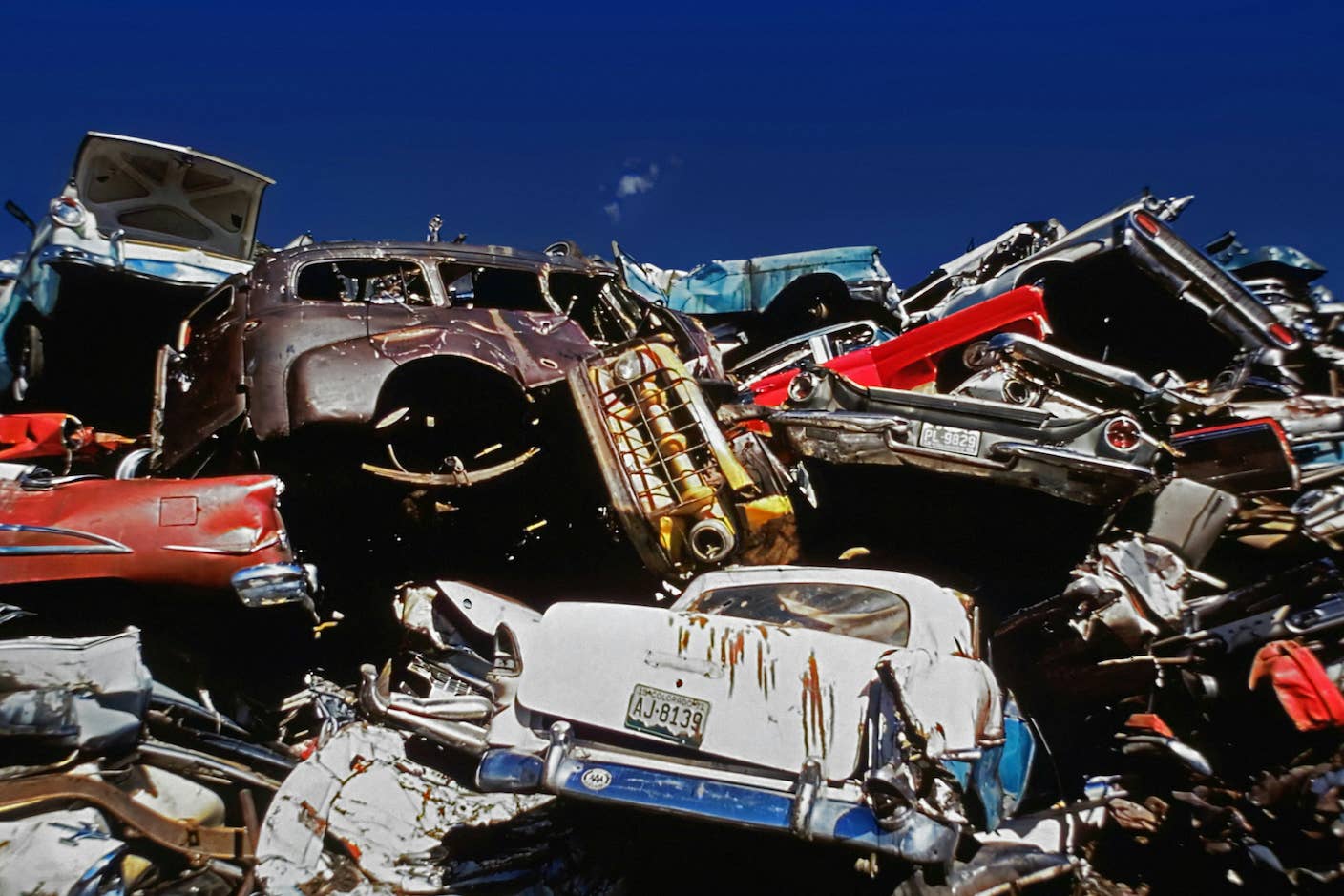
Image Credit
Documerica on Unsplash
Share
You might assume scrapping a brand new car would be terrible for the environment, but it depends on what you replace it with. New research suggests replacing a gas car with an electric vehicle can cut overall emissions even when the gas car is only a year or two old.
Transportation is the second biggest source of carbon dioxide emissions globally, and passenger vehicles contribute nearly half of them, according to Our World in Data. That means the speed at which drivers switch to electric vehicles is a critical factor in efforts to fight climate change.
But while electric vehicles may not directly emit carbon dioxide on the road, they’re only as green as the grid used to charge them. And manufacturing EVs still produces significant emissions, often more than it takes to build a gas car. That makes comparing the green credentials of electric and gas vehicles more complicated than it appears.
However, new research in Science aims to simplify the debate for cars in the US. The paper models how scrapping a gas car at various ages and replacing it with an electric vehicle affects lifetime emissions. The authors found this led to lower emissions across most of the scenarios they investigated, including cases where the gas car was barely a year old.
“I think this is really a definitive study about the carbon emissions benefits of electric vehicles, because it shows that even in such an extreme scenario, the electric vehicle is still the obvious winner,” lead author Elliott Campbell, a professor of environmental studies at the University of California, Santa Cruz, said in a press release.
“So if you’re someone who’s trying to decide whether or not to put money into keeping your gas car going, switching to an electric vehicle as soon as a financially viable opportunity comes up is absolutely the right thing to do for the environment.”
Previous research had already established that the lifetime emissions of electric vehicles are substantially less than those of gas cars, making them the obvious climate-friendly choice when buying a new car. But it was less clear when to switch if you already have a gas car.
To answer this question, the researchers worked out lifetime carbon emissions for more than 400 gas and electric vehicle models with varying efficiencies and battery sizes, while also considering things like mileage, manufacturing emissions, and the energy mix of the grid used to charge the vehicles.
A key point the researchers made is that the emissions used to build a gas car are sunk costs, identical in every scenario. That means the only figures that matter are how much fuel the gas car burns over its liftetime set against the manufacturing and charging emissions of the new one.
For an average-selling SUV on the average US grid over a 16-year lifespan—the researchers’ baseline case—scrapping the car just two years after purchase and switching to an electric vehicle cut cumulative emissions by 44 percent. The carbon emissions required to build the replacement were paid back within three years.
Be Part of the Future
Sign up to receive top stories about groundbreaking technologies and visionary thinkers from SingularityHub.

Across the full range of US vehicle efficiencies in the study, scrapping a gas car after just a year cut lifetime emissions in 92 percent of cases, with the average vehicle saving 58 percent. The benefit only disappears in the most extreme cases—when an electric vehicle is using more than 30 kilowatt-hours per 100 kilometers (62 miles) on a grid that emits more than 500 kilograms of carbon dioxide per megawatt-hour.
To make that more concrete, this equates to one of the most power-hungry electric vehicles on the market—for instance, GMC's Hummer electric SUV electric pickup—charging on a coal-heavy grid that emits nearly 50 percent more carbon than the US average.
The advantage also narrows or vanishes when scrapping gas vehicles driven far below the national average mileage and hybrid vehicles driven in regions with high-emission grids, which still account for around a third of US electricity generation.
And plug-in hybrids—which have larger batteries than regular hybrids and can be charged from the wall rather than only generating electricity from the engine and regenerative braking—are almost never worth replacing. For SUVs, the benefit is roughly zero, and for cars, lifetime emissions actually end up 11 percent higher.
But Gregory Keoleian at the University of Michigan told New Scientist that scrapping a one-year-old car is an “extreme case.” In reality, those cars would be resold rather than scrapped, which could lead to cheaper second-hand vehicles that pull people off lower-emission options like buses and trains and get them back behind the wheel.
Campbell admitted to New Scientist that more research is needed to model those kinds of scenarios. But it also backs up the authors’ call for more generous subsidies for scrapping gas vehicles, so that it becomes financially viable to replace relatively new gas cars without just redirecting them to the used-car market.
Until that happens, even the most eco-conscious among us are unlikely to scrap a brand new vehicle. Still, the study weakens the argument for holding on to an aging gas car.

Related Articles

Google DeepMind Gives AI-Designed Proteins a Watermark

How Would AI Actually Kill All Humans? Here Are the Top 5 Scenarios

Content for Clicks: AI Is Tearing Up the Web’s Social Contract
Google DeepMind Gives AI-Designed Proteins a Watermark
How Would AI Actually Kill All Humans? Here Are the Top 5 Scenarios
Content for Clicks: AI Is Tearing Up the Web’s Social Contract
What we’re reading