Stanford Creates World’s Smallest Writing, Less Than a Nanometer

Share
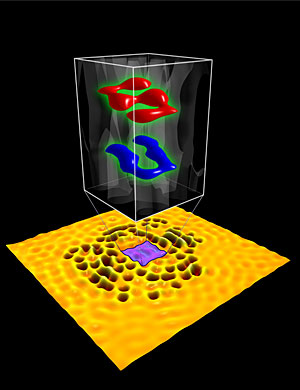
"Stanford researchers have reclaimed bragging rights for creating the world's smallest writing, a distinction the University first gained in 1985 and lost in 1990."
Thus begins an article from Stanford that chronicles the history of nanoscale (atomic and now subatomic) sized writing. Nanoscale writing could have many uses for labeling objects large and small with identifying information (serial numbers, ownership rights, tracking information, etc.), but it is also a barometer of man's ability to harness the world at the nanoscale. For the full dirt, read the article. Otherwise, see below for summary:
So how small is the writing recently created at Stanford? "The letters in the words are assembled from subatomic sized bits as small as 0.3 nanometers, or roughly one third of a billionth of a meter."
Be Part of the Future
Sign up to receive top stories about groundbreaking technologies and visionary thinkers from SingularityHub.

The article from Stanford highlights three major milestones in the history of nanoscale writing:
- In 1985, Stanford grad student Tom Newman used electron beam lithography to engrave the opening page of Dickens' A Tale of Two Cities in such small print that it could be read only with an electron microscope.
- In 1990 IBM researchers famously spelled out the letters IBM by arranging 35 individual xenon atoms. Singularity Hub reported on this here
- Now, in a paper published online Sunday in the journal Nature Nanotechnology, the Stanford researchers describe how they have created letters 40 times smaller than Newman's effort and more than four times smaller than the IBM initials.
The new small writing technique from Stanford, called Electronic Quantum Holography, actually creates a hologram that can be read with a scanning tunneling microscope. Each letter, or image, is stored and viewed at a particular electron wavelength. The researchers read them separately, like stacked pages of a book.

Related Articles
Orbital Airbag Could Shield Earth From Devastating Solar Storms

This Week’s Awesome Tech Stories From Around the Web (Through June 7)
Toxic Clumps in Huntington’s Disease May Protect the Brain Too
Orbital Airbag Could Shield Earth From Devastating Solar Storms
This Week’s Awesome Tech Stories From Around the Web (Through June 7)
Toxic Clumps in Huntington’s Disease May Protect the Brain Too
What we’re reading