



Among the many promises of Star Trek is the ultimate manufacturing device: the replicator. Just ask for an object, and the device produces it for you out of thin air. The first baby-step towards that scifi dream is the 3D printer. We’ve had these machines for many years now; they typically use a steady layering of plastic to build models you’ve designed. Your average 3D printer is expensive, well over $20k, but industry leader Stratasys (NYSE: SYSS) was able to get that down under $15k with the uPrint. That price may drop even further. According to a recent press release, Hewlett-Packard (NYSE: HPQ) has partnered with Stratasys to develop a line of HP branded 3D printers for global sales in 2010. The two companies hope that the partnership will help bring the technology into the mainstream, making 3D printing a staple for businesses around the world. If successful, HP and Stratasys could ultimately bring their cheap 3D printing into homes.
Of course, if an HP 3D printer ever makes it into the personal market it won’t be alone. Today, both MakerBot and RepRap sell 3D printers for your home for less than $1000. In fact, either company will even help you build your own. Now, these hacker-style machines can’t print much bigger than 4″x4″x6″, which is smaller than the sizes available to commercial devices. They also don’t have the same flash or style. There’s no fancy housing, LCD interfaces, or noise dampening. Still, they print in three dimensions and that’s what people want, right?
Well, it’s unclear what the exact market for 3D printers is at the moment. Certainly the community of do-it-yourself hobbyist is an enthusiastic one, and MakerBot is selling 1800+ printers a year. But even at $1000 a piece (a high estimate), that’s only about 1% of Stratasys sales. The real money seems to be professional design. Companies with engineers, architects, and graphic artists – these are the groups that can afford to spend $15k+ to have easy access to 3D printing.
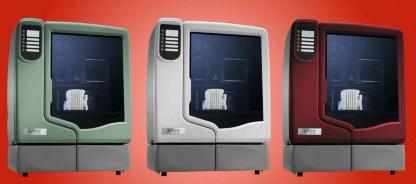
HP hasn’t released any particular information about the actual price of their Stratasys printers. That news is expected in the second half of the year. Most speculate that the HP printer will be a repackaging of the uPrint. That machine costs $14,900, can print objects up to 8″x6″x6″ in size, and uses fused deposition modeling to print objects out of ABS plastic.
For the next 90 days (from Jan 19, 2010) you can hear more details about the agreement between the two companies by listening to the hour long phone conference. From that conference we know HP is gaining the option to purchase millions in Stratasys shares. We also know that Stratasys is looking for major growth in the next five years. Stratasys anticipates increasing from 2000 to 5000 systems sold per year in the short term. They hope that five years will have them become a $500 million revenue company, shipping 50,000 units per year. That’s a big ramp up. And it depends on HP bringing their new 3D printers to a global market fairly soon. Right now, HP plans on an initial roll out for the printer in just five select countries: UK, Spain, Italy, Germany, and France. That’s a temporary bummer for us here in the US.
Getting a powerhouse like HP into the 3D printing game is an important step towards increasing the popularity of the technology. HP was one of the pioneers (and still probably the biggest name) in over-sized 2D printing. They could bring similar success to three dimensional plastic models. All that is good, but I’m really hoping that increased sales will directly translate into increased budgets for research. Moving away from plastics and into other materials will finally get us to be able to print electromechanical devices. Xerox has a silver ink, and Shapeways a stainless steel powder, that could lead to printing circuits. Maybe HP’s success could help accelerate those technologies so that in a few years we could be printing 3D printers. It’s this self-replicating dream that is driving MakerBot, RepRap, and other hobbyists. If HP picks up on it success could happen much sooner. So, good luck to HP and Stratasys. I’m very unlikely to buy their new product, but I have big hopes for where it may eventually lead
[image credit: Stratasys]