While NASA’s Robonaut 2 Is In Orbit, Its Hype Has Escape Velocity
Share
Will Robonaut 2 usher in a new age of man-machine space exploration? No.
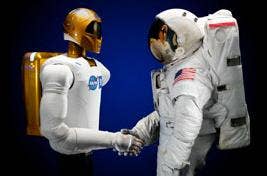
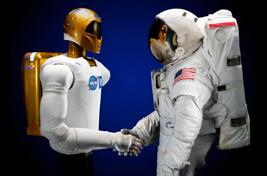
Sorry to kill your buzz, NASA and GM, but your jointly developed humanoid robot, the Robonaut 2, is way over hyped. The 300 pound bot, which consists of a torso, two arms, and shiny gladiator looking head, is currently in the belly of the space shuttle Discovery set to arrive at the International Space Station. It's "the first humanoid robot in space"! ...Whoop-di-freakin'-doo. NASA has put dozens of robots into space, and had them perform amazingly complex missions both remotely operated and autonomously. Why should this one get all the press simply because its shape is humanoid? And the things that are being discussed - Robonaut helping astronauts perform repairs in space, being paired with humans for long range space missions, being set loose on Mars - these things are years (if not decades) away from being achieved. Robonaut is being sent into space simply so it can be tested to make sure it works in the new environment. All these other bits of hype are the worst kinds of speculation: they get our hopes up so high we won't appreciate the real achievements we'll end up seeing. Seriously, I'm not one to bad mouth a good piece of technology (and Robonaut 2 is a fine piece of electronic wizardry), but the hype surrounding this robot is some of the most ridiculously misleading and misguided PR claptrap out there. Check out the Robonaut videos, and much more of my ranting, after the break.
Robonaut 2 should be properly viewed as a research robot. It's a device that can help engineers and scientists understand how humanoid machines function. With five fingered hands, a sensor-packed head, and relatively strong arms (capable of lifting 20 pounds at full extension), the robot is a good model for how the human form can be used as a model for building dexterous machines. Robonaut 2 is not, I repeat, NOT a functioning tool for space exploration. To get to that level could take decades.
That's not the expectation you would get if you saw much of the media coverage about Robonaut 2's trip into space from the past year. Here's a clip from ABC that's pretty typical.
Project M, which is discussed in the second half of the video, is a yet-to-be-funded endeavor aimed at putting a humanoid robot on the moon by 2013. Why a humanoid robot when a rover or exploration drone might be much more useful, not to mention cheaper? Ostensibly because humanoid robotics are such an important avenue of research, but I'll tell you the real reason: humanoid robots are more exciting! Project M is a PR stunt. A well intentioned one, probably aimed at generating some much needed interest in space exploration and robotics, but a PR stunt all the same. And Project M isn't the only PR stunt that involves the Robonaut. NASA has the robot tweeting, making Facebook status updates, and generally anthropomorphizing the heck out of it. GM has been hyping the bot as well, going so far as to buy some air time before the Superbowl to show-off Robonaut's shiny golden frame. GM, the same automotive company that has struggled to stay solvent, is buying some of the most expensive TV coverage possible just to generate some buzz around all the great technology it's helping to develop. What a stupid investment of time and money.
Yet some people are buying the hype! I really have to pick on Engadget readers who voted the Robonaut 2 number one in their poll for Best Robot of 2010. Wow. It didn't even make it on our list. The thing you won't find in any of Engadget's prolific coverage of Robonaut is a rational explanation as to why NASA (and GM) are spending so much money selling everyone on the idea of humanoid robots in space.
You know who likes humanoid robots? Humans. We like the human form, we identify with it. Humanoid robots are going to be an important part of getting people to accept automated machines in sensitive industries such as elder care. Japan is working over time developing life like humanoids that people will feel warm and caring towards. Grandma won't like her bedpan being changed by a robot, but if it looks like a friendly woman maybe she'll complain a little less. And if you give a robotic baby she can hold and use as a phone (seriously), well things just got that much better. Human-like robots make sense in human environments.
You know which environment has, like, zero humans? Outer-freakin'-Space!
Time and again, though, NASA has painted the picture that Robonaut's successors will be used in space travel. They have tons of animated footage showing a golden robot exploring the Moon, Mars, and Earth's orbit - often accompanied by humans it is assisting. Here's a video that puts all these clips together:
Gimme a break, NASA! Are you seriously going to tell us that the best robot for a job in space is a shiny metal humanoid that can hand briefcases to human astronauts? Not to mention the fact that you keep showing Robonaut walking around on legs. Bipedal motion, especially in changing gravities, is incredibly difficult to master. The Robonaut project hasn't even started developing legs yet. You literally have no legs to stand on, NASA!
I find this so frustrating because NASA has created some amazing robots in the past. Robots that it has already launched into space, and already landed on Mars. There are, in fact, amazing robots on the International Space Station waiting for Robonoaut 2's arrival. The Canadarm2 is a long telescoping robotic arm that helped build the freakin' ISS in the first place! Dextre is a super articulate manipulator whose arms and hands are capable of some amazing tasks, equal to and exceeding human levels in some cases. And those hands have built-in tools! Why design a humanoid robot that can pick up a tool when you can design a better robot that has the tool already inside of it?
Humanoid robots would only make sense if you anticipate having humans involved in every step of future space exploration...and honestly, I just don't see that happening. Humans aren't designed for deep space, but robots can be. We shouldn't handicap ourselves by thinking that robots need to look human in order to succeed in space.
As I mentioned in the beginning, the serious damage from all this humanoid in space hype, however, is that it will obscure the real benefits that this ISS mission for Robonaut 2 could achieve. NASA has us expecting robots and humans acting together in some sort of Star Wars style mission. Robonaut 2 is not R2D2. You know what Robonaut 2 will be doing while at the ISS? Here's a video to give you some idea:
That's right: tedious, tedious testing of maneuvers. That's pretty much all Robonaut 2 is slated to do in space. NASA has to learn how the robot reacts to the microgravity, the radiation, and the electromagnetic interference. Other robots, like Dextre, have had a long history of malfunctioning in the dangerous environment. It can take years or troubleshooting to get a space robot fully functional. But read this quote from NASA:
Be Part of the Future
Sign up to receive top stories about groundbreaking technologies and visionary thinkers from SingularityHub.

"R2 will be confined to operations in the station's Destiny laboratory. However, future enhancements and modifications may allow it to move more freely around the station's interior or outside the complex."
---Description of International Space Station mission on Robonaut website (2011)
That first sentence is all we really need. Yet they can't seem to avoid the hype-machine. They always have to push it.
Let me give you a much more reasonable expectation for what Robonaut 2's trip to the ISS will be all about: NASA will perform some boring and routine tests of the robot that will greatly resemble work that has already been done on the ground. After (what will probably be) months of problem solving, Robonaut 2 will start to be able to perform slightly more complex maneuvers that have nothing to do with the safety or function of the ISS. NASA might learn a thing or two about robots operating in space. Maybe we can use some of this research back on Earth if it can be generalized to systems outside of NASA's hardware/software. ...That is all.
This photo gets it right:
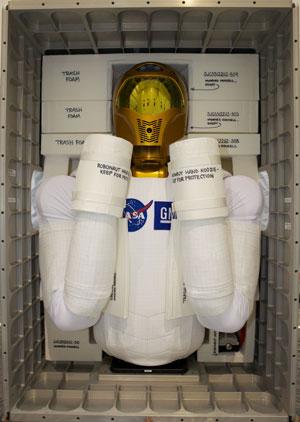
Robonaut 2 in storage for transit.
This video gets it wrong:
Look, I think Robonaut 2 is a great piece of technology. Humanoid manipulation isn't exactly easy, and this bot does it fairly well. It's not the best, but it's pretty good. The harsh environment and rigorous testing aboard the ISS may provide some great insight into humanoid robotics in general. I'm not denying any of that. These positives are just getting oversold to the public. ...and maybe I'm even a little upset because the hype might actually work. NASA and GM aren't in the best financial situations, but they are getting some major attention from Robonaut 2 and its "potential" uses in space. Even if the robot isn't the best investment in the world, the PR surrounding it could be. Does that make all this hype even more sad...or ingenious? You decide. I'm going to go buy some more exclamation points and inflammatory statements at the hackneyed writer's store. Somehow it seems I've run out.
[image credits: NASA]
[sources: NASA]
Related Articles
Star Catcher Is About to Beam Power Between Two Satellites for the First Time
This Robot Dog Crushed a Marathon Without Stopping to Recharge
Europe’s First Private Rocket Reaches Orbit
Star Catcher Is About to Beam Power Between Two Satellites for the First Time
This Robot Dog Crushed a Marathon Without Stopping to Recharge
Europe’s First Private Rocket Reaches Orbit
What we’re reading